Today, April 9th, 2026, at 11:00 AM MT, SCRAM Systems released multiple enhancements for your SCRAM 24/7 GPS Activity Client Caseload.
These enhancements allow you to perform the following tasks from within SCRAM 24/7:
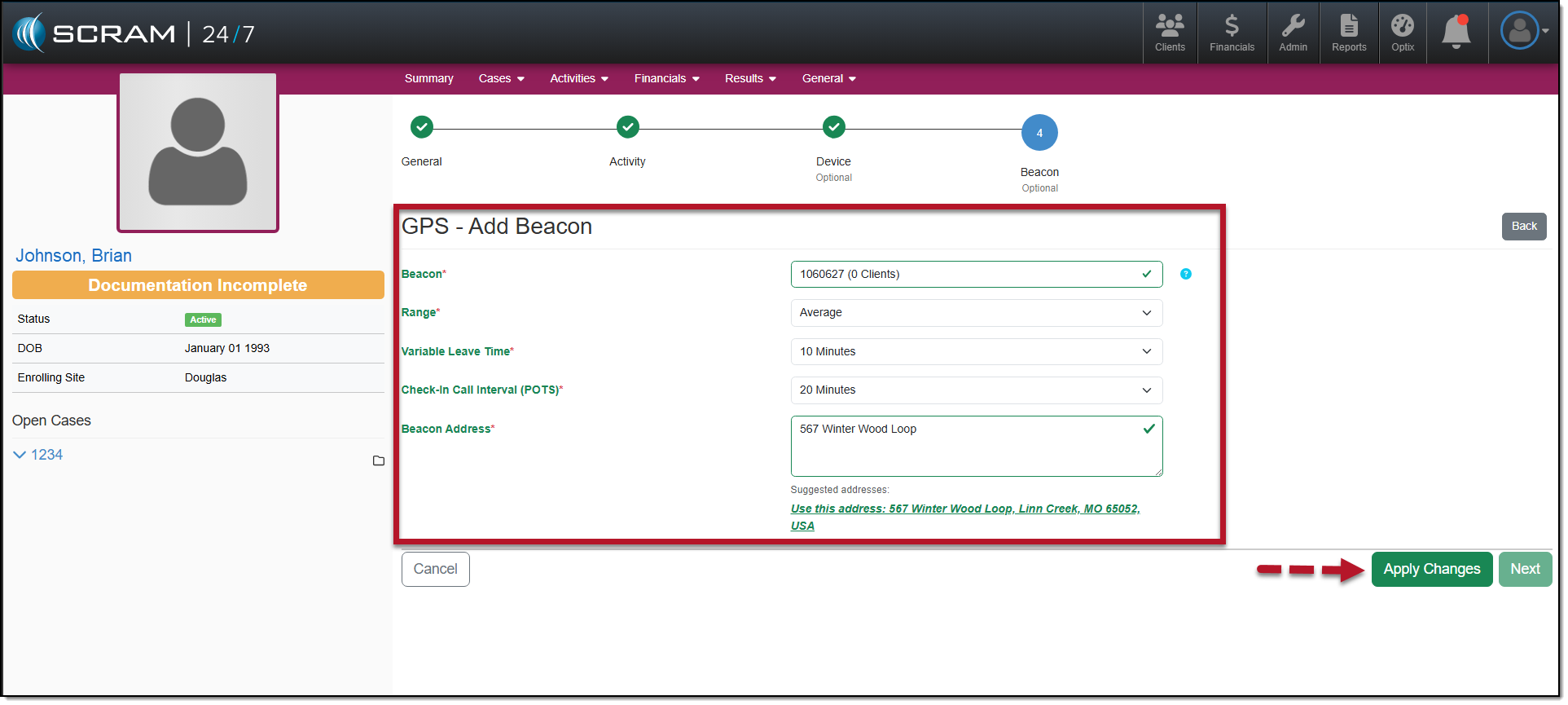
- During the Add GPS activity setup, you may now add and assign the SCRAM GPS Bracelet and Beacon.
- View SCRAM GPS Supervision History on the client’s Summary page.
- Unassign the SCRAM GPS bracelet and Beacon when removing the GPS Activity.
Add GPS Activity
Once you have created the client’s profile in SCRAM 24/7, the next step is to add the GPS Activity and then complete the equipment assignment.
Starting on the client’s Activities tab:
- Select the +Add an EM Activity button, and then select the Add GPS Activity option from the dropdown menu.
 |
|
General Step
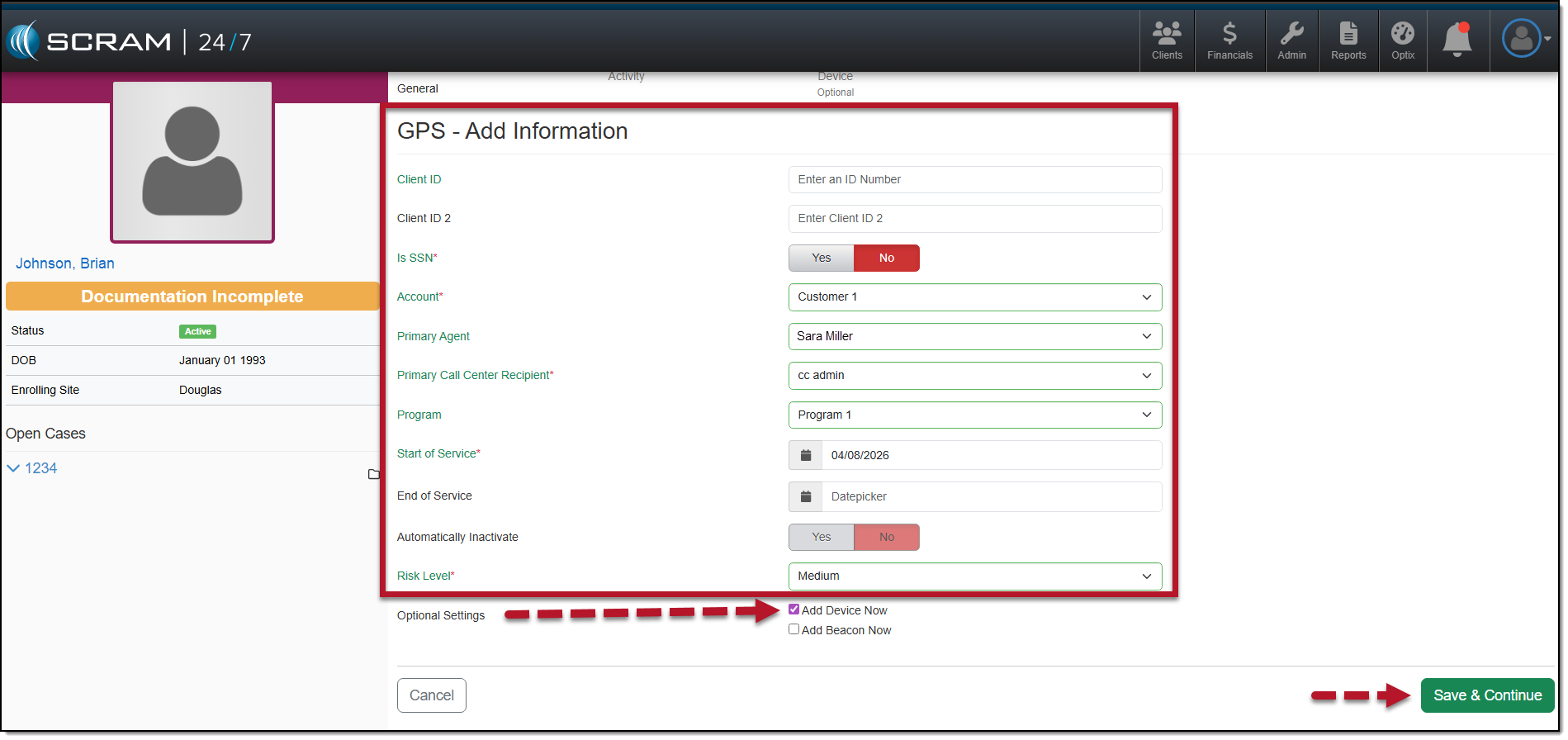
- Add the client-specific and “SCRAMNET GPS account” information. The fields and options available here are based on the selected Account.
- You may elect to assign a SCRAM GPS bracelet and Beacon at this time by selecting the checkboxes next to the appropriate selections in the Optional Settings section.
- Once your selections are made, select the Save & Continue button.
Activity Step
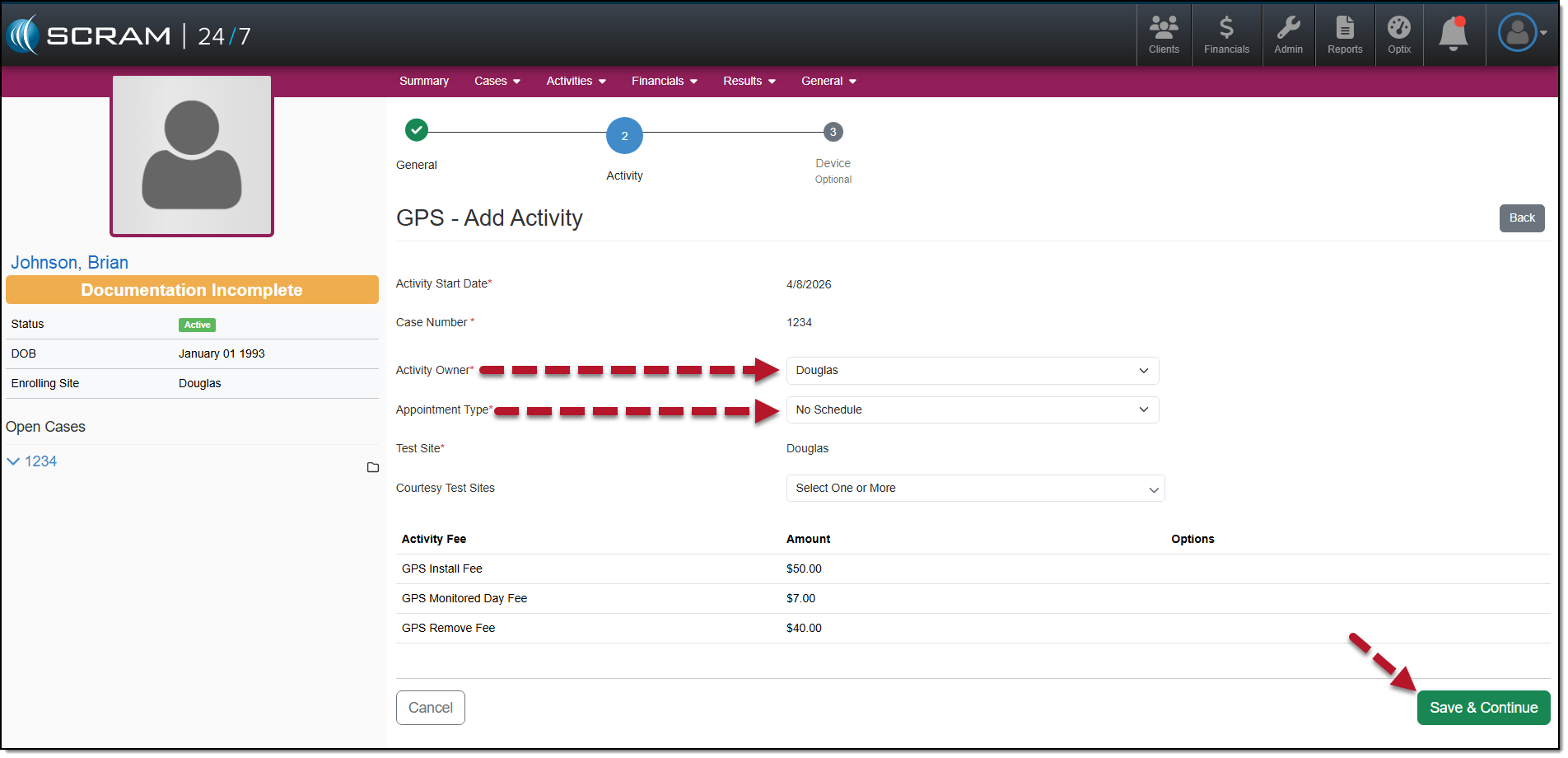
- Add the Activity details. All required fields are marked with a red asterisk.
- Appointment Type:
- The two options available are “No Schedule” or “In-Person Appointments.” When this In-Person Appointments option is selected, you will enter the appointment details. Once saved, the appointment is visible on the client’s Activity Calendar on the client’s Summary page and will populate on the Appointments Dashboard on the appointment date.
- Verify and update the Activity Fees if needed.
- After making your selections, select the Save & Continue button.
Device Step
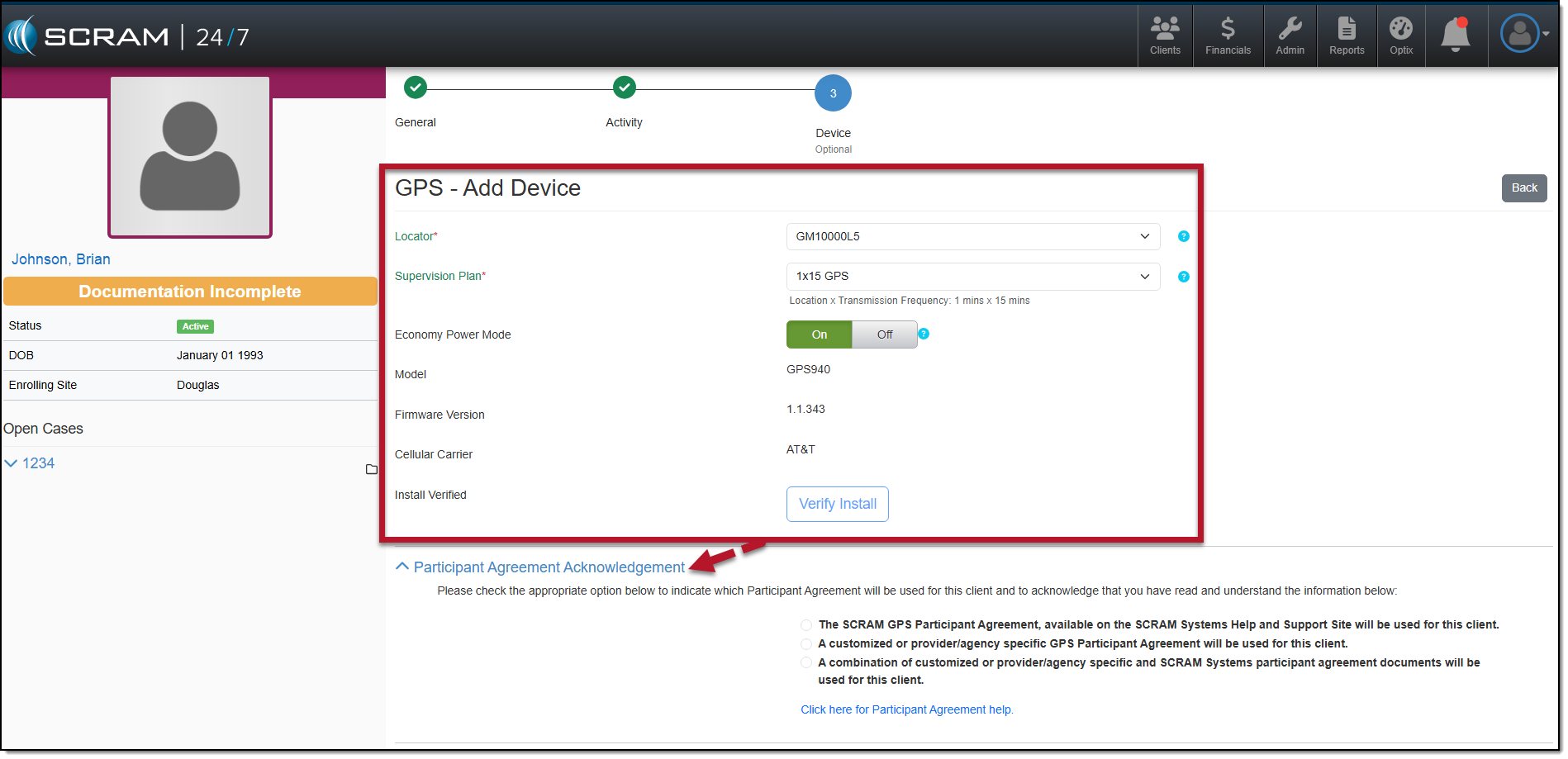
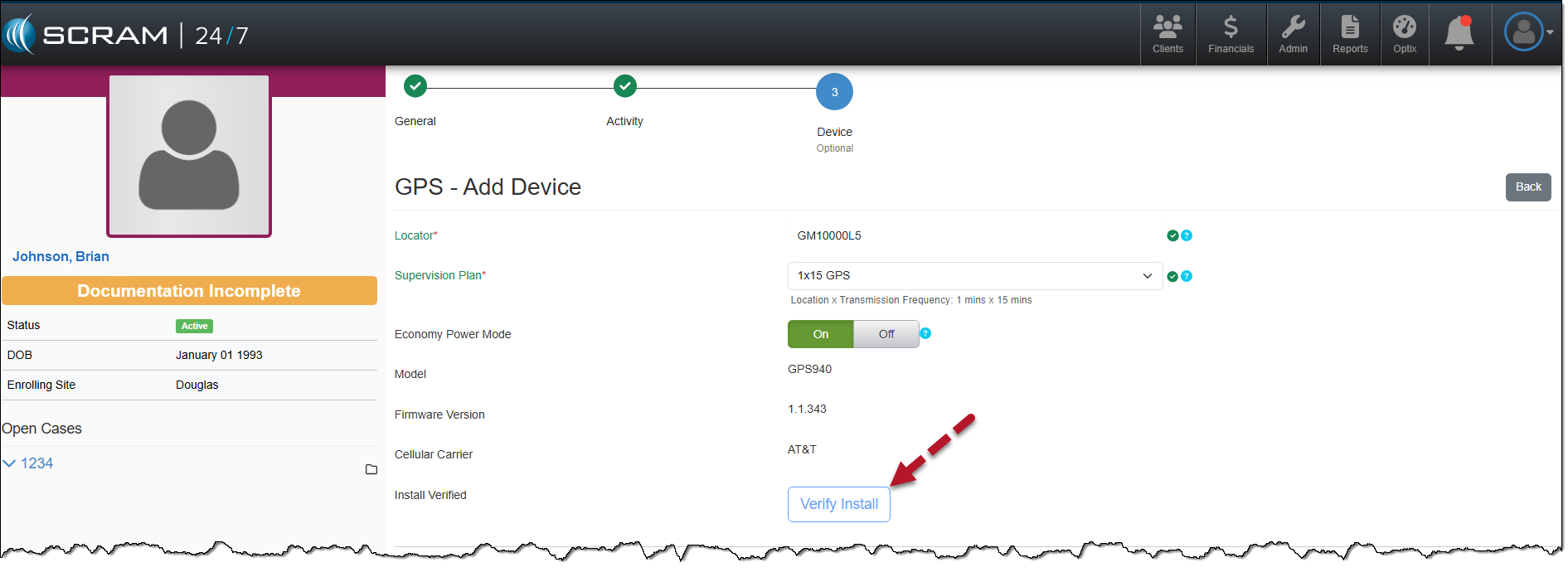
- Select a locator from the dropdown menu.
- Select the Supervision Plan from the dropdown menu.
|
|
 |
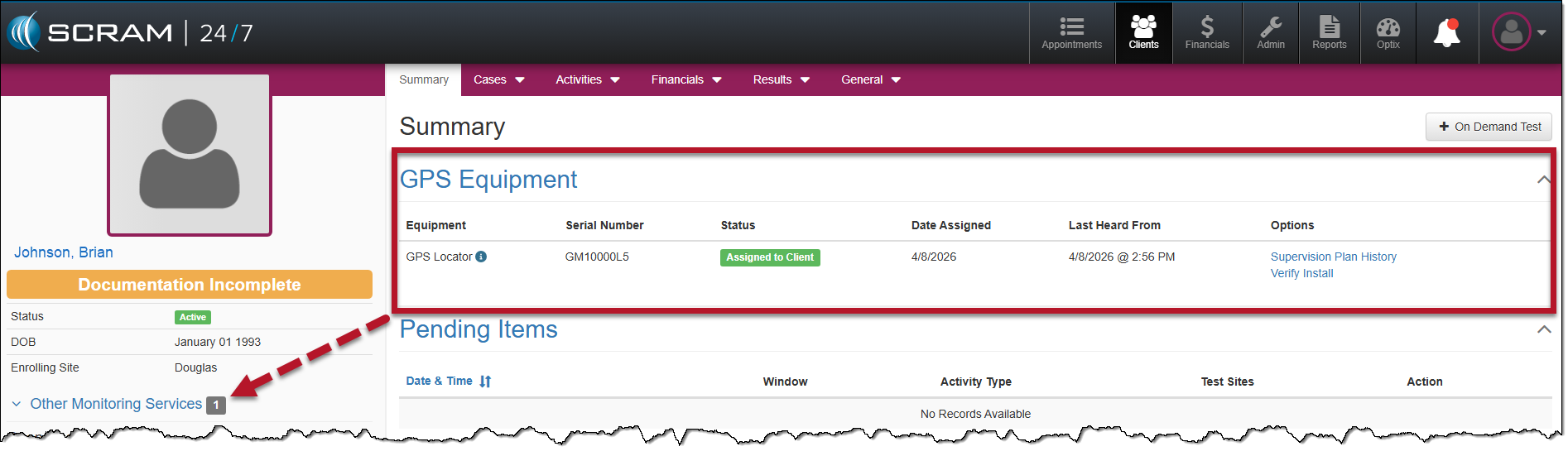
At this time, you must access the client’s SCRAMNET GPS profile page by selecting their name hyperlink in the Other Monitoring Services section in the sidebar. It is imperative that you:
If you skip this step, the client may not be properly monitored. |
Supervision Plan History Hyperlink
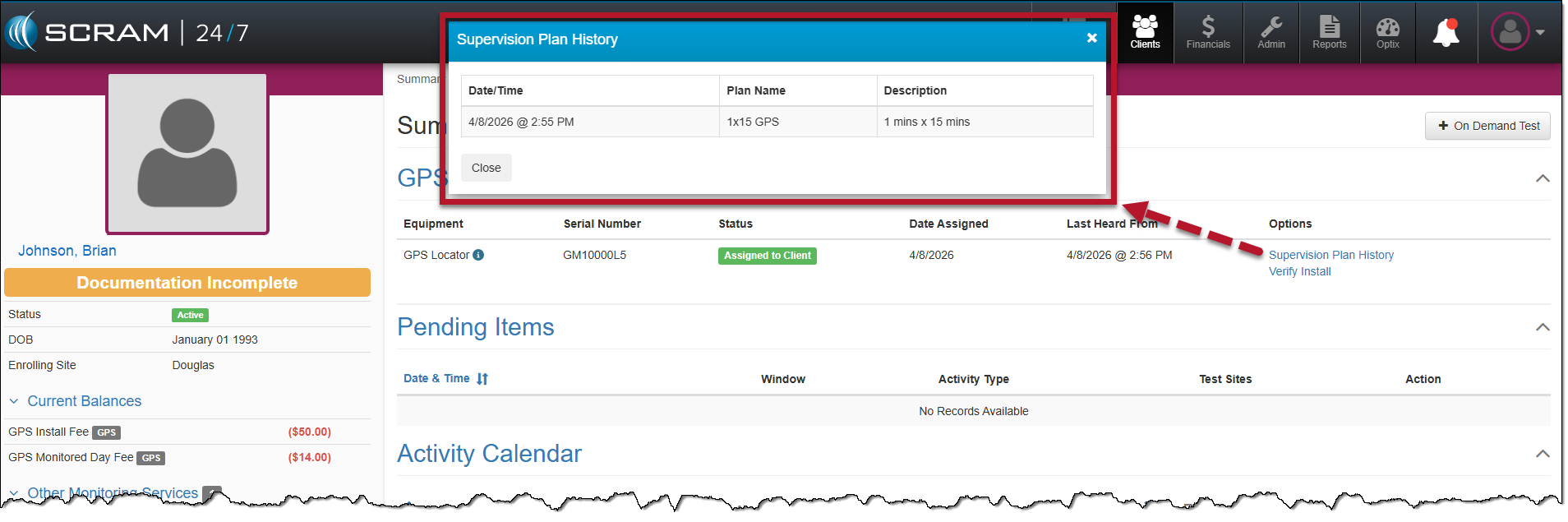
You may view the supervision plan information for the assigned bracelet by selecting the Supervision Plan History hyperlink located in the Options column on the client’s Summary page.
Removing the GPS Activity
When it is time to remove the GPS activity and check in the equipment, start by:
- Accessing the GPS Activity Details page.
- Select the Remove Activity button.
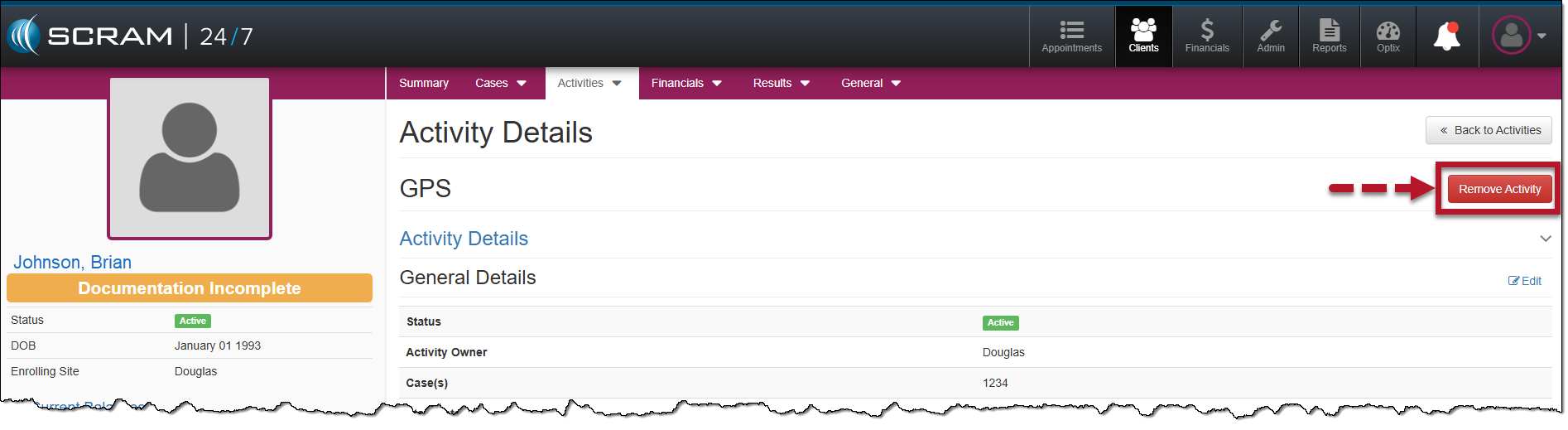
- On the Remove GPS Device page, open the Equipment Status dropdown menu and select the appropriate option. In this example, “In Inventory” was selected.
- After selecting the device status, select the Unassign Locator button.
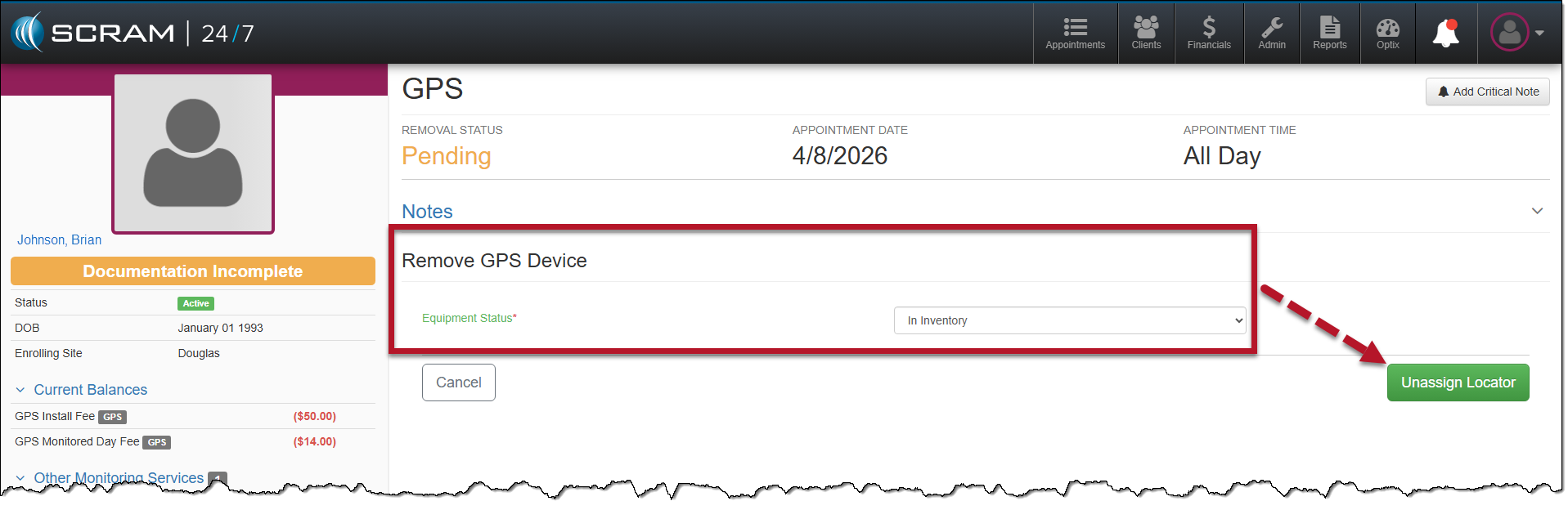
- Complete the GPS Removal appointment. Here, you may select whether the client is in attendance and record any payments made.
- Once information is entered, select the Save & Remove Activity button.
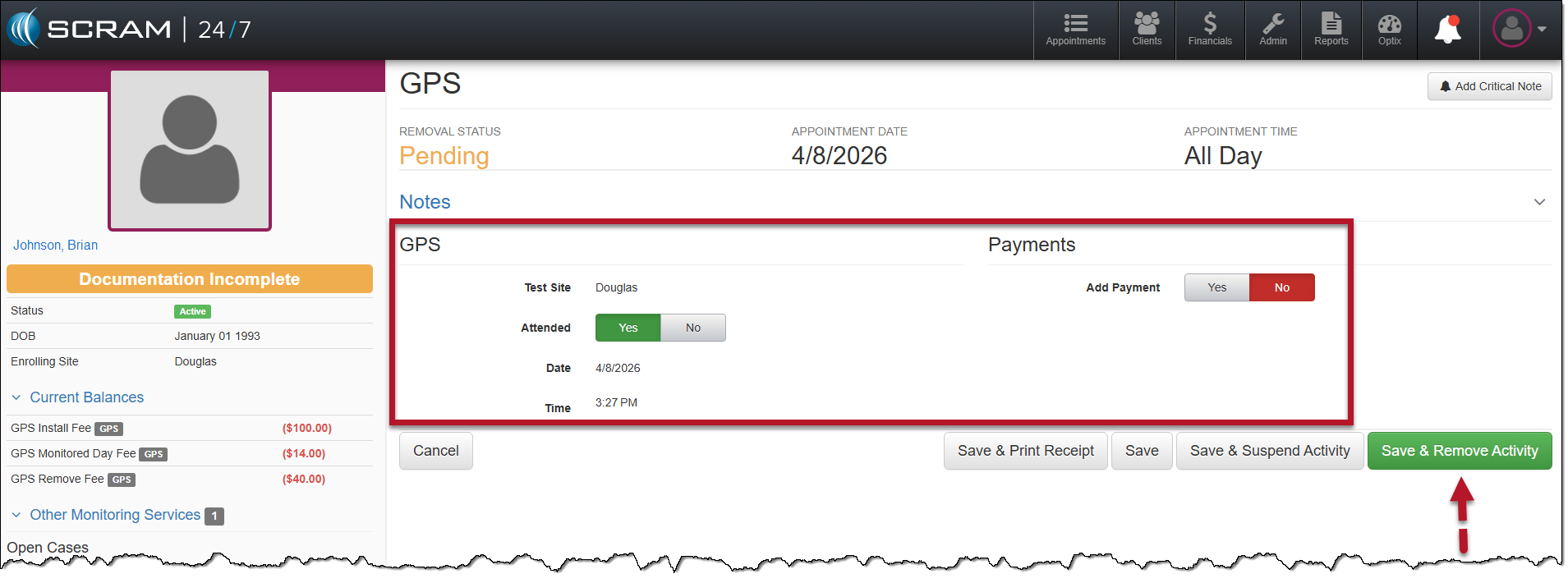
- Verify the Effective Data entry field and then select the Remove Activity button.
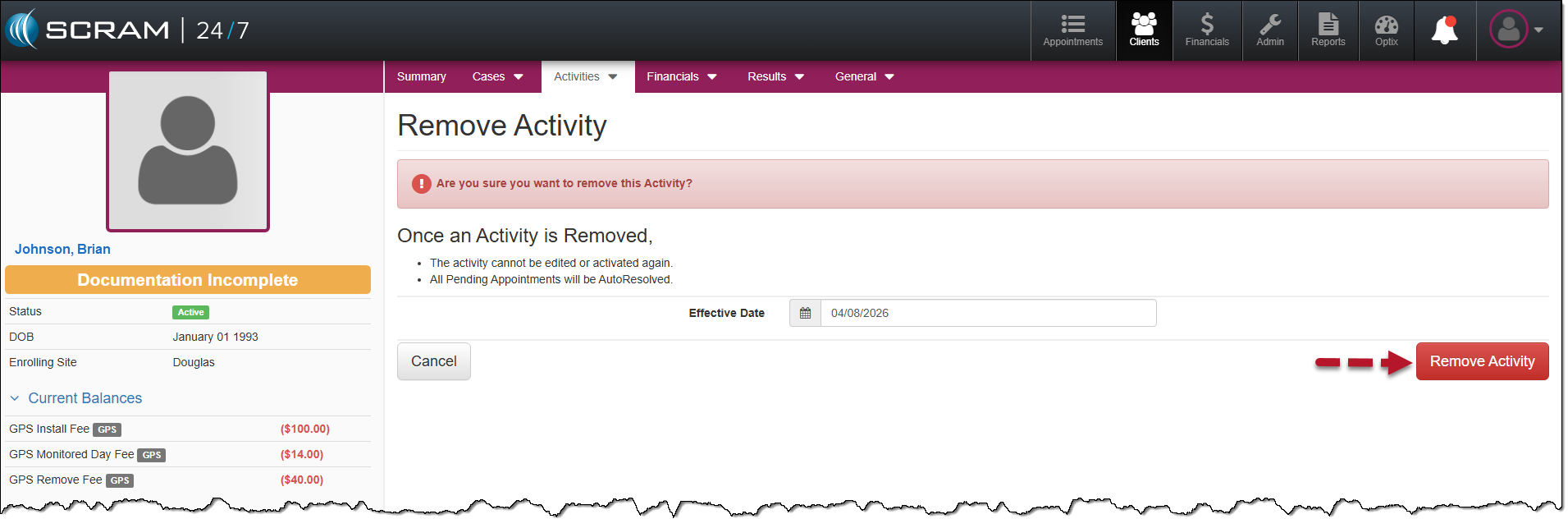
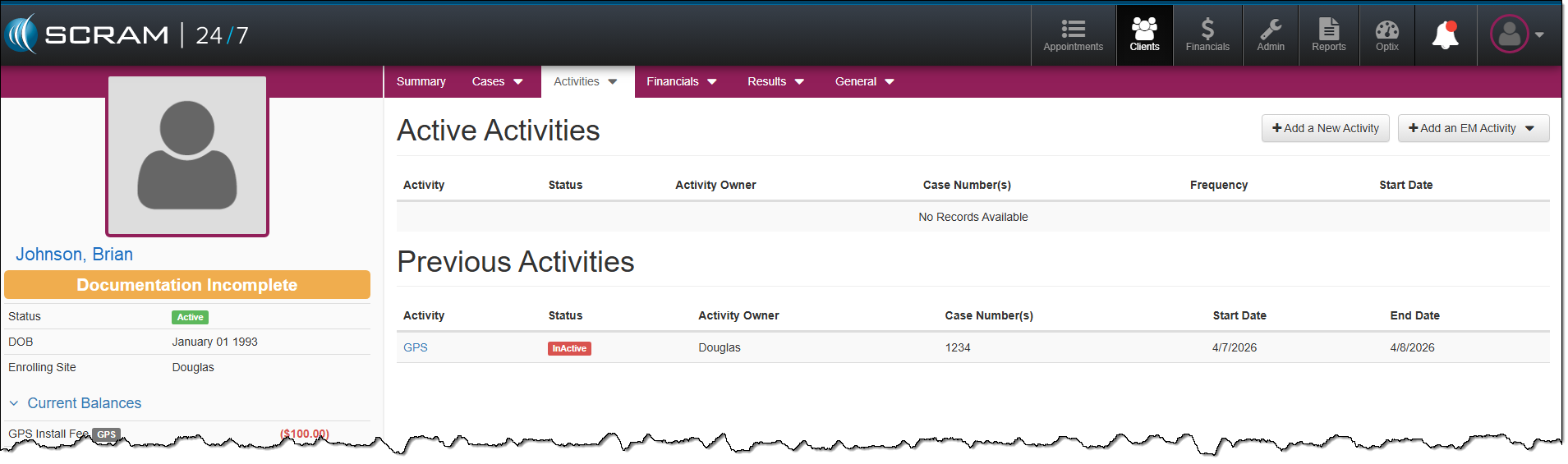
The Active Activities page now reflects the Inactive GPS Activity.
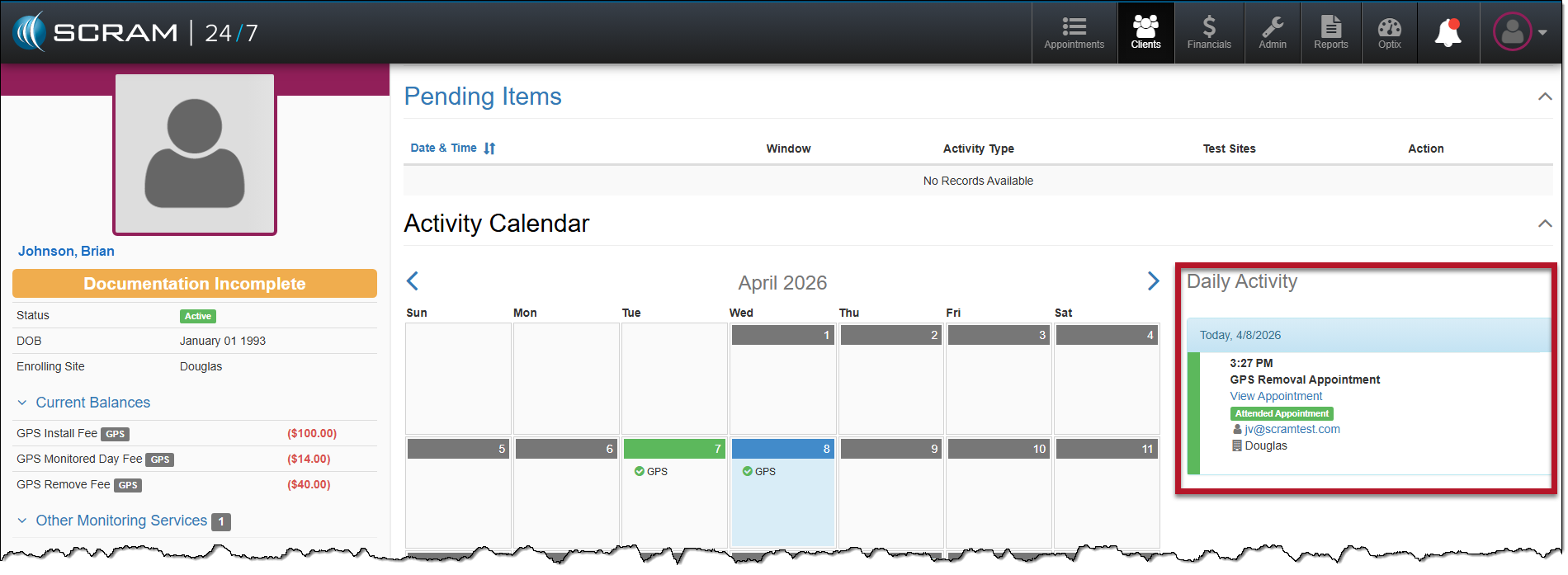
On the client’s Summary page, the Activity Calendar and Daily Activity stream will reflect a completed GPS Removal Appointment.
|
Replace GPS Device To replace a GPS Bracelet
|
|
In a future enhancement, you will be able to change the client’s username or email address for their TouchPoint Mobile application. For the time being, navigate to the client’s Optix TouchPoint profile to make any updates. |
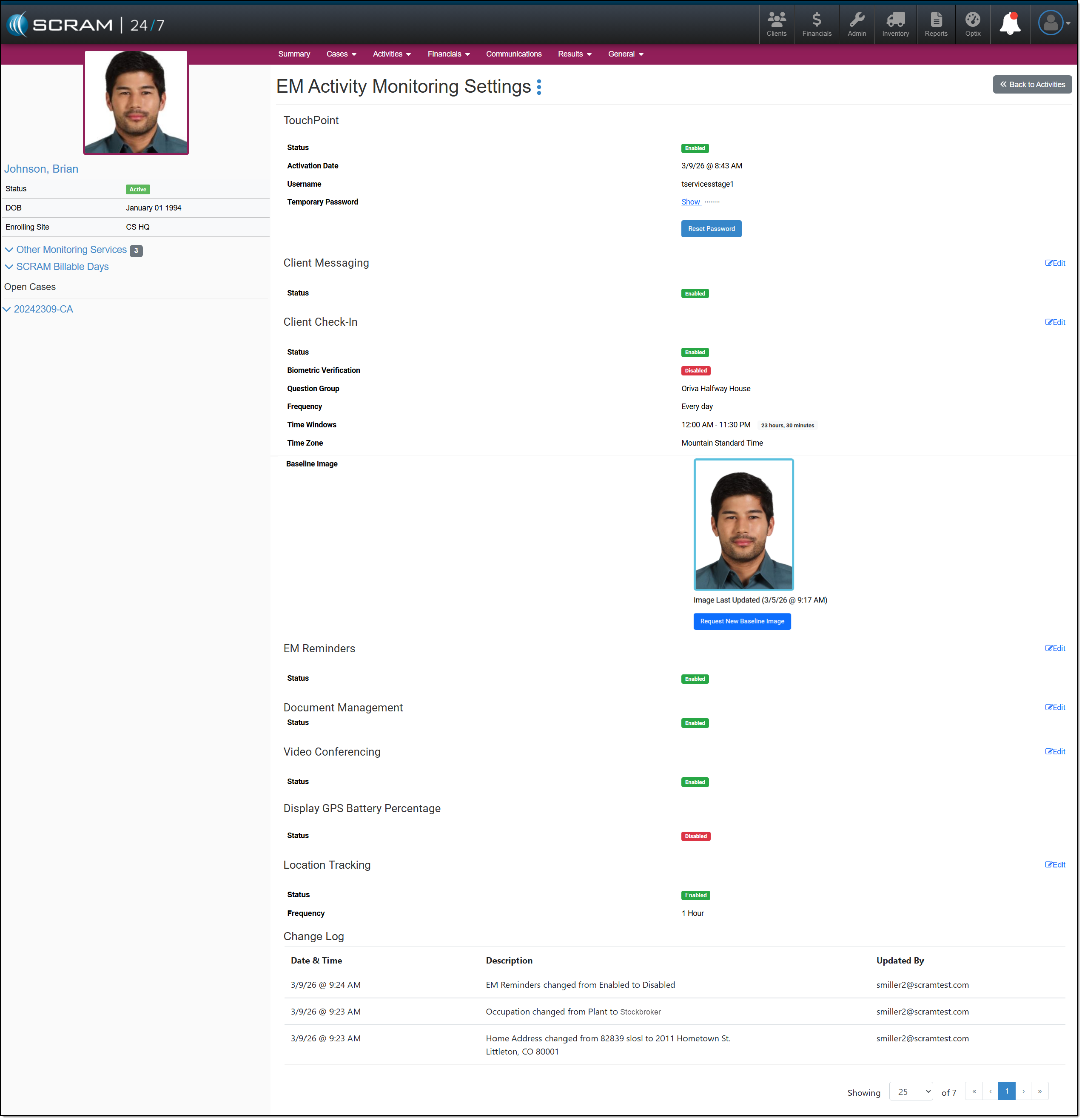
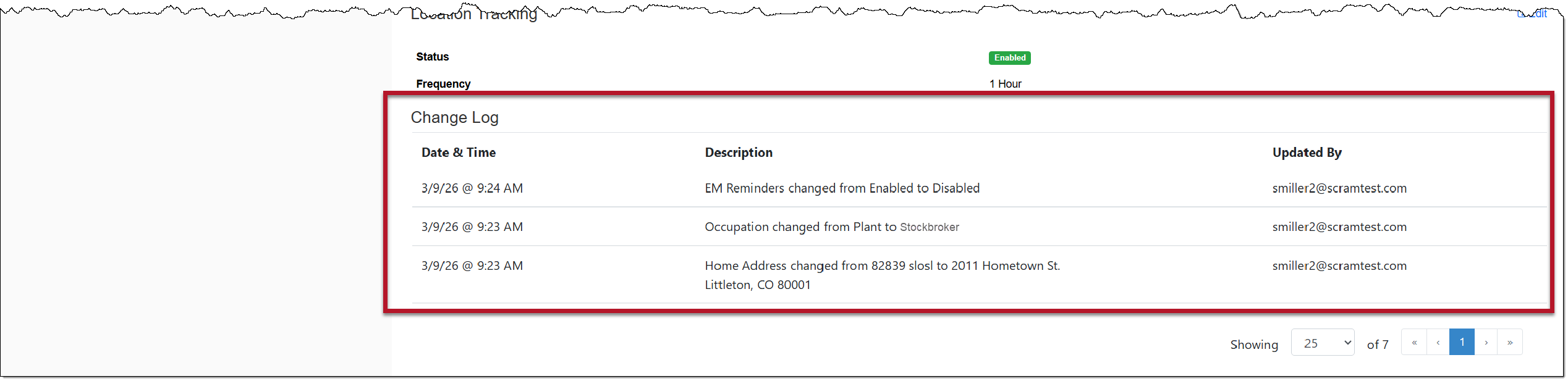
In addition to the TouchPoint services, the TouchPoint Change log history information will now be displayed on the TouchPoint Activity EM Activity Monitoring Settings page.
Offline Location Tracking
|
Your account must be enabled for location tracking for these instructions to work. Contact your SCRAM Systems Account Representative if you are interested in activating this service. |
For clients who are enabled for the SCRAM TouchPoint Location Tracking service, their smartphone’s location data will be captured and stored during periods without network or internet connectivity. Once service is restored, the stored data will be transmitted to the system.
Here is how it works:
For this example, the client’s Location Tracking service is configured to collect location data every 5 minutes.
- View the Location Tracking Map by selecting the ellipsis next to the client’s name in the Other Monitoring Service, TouchPoint section.
- Select the Location Tracking Map option.
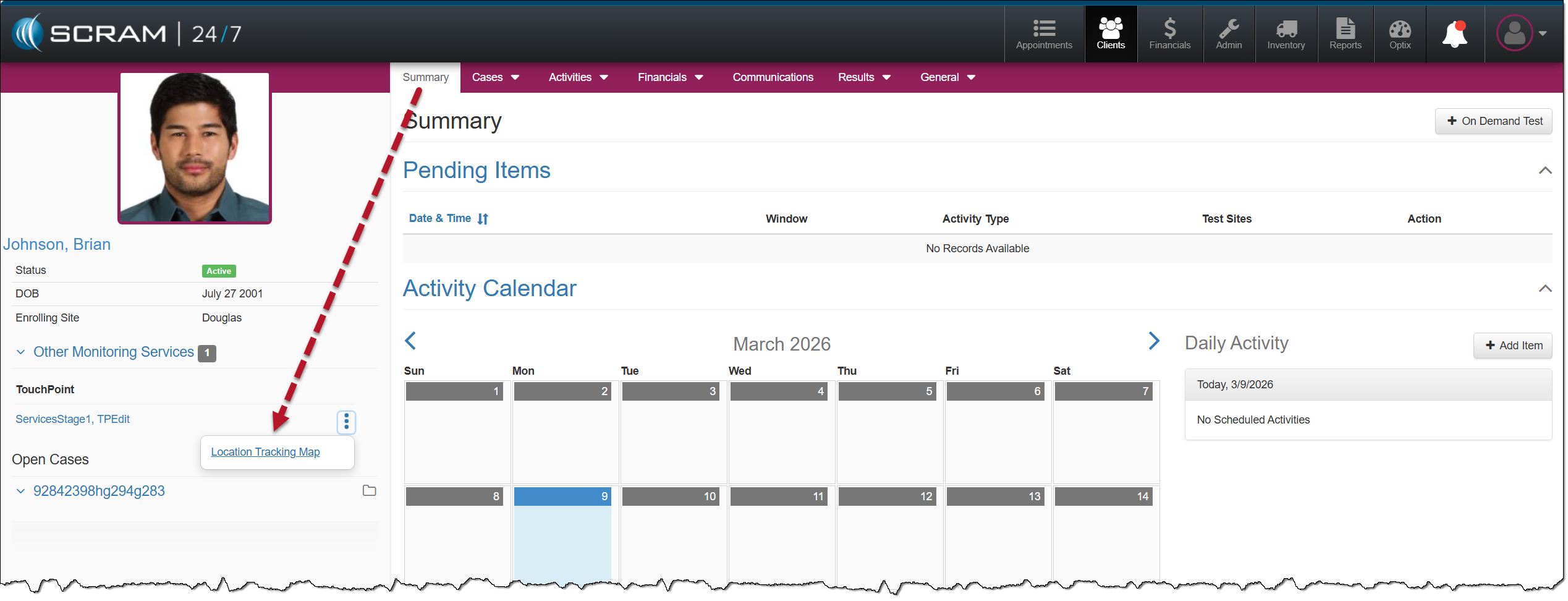
On the Location Tracking pop-up window:
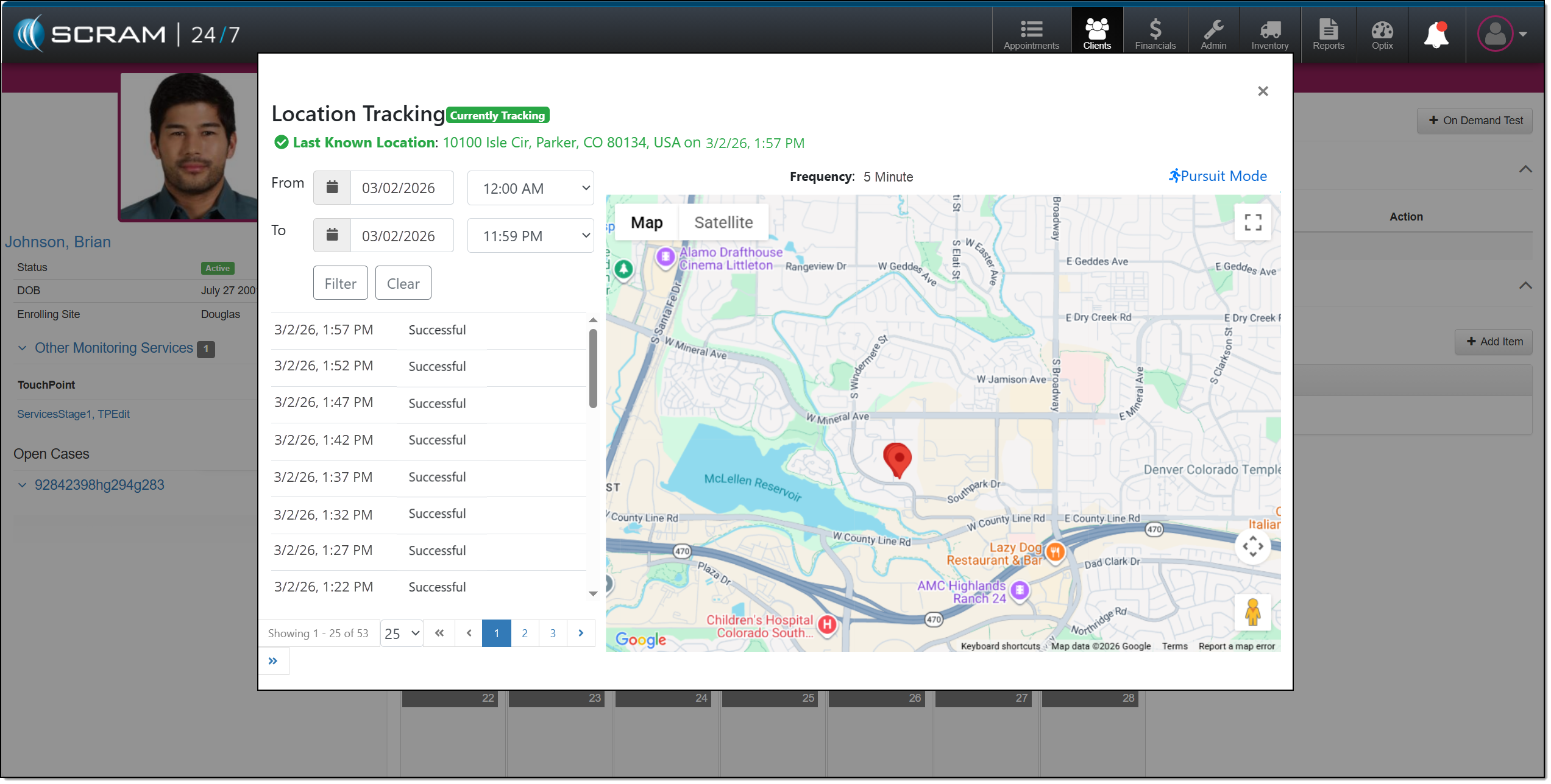
When connectivity is available:
- The location points are plotted on the map.
- Each point is recorded as Successful.
- The Location Tracking pop-up window reflects normal communication.
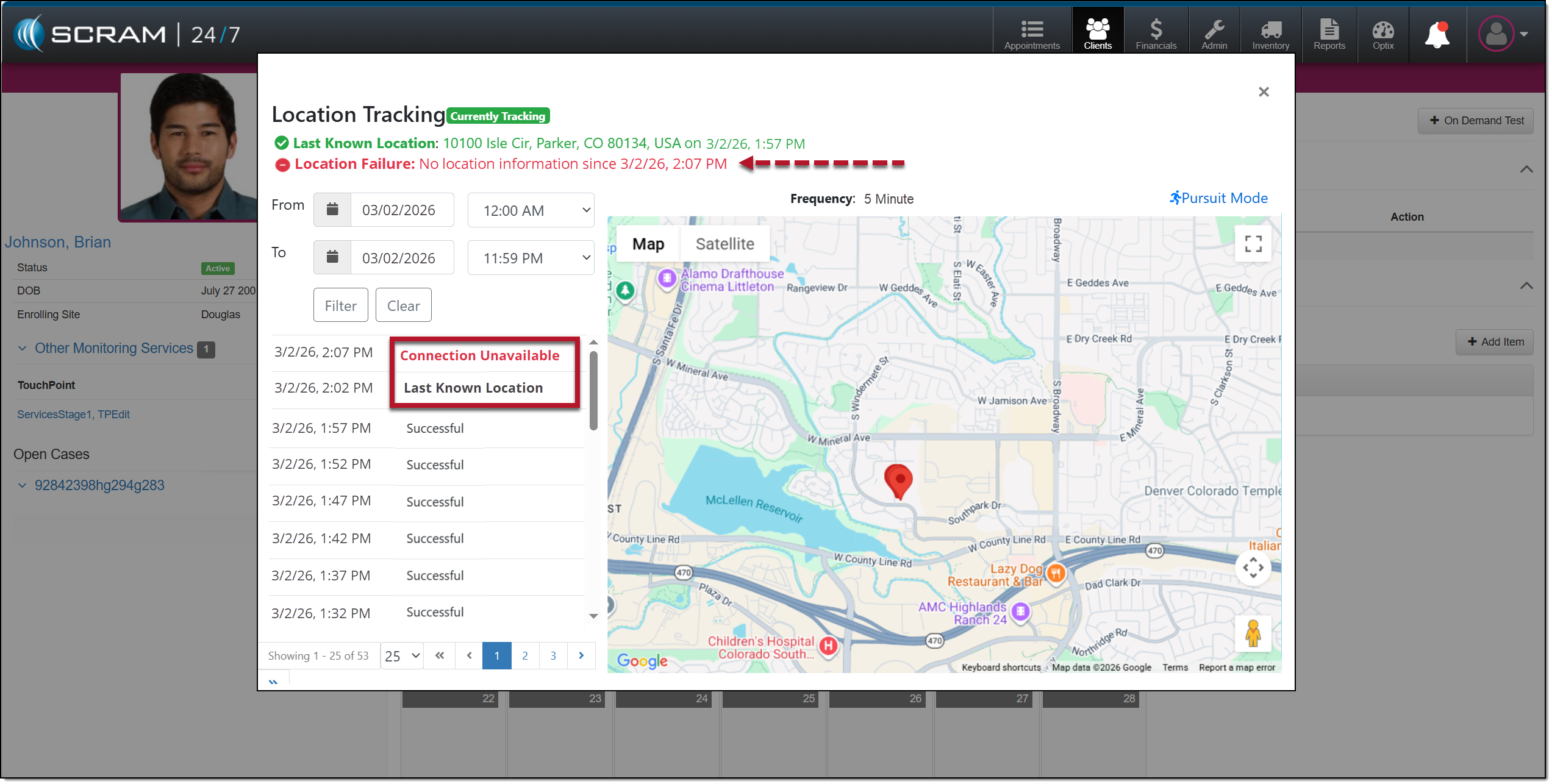
When the connection is not available:
- The location table will indicate the last known location in bold.
- At the next location interval, in this case the 5-minute interval, the location table will display Connection Unavailable in red.
- Additionally, a red Location Failure heading is displayed at the top of the pop-up window, displaying the last communication date and time.
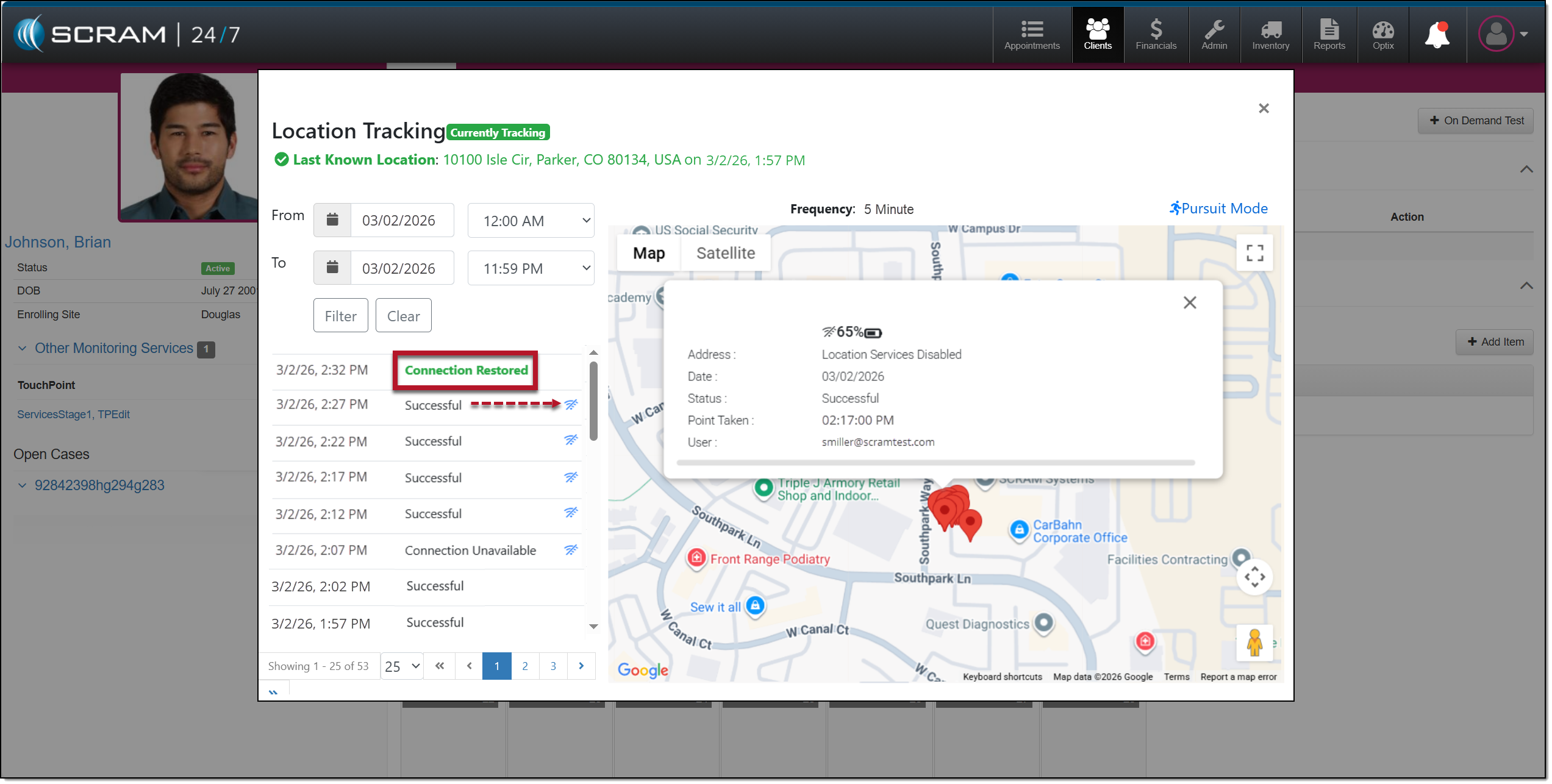
Once the connection is reestablished:
- The location data will automatically update on the map and on the location table.
- The “Connection Unavailable” message will no longer display in bold or in red.
- A “Connection Restored” message will appear bolded and in green on the location table with the date and time stamp of when communication was restored.
|
Status Updates: Location Tracking status updates are tied to the client’s configured frequency. For example, location information is gathered and communicated every 5, 10, 15, 30, and 60 minutes. Any change in connectivity or location status will only be displayed at the sent interval. |
Loss of Connectivity During Pursuit Mode
During the 15-minute Pursuit mode window, if connectivity is lost, the location table will display “Connection Unavailable,” and the red failure banner will display in the Location Tracking pop-up window.
If the device reconnects during the 15-minute Pursuit Mode window, location collection will resume automatically and continue at one-minute intervals for the remainder of the session.
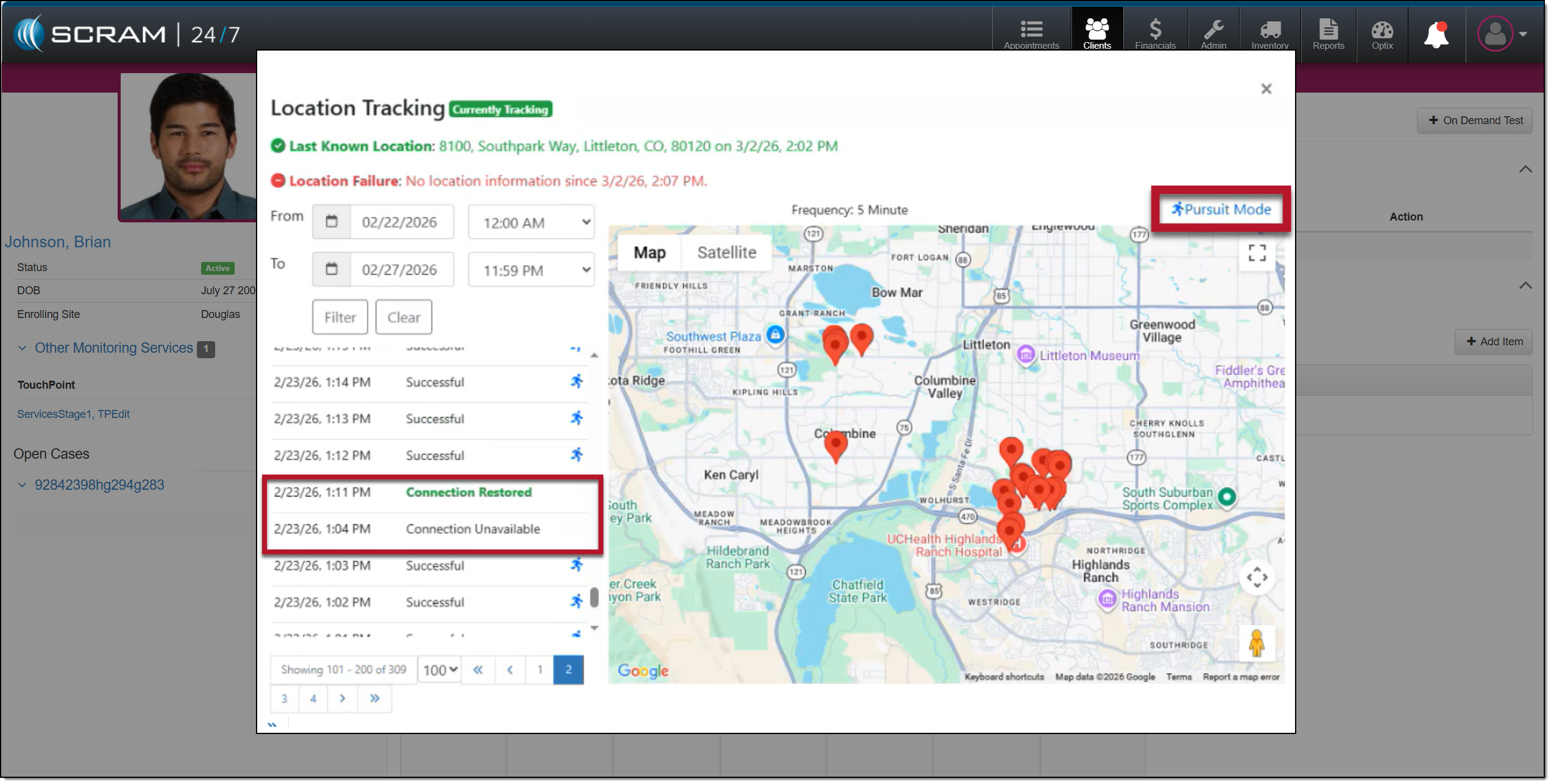
On March 12, 2026, SCRAM Systems will release an enhancement to your TouchPoint Monitoring program. For clients who are enabled for the SCRAM TouchPoint Location Tracking service, their smartphone’s location data will be captured and stored during periods without network or internet connectivity. Once service is restored, the stored data will be transmitted to the system.
|
Your account must be enabled for location tracking for these instructions to work. Contact your SCRAM Systems Account Representative if you are interested in activating this service. |
How It Works
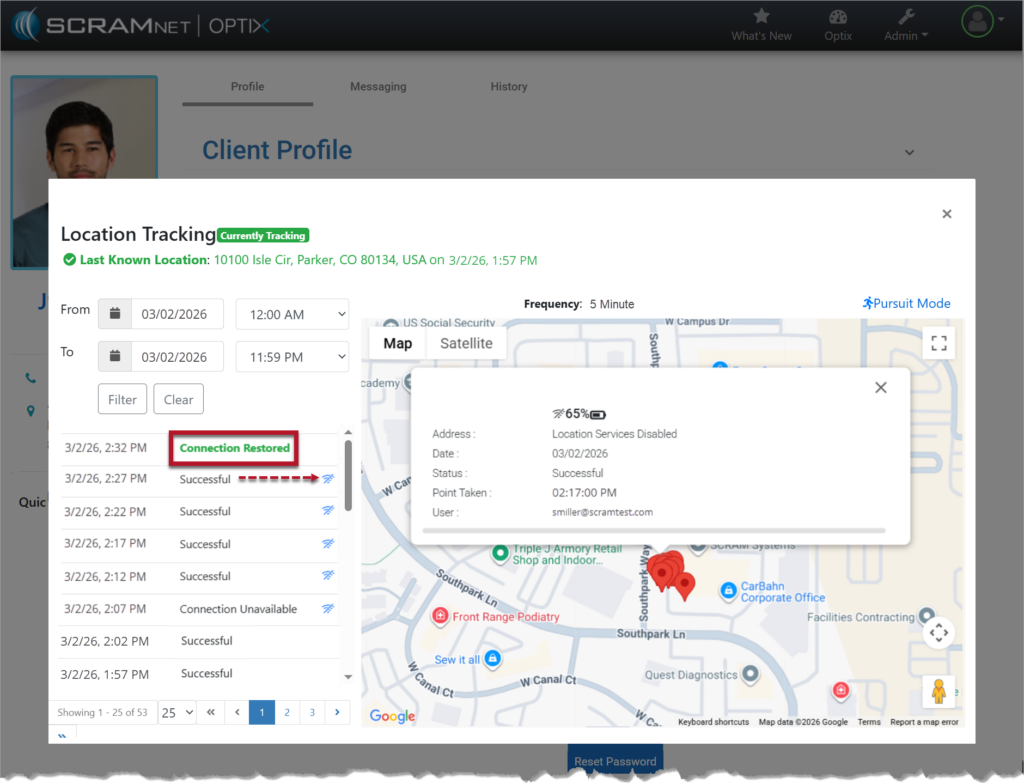
For this example, the client’s Location Tracking service is configured to collect location data every 5 minutes.
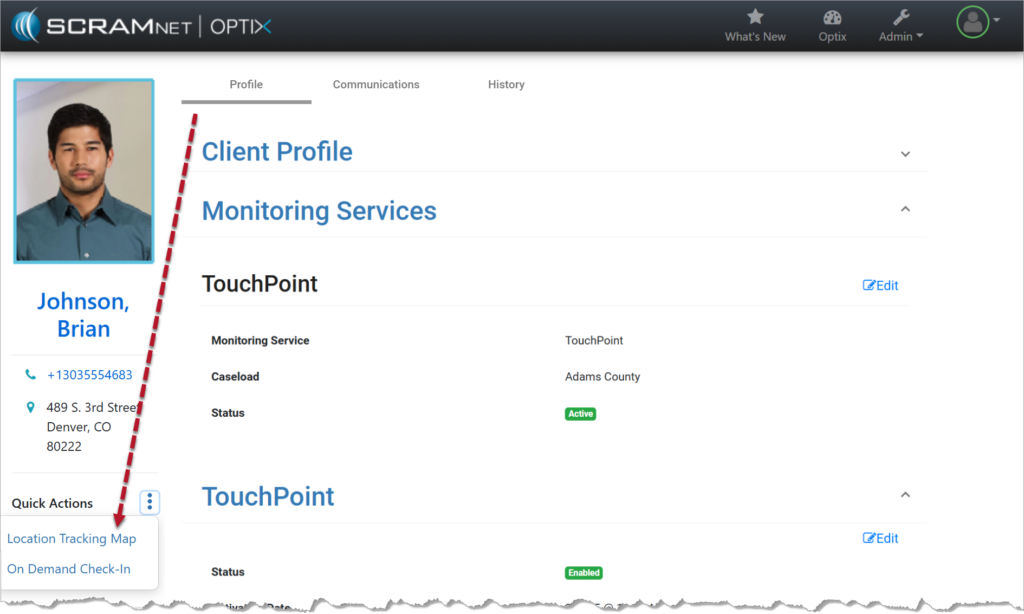
From the Client Profile page, select Location Tracking Map from the Quick Actions dropdown ellipsis menu.
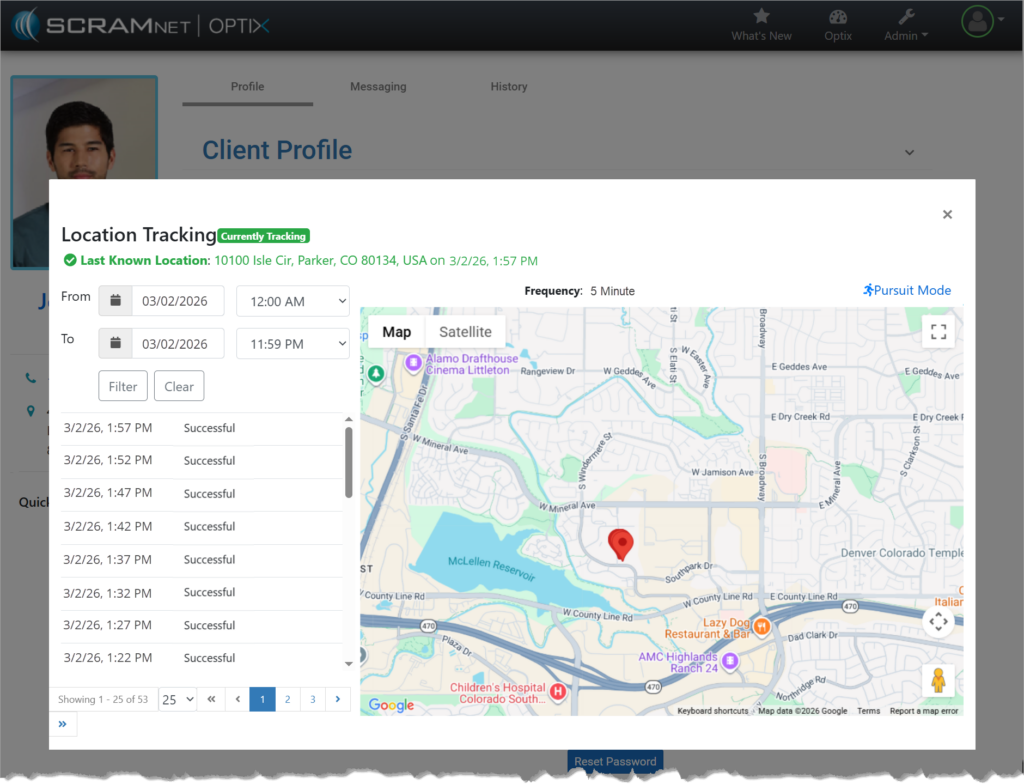
On the Location Tracking pop-up window:
When connectivity is available:
- The location points are plotted on the map.
- Each point is recorded as Successful.
- The Location Tracking pop-up window reflects normal communication.
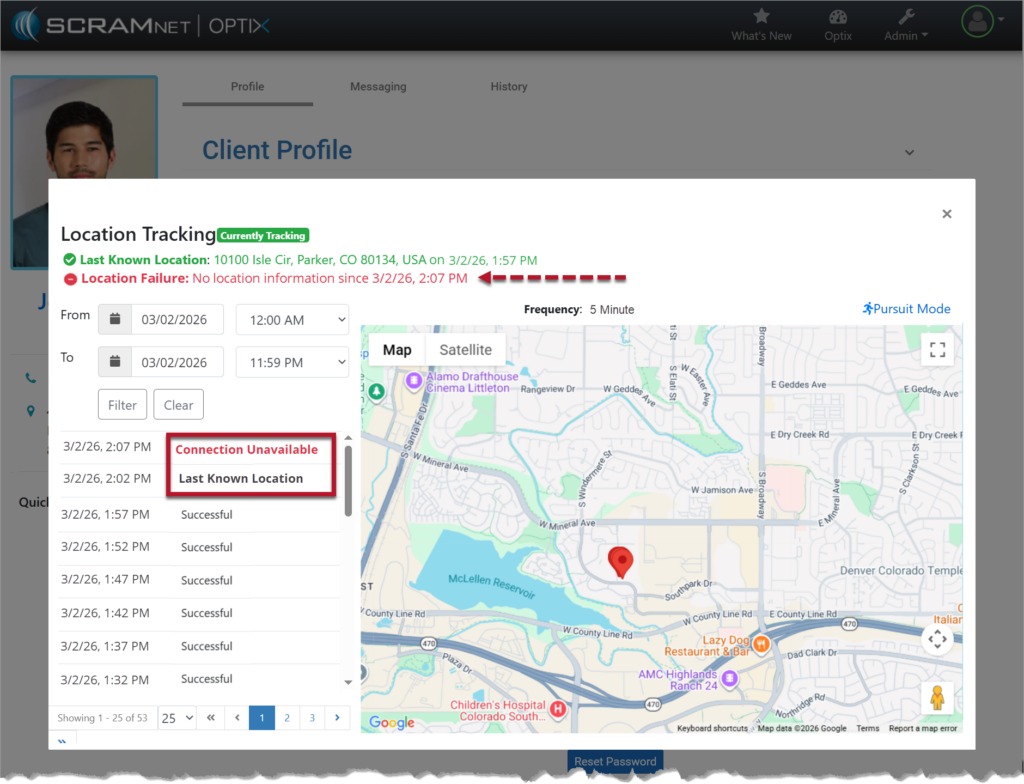
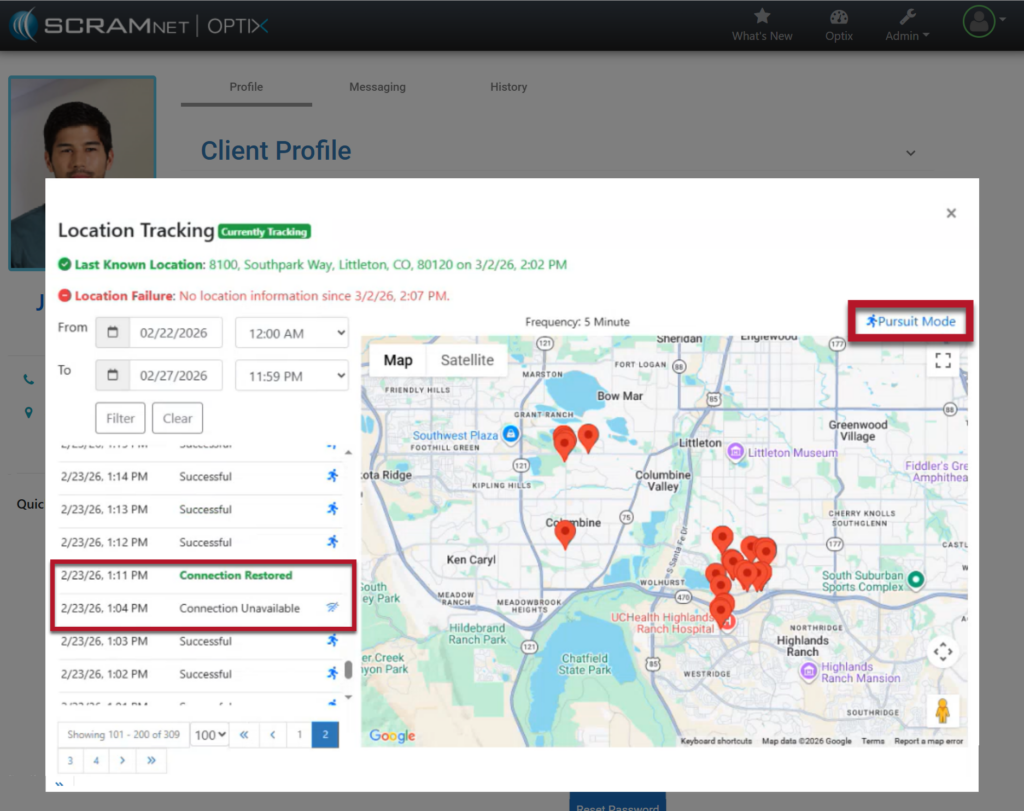
When connection is not available:
- The location table will not indicate the last known location in bold.
- At the next location interval, in this case the 5-minute interval, the location table will display Connection Unavailable in red.
- Additionally, a red Location Failure heading is displayed at the top of the pop-up window, displaying the last communication date and time.
Once the connection is reestablished:
- The location data will automatically update on the map and on the location table.
- The “Connection Unavailable” message will no longer display in bold or in red.
- A “Connection Restored” message will appear bolded and in green on the location table with the date and time stamp of when communication was restored.
|
Status Updates: Location Tracking updates are tied to the frequency configured for the client. For example, location information is gathered and communicated every 5, 10, 15, 30, and 60 minutes. Any change in connectivity and location status will only display at the sent interval. |
Loss of Connectivity During Pursuit Mode
During the 15-minute Pursuit Mode window, if connectivity is lost the location table will display “Connection Unavailable,” and the red failure banner will display in the Location Tracking pop-up window.
If the device reconnects during the 15-minute Pursuit Mode session, location collection will resume automatically and continue at one-minute intervals for the remainder of the session.
RE: Fraudulent Phone Calls Targeting Individuals on Electronic Monitoring
To our valued partners,
We want to make you aware of a recent increase in fraudulent phone calls being made to individuals involved in electronic monitoring (EM) or community supervision programs. These scams are occurring nationwide in the United States, and have affected programs using a variety of EM technologies—not just SCRAM Systems monitoring technologies.
In these calls, the scammer poses as a representative of a sheriff’s office, court, or monitoring company and claims that the individual owes money, is in violation, or could be taken back into custody unless a payment is made immediately. The goal of these calls is to create fear and prompt a quick payment.
Please note the following:
- There has been no data breach or security incident at SCRAM Systems.
- This is not a SCRAM-specific issue. Similar scams have targeted programs using other EM devices, as well as drug-testing and supervision programs with no electronic monitoring at all.
- These scams appear to draw on publicly available information or data obtained through unrelated means.
If any client, agency, or staff member receives such a call:
- Do not provide any personal or payment information.
- Do not make any payment requests over the phone.
- Immediately contact local law enforcement to report the incident.
- Notify your SCRAM Account Manager or SCRAM Systems Customer Support so we can assist with awareness and tracking.
SCRAM Systems continues to monitor these incidents closely and remains in contact with law enforcement and agency partners. Protecting the integrity of our programs and the safety of the individuals we serve is our top priority.
Thank you for your continued vigilance and partnership.
Sincerely,
John Hennessey
Chief Operating Officer
SCRAM Systems
jhennessey@scramsystems.com
815-342-4469
On February 4, 2026, SCRAM Systems will release an update that allows providers to control whether the GPS battery level is visible to clients in the TouchPoint Mobile app. This setting can be managed in SCRAM Optix or 24×7.
Enable the Display GPS Battery Level Setting in Optix
- In Optix, navigate to TouchPoint.
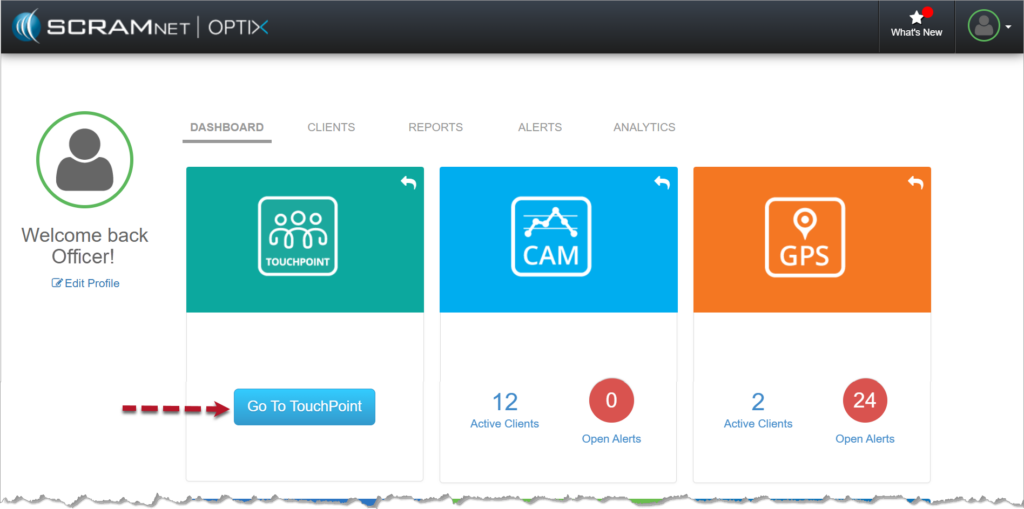
- Select the Admin tab from the top toolbar and then the Manage Caseloads option.
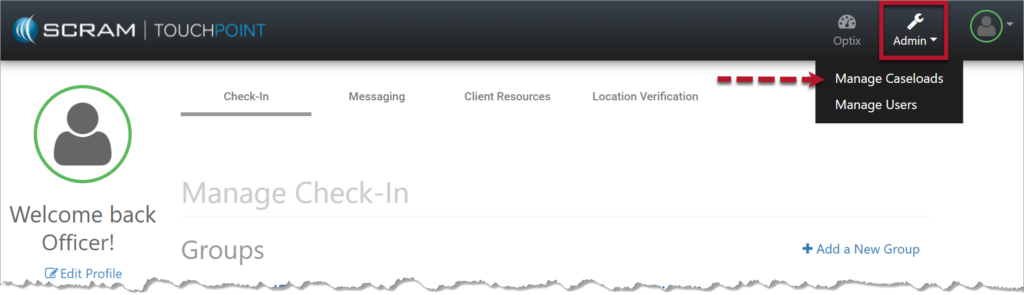
- Select the caseload.
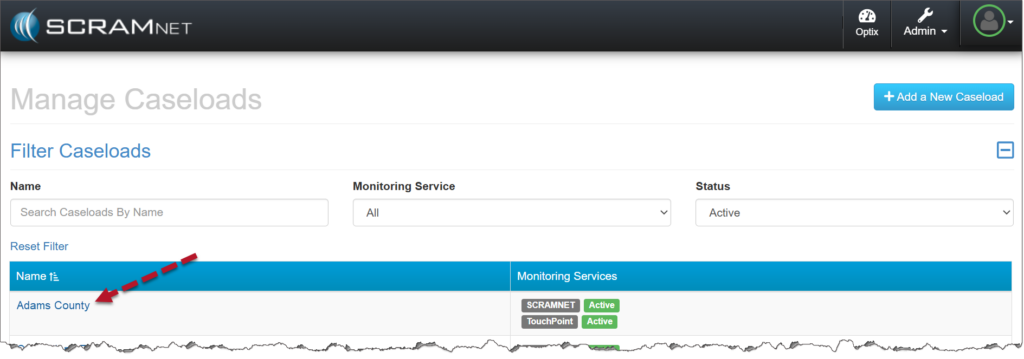
- From the Caseload Detail page, select the View Settings hyperlink.
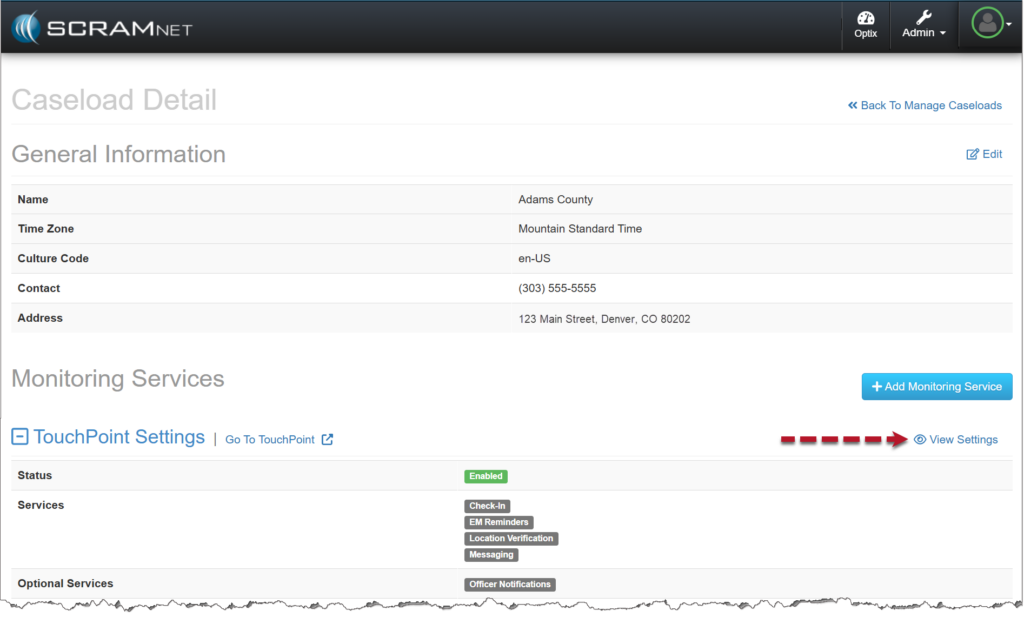
- Select the Edit hyperlink.
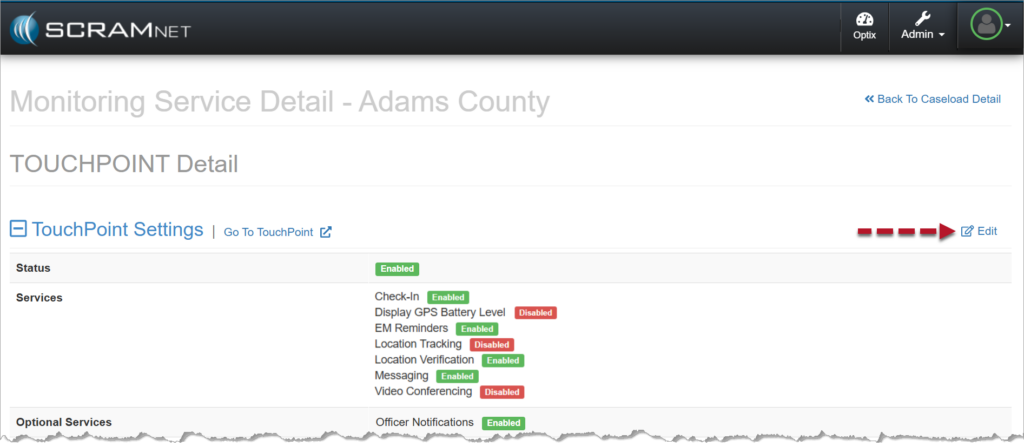
- Select the checkbox next to Display GPS Battery Level.
- Save your changes.
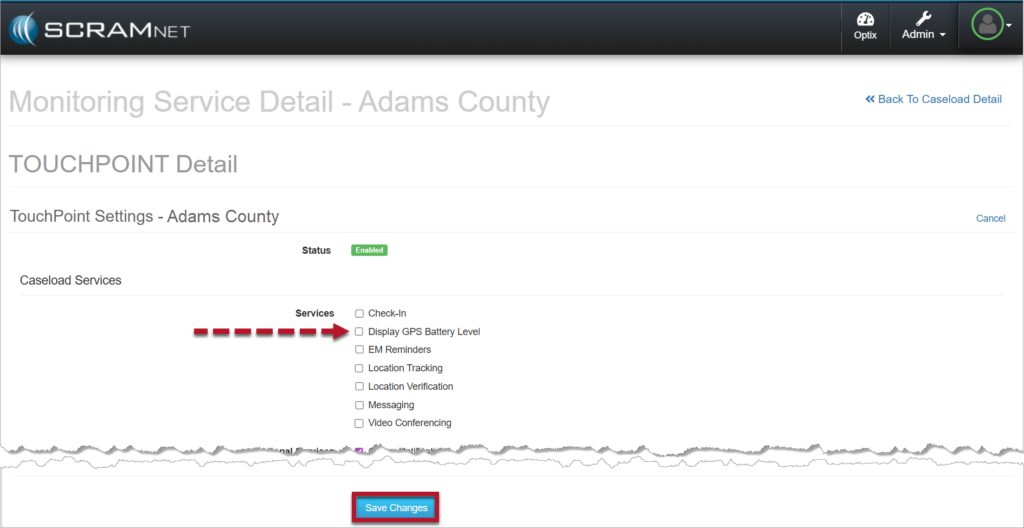
Once saved:
- The setting will appear as Enabled under TouchPoint Settings on the TouchPoint Detail page for the caseload.
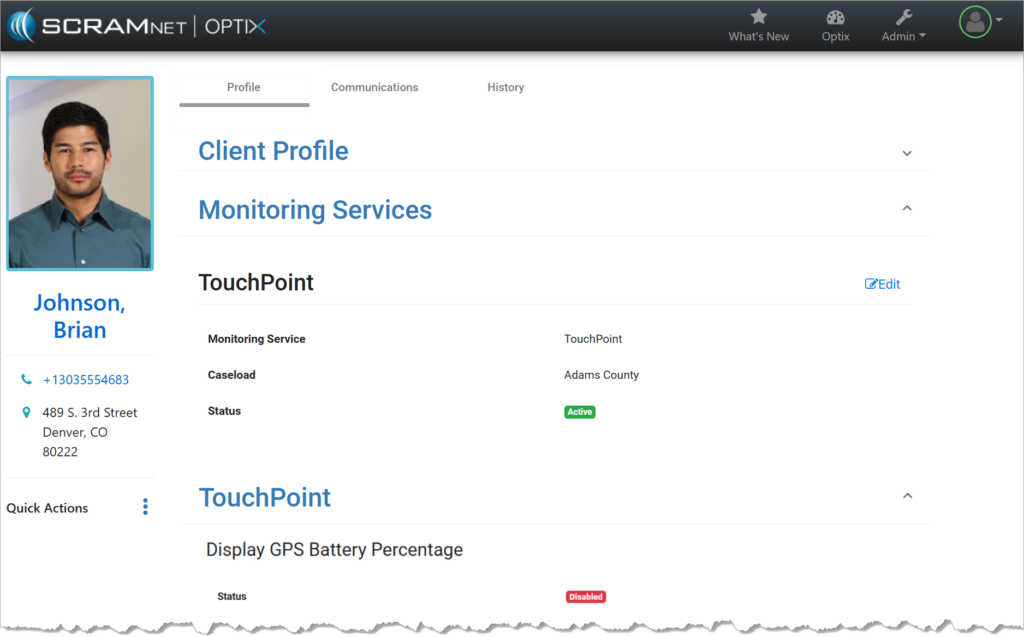
- The Display GPS Battery Percentage option will be visible on the client’s Profile page in Optix.
- Enable the Display GPS Battery Percentage service for the client:
- Select the Edit hyperlink on the client’s Profile page.
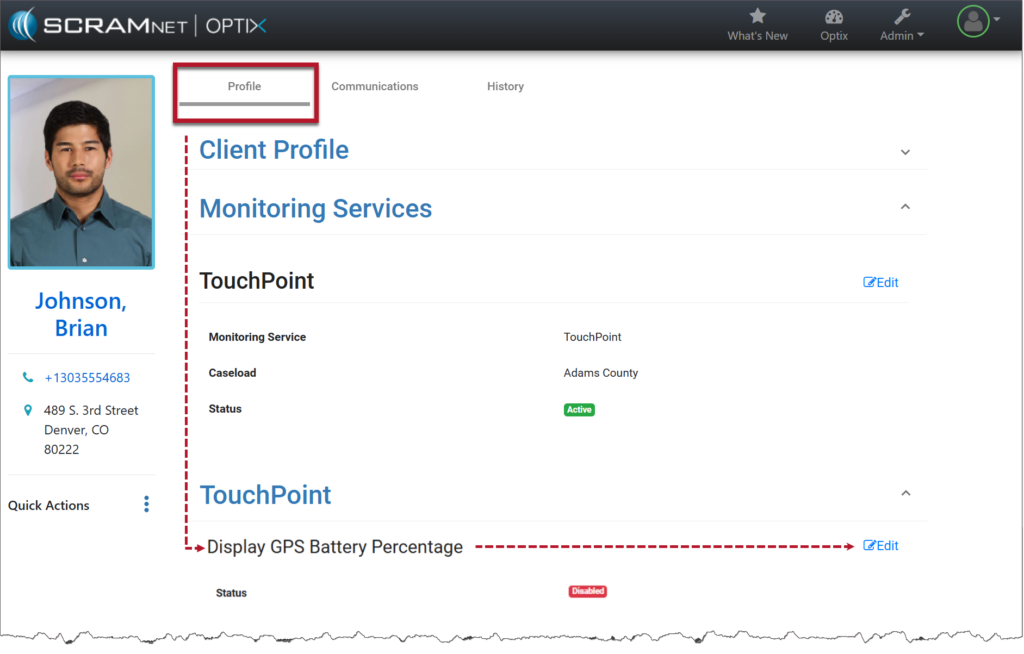
- Change the Status from Disabled to Enabled.
- Save your changes.

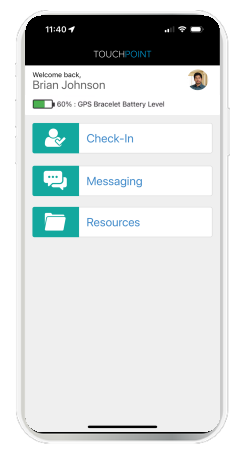
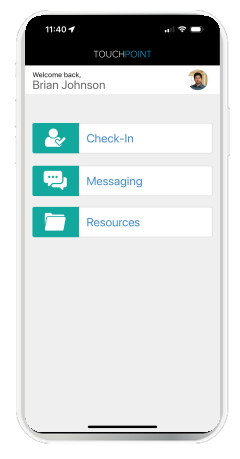
The client’s last reported SCRAM GPS bracelet’s battery level is displayed at the top of the home screen within the TouchPoint mobile application.
| Important Notes:
|
Disable the Display GPS Battery Level Setting Once Enabled in Optix
- From the client’s Profile page, select the Edit hyperlink next to Display GPS Battery Percentage.
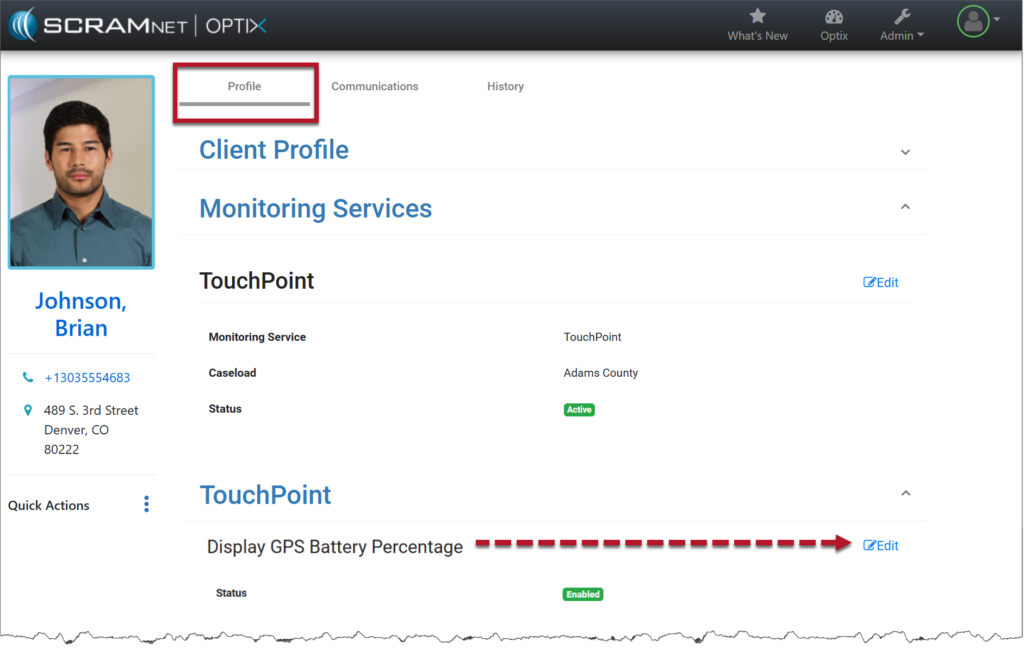
- Toggle the status to Disabled and select the Save Changes button.
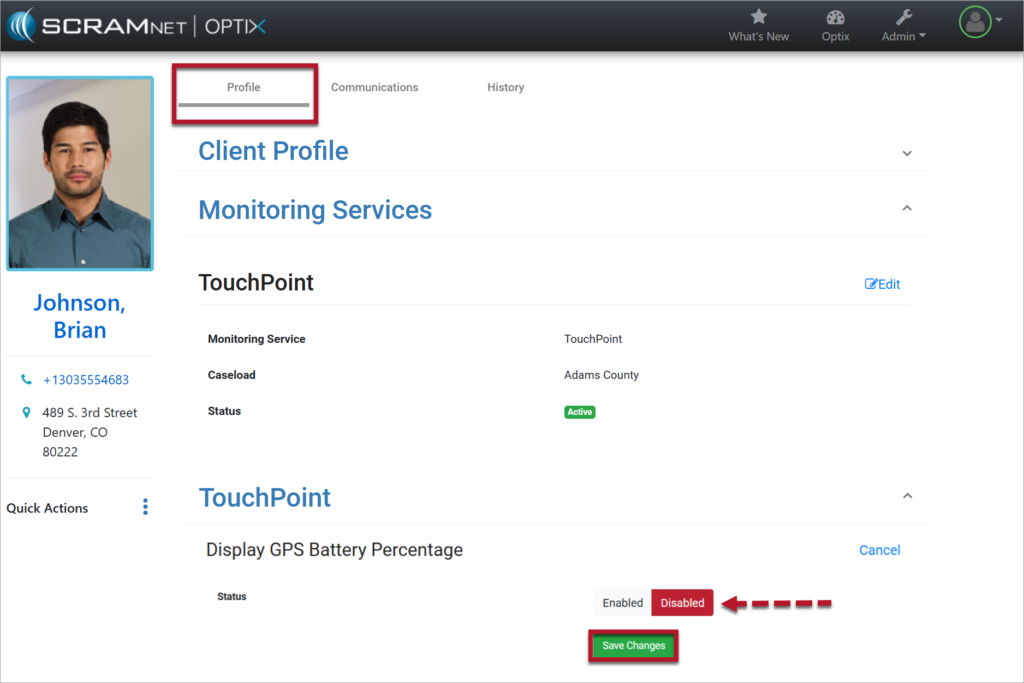
- The Display GPS Battery Percentage setting has been disabled for the client.
- The SCRAM GPS bracelet’s battery level is no longer displayed at the top of the home screen within the TouchPoint Mobile application.
Enable the Display GPS Battery Level Setting for a SCRAM 24×7 Client
After adding a GPS Activity to a client, you may also add a TouchPoint Activity and enable the GPS Battery Level feature from within SCRAM 24/7.
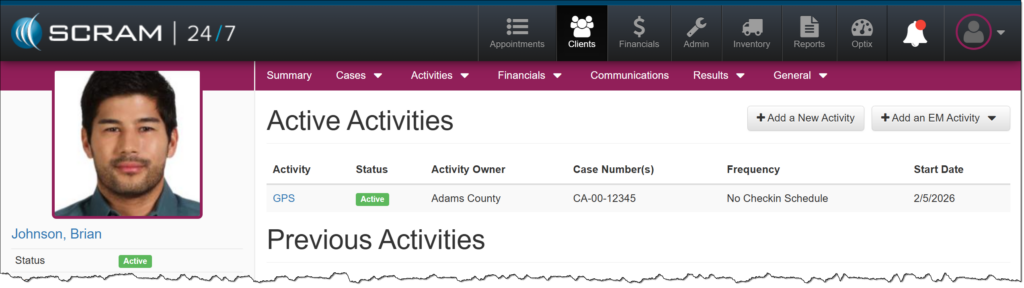
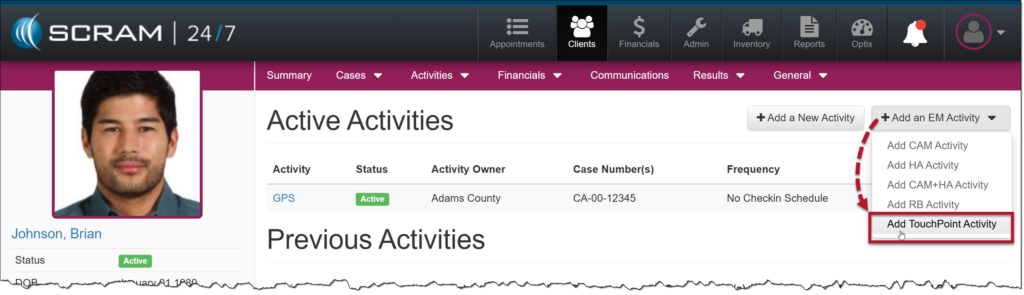
On the client’s Activities page:
- Open the +Add an EM Activity dropdown menu, and then select the Add TouchPoint Activity option.
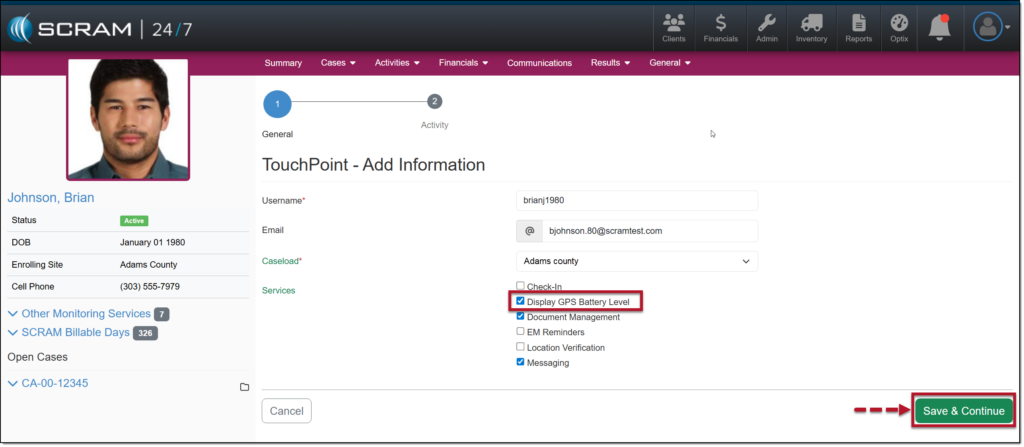
- On the TouchPoint – Add Information page, enter the TouchPoint details. This includes the client’s username for the mobile application, email address, and TouchPoint Caseload.
- Select the checkbox next to each TouchPoint service the client will be utilizing. To display the client’s GPS battery voltage in the mobile application, select the checkbox next to the Display GPS Battery Level option.
- Once you have made your selections, select the Save & Continue button.
|
When adding a TouchPoint Activity, the services and features available to select on dependent on the TouchPoint Caseload selected. |
- Add the Activity Start Date and any additional monitoring requirements, and then select the Save & Finish button.
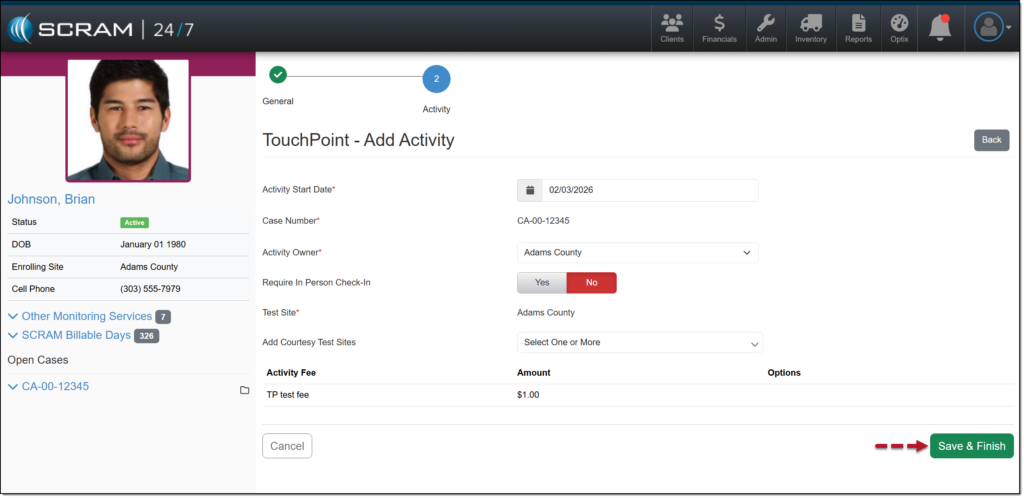
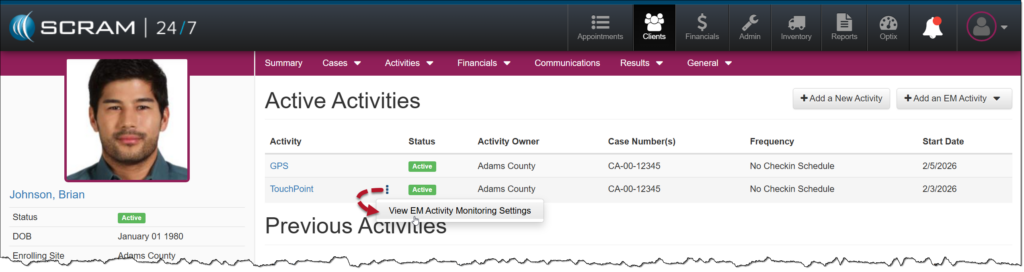
The TouchPoint Activity is now displayed on the client’s Activity page.
To view or edit the TouchPoint settings, select the ellipsis, and then the View EM Activity Monitoring Settings option.
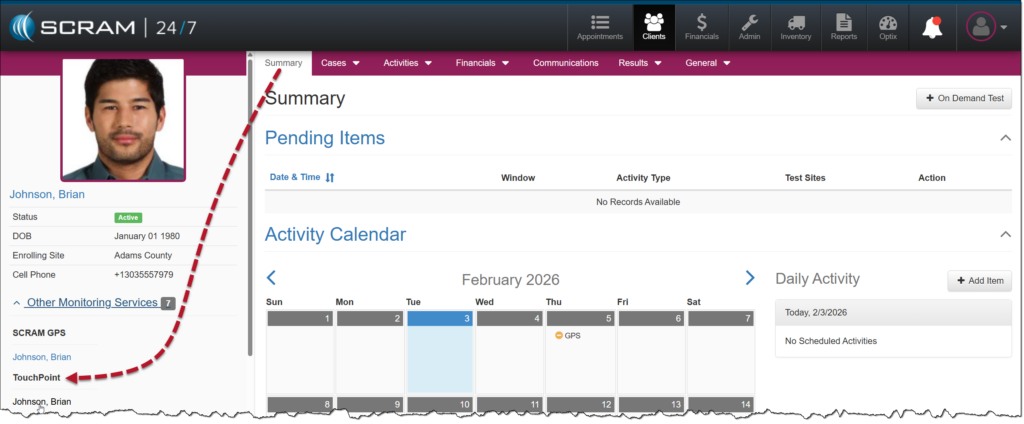
Or, you may navigate to the client’s TouchPoint Profile page in Optix by selecting their name hyperlink in the Other Monitoring Services section on the Summary page.
|
The Display GPS Battery Level option is only editable after a GPS device has been assigned to the client. |
Proper Alignment of the Device Strap and Backplate
To ensure the backplate is oriented correctly for installation:
- Place the bracelet face up on a desk with the strap on the right side.
- Next, place the backplate under the strap with the large posts closest to the bracelet.
The farther away the backplate is positioned from the bracelet body, the larger the circumference of the strap.
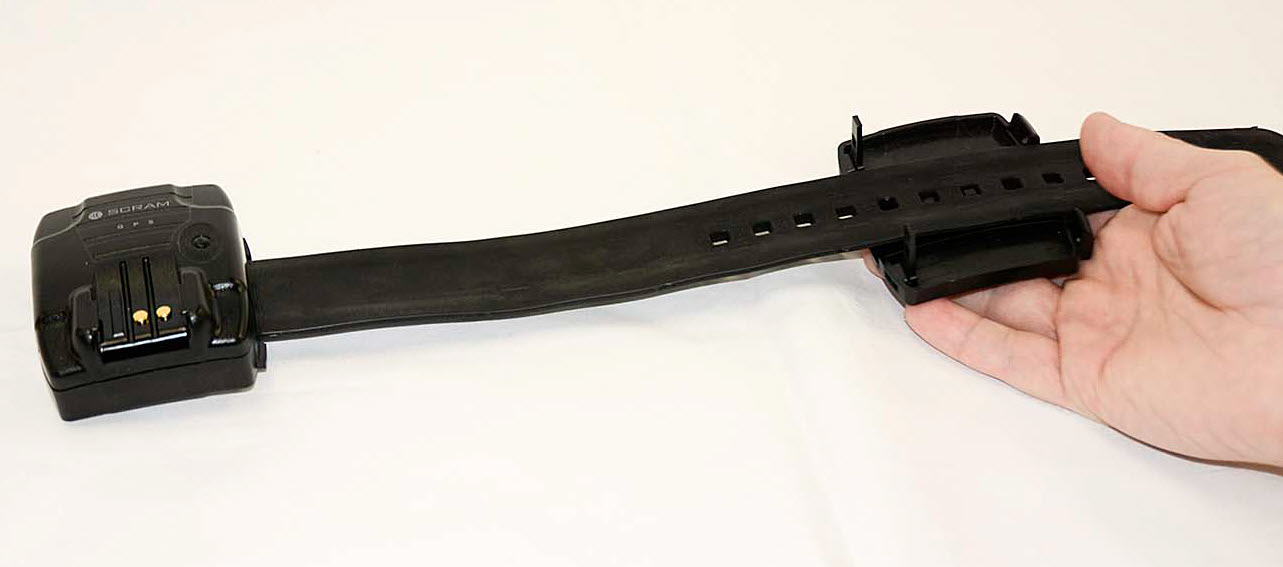
|
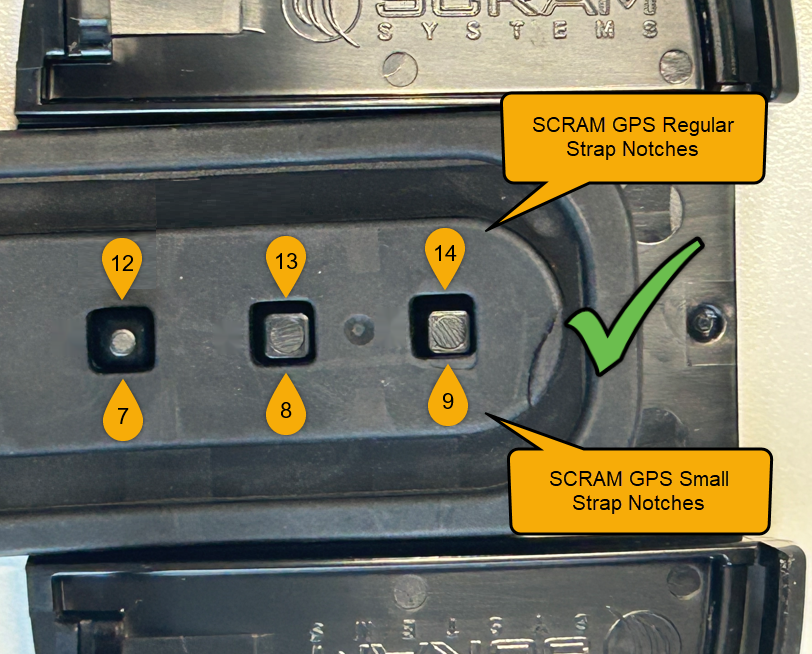
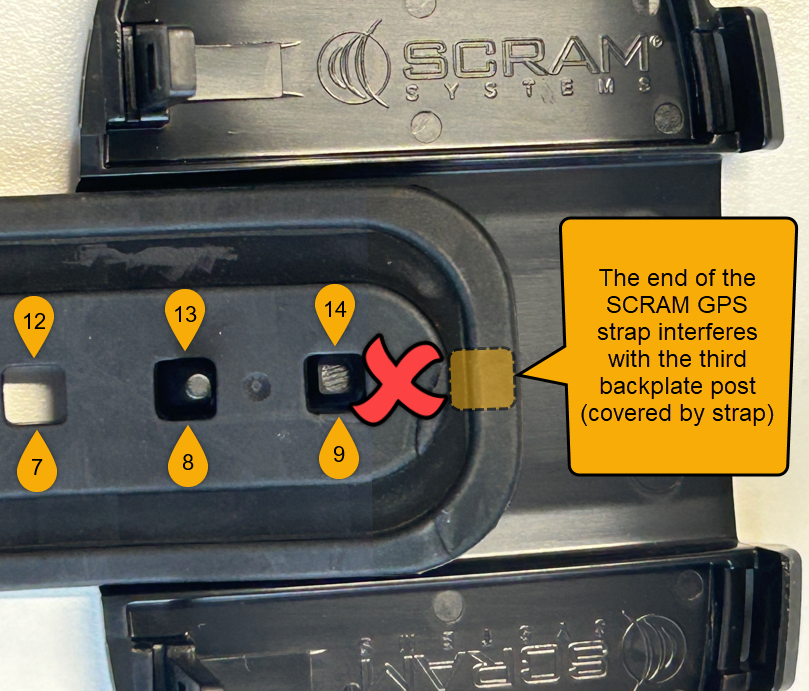
IMPORTANT! There are nine sizing notches in a “small” (sometimes referred to as “juvenile”) SCRAM GPS strap, and 14 sizing notches in a “regular” (adult) SCRAM GPS strap. Ensure that the three raised pegs in the backplate fit into three of the available sizing notches in the strap. DO NOT attempt to secure the strap on only the last two notches of the strap (8 & 9 for small, or 13 & 14 for regular); otherwise the backplate will not close flush against the device casing and may result in tamper alerts being generated in SCRAMNET GPS. |
On January 28, 2026, SCRAM Systems will release multiple enhancements for your SCRAM 24/7 Client Caseload.
These enhancements are:
- Consolidate Topic-Driven Client Tabs
- Activity Type Menu Options Update
- Activity Electronic Monitoring (EM) Monitoring Settings
Topic Driven Client Tabs
To accommodate future enhancements and provide an efficient user experience, the tabs used to view and access client information and tasks have been consolidated into topic-driven navigation tabs that include dropdown menus.
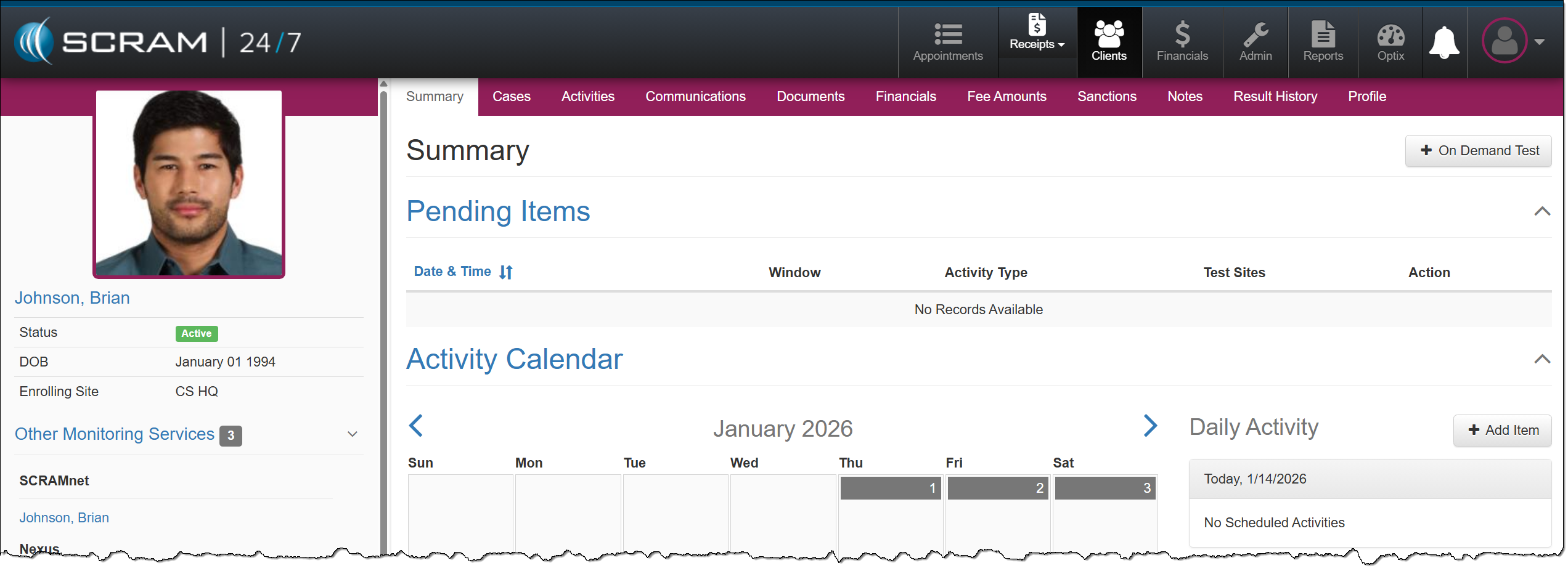
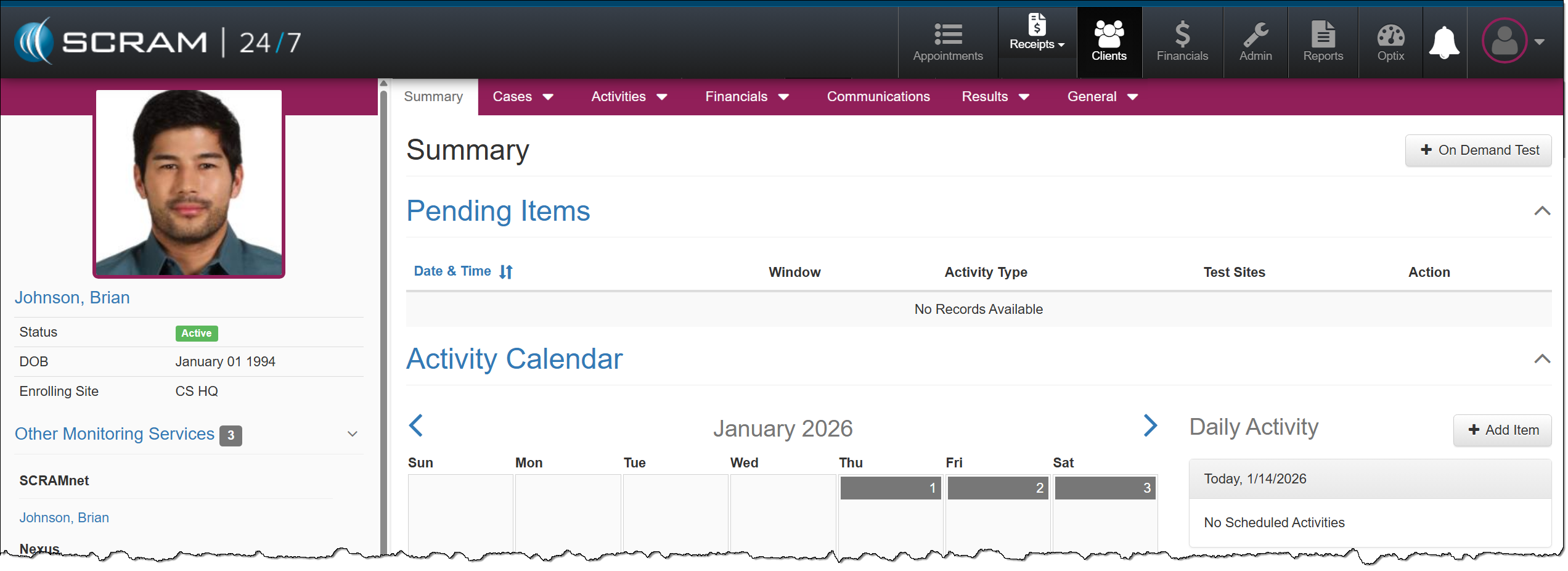
The Cases tab dropdown menu includes access to the client’s:
- Cases
- Add Case*
The Activities tab dropdown menu includes access to the client’s:
- Activities
- Add Activity
- Add an EM Activity**
The Financials tab dropdown menu includes access to:
- Client Financials
- Fee Amounts
The Results tab dropdown menu includes access to the client’s:
- Result History
- Sanctions
The General tab dropdown menu includes access to the client’s:
- Profile
- Documents
- Notes
- Add Notes*
*New direct access to specific tasks.
Activities Option
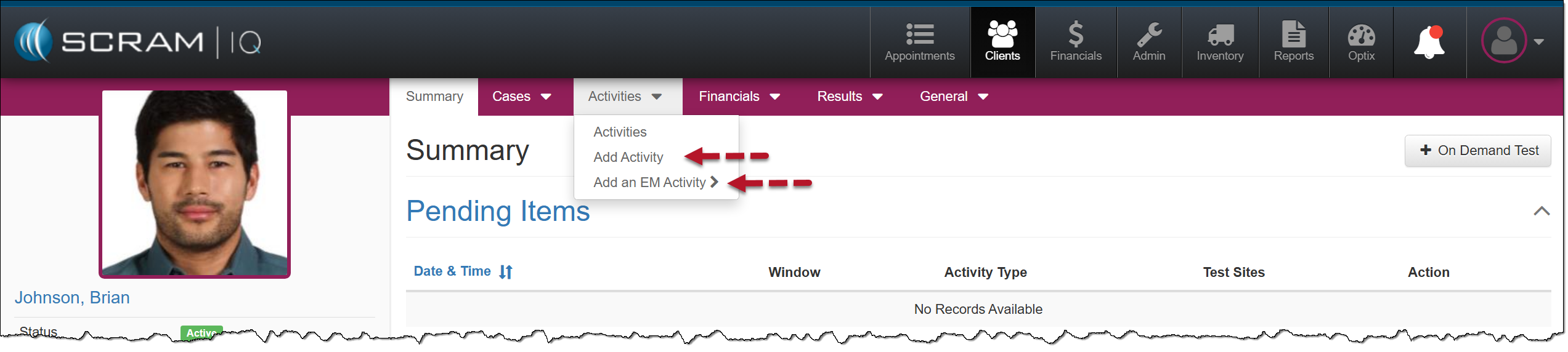
There are two additional options available on the Activities tab dropdown menu: Add Activity and Add an EM Activity. These two options separate the EM-related activities from the non-EM-related activities.
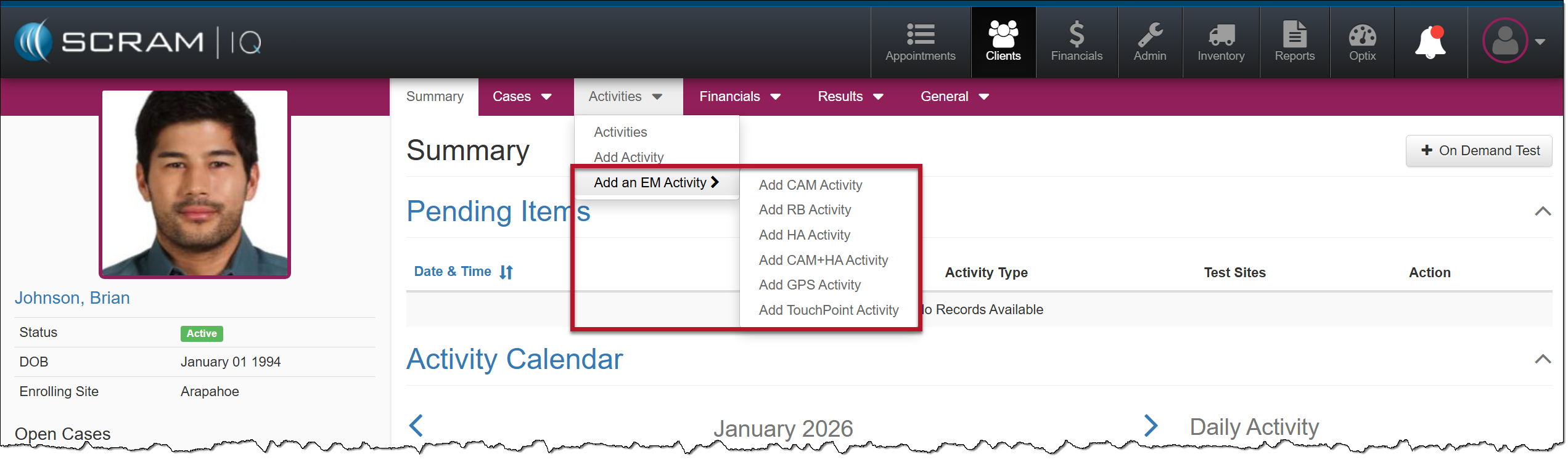
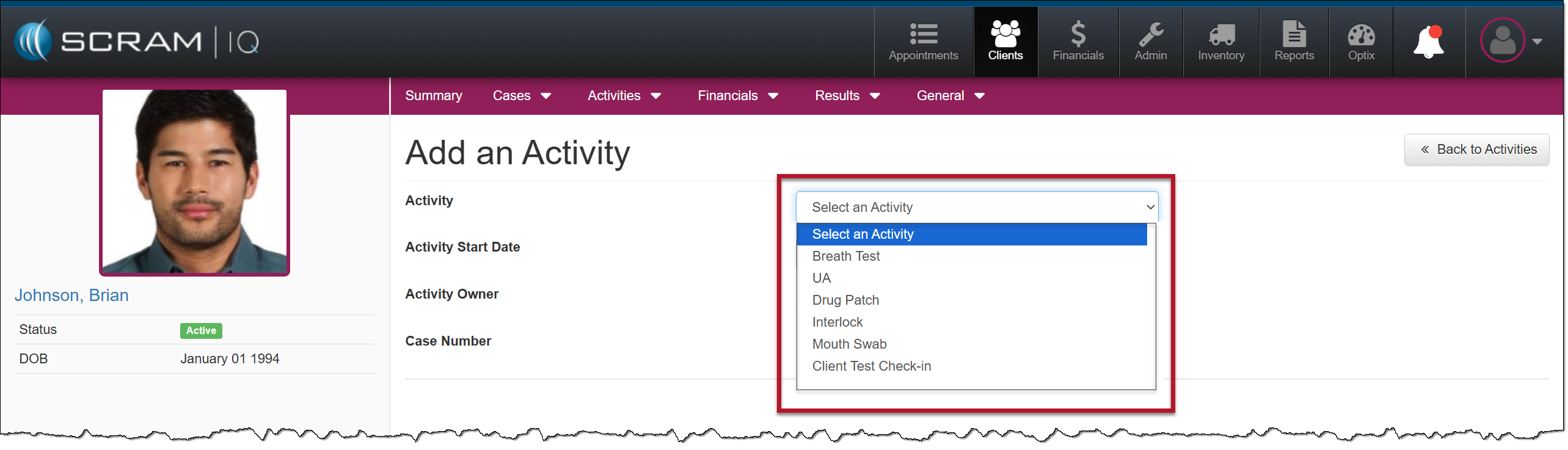
The client’s Activities page will also reflect EM-related activities from the non-EM-related activities.
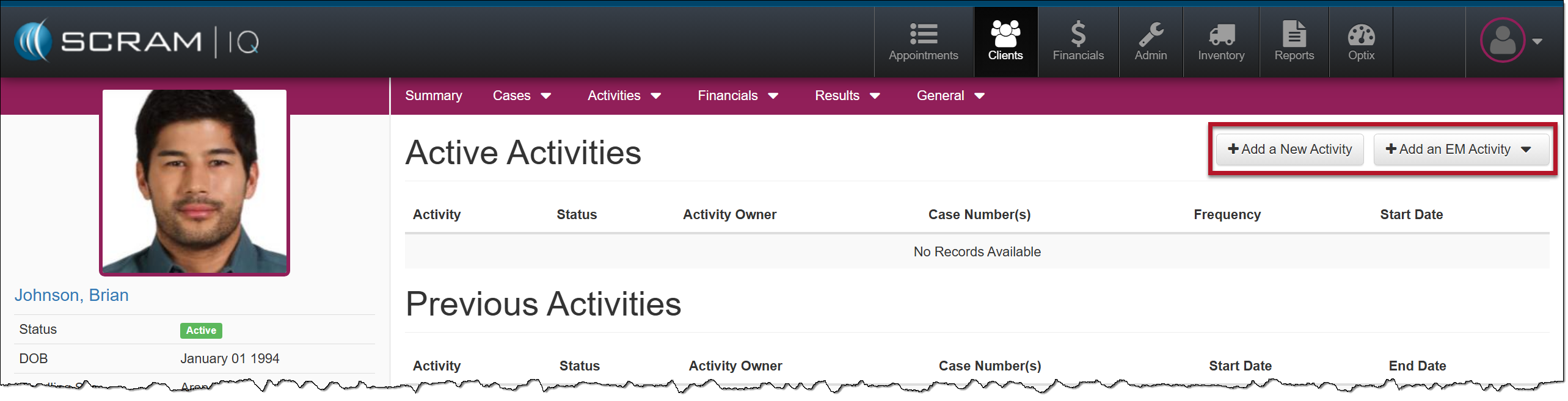
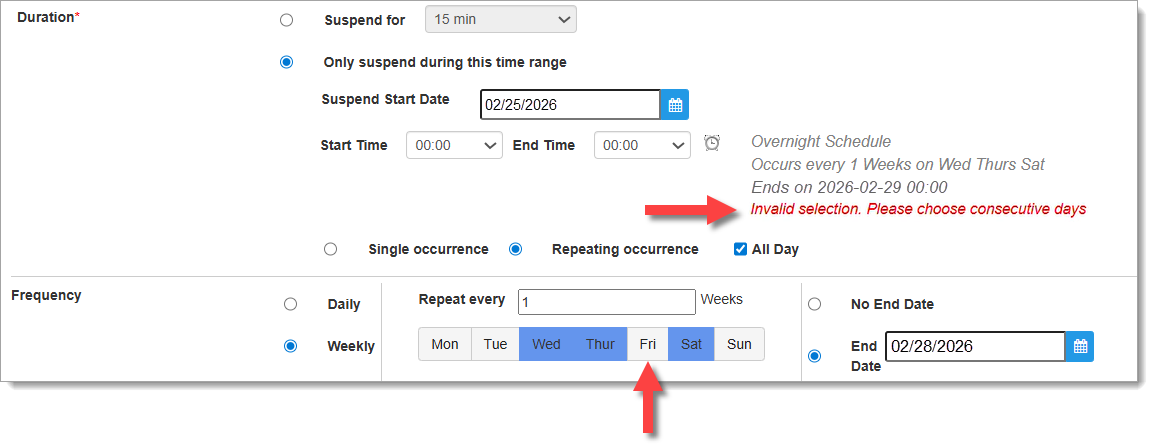
 | Tip: The available Activity options will reflect the activities currently active in your program and the EM Activities you have access to. Additionally, if an Activity is currently active for the client, that option will NOT appear in the dropdown menu. |
Monitoring Settings for an Electronic Monitoring (EM) Activity
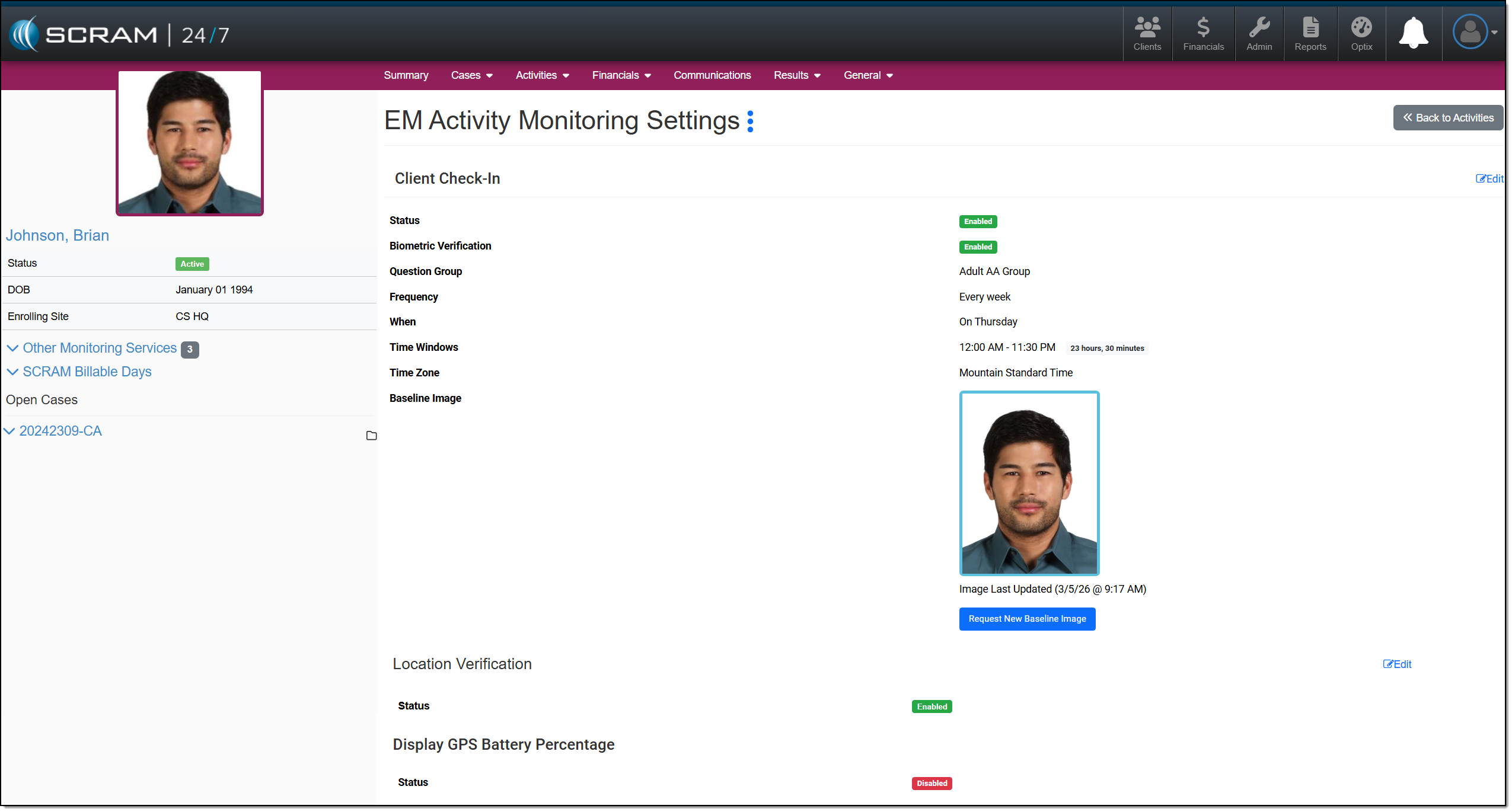
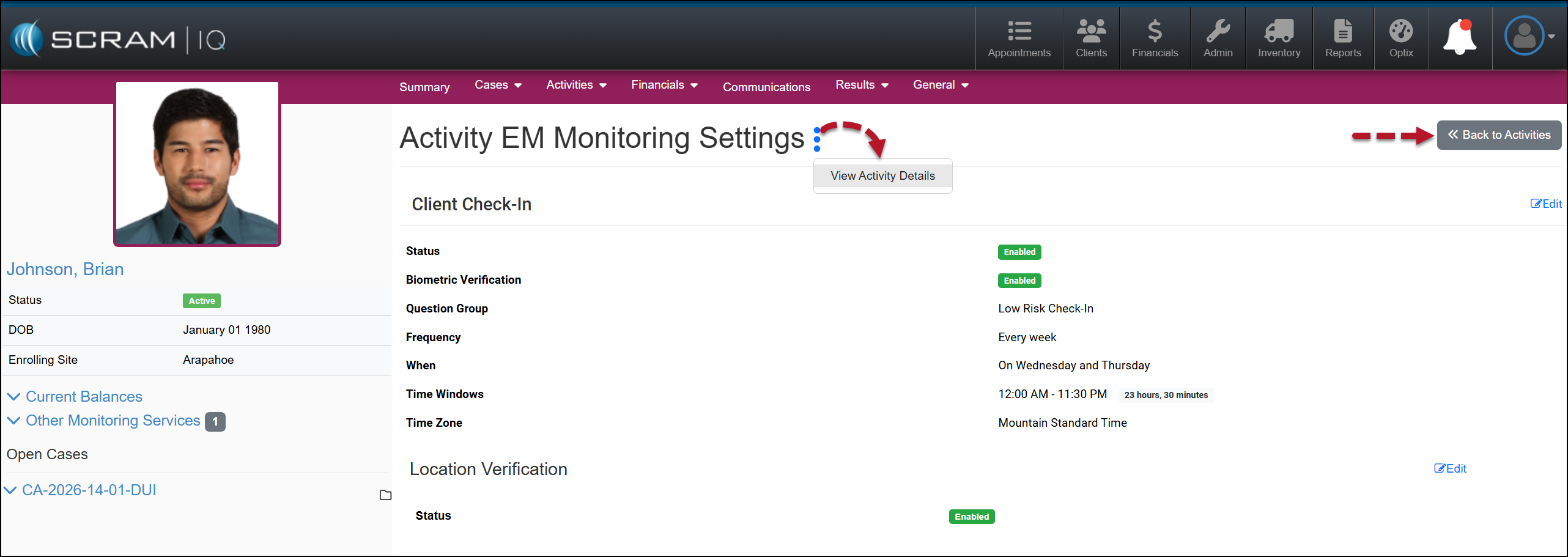
Once an EM Activity is active for a client, you may view their EM Monitoring Settings by selecting the ellipsis next to the Activity on the Active Activities page or the Activity Details page and then the View Activity EM Monitoring Settings option.
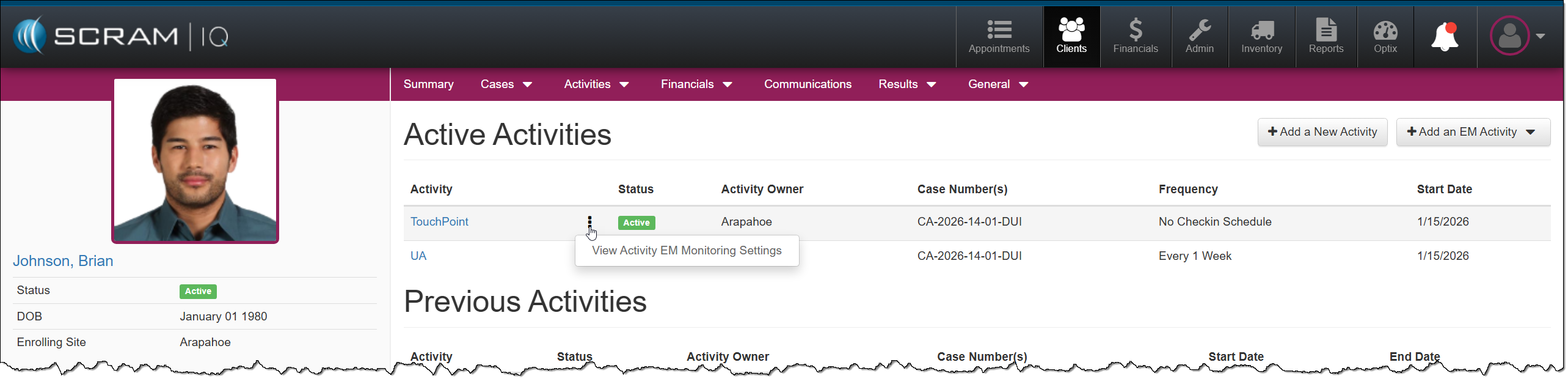
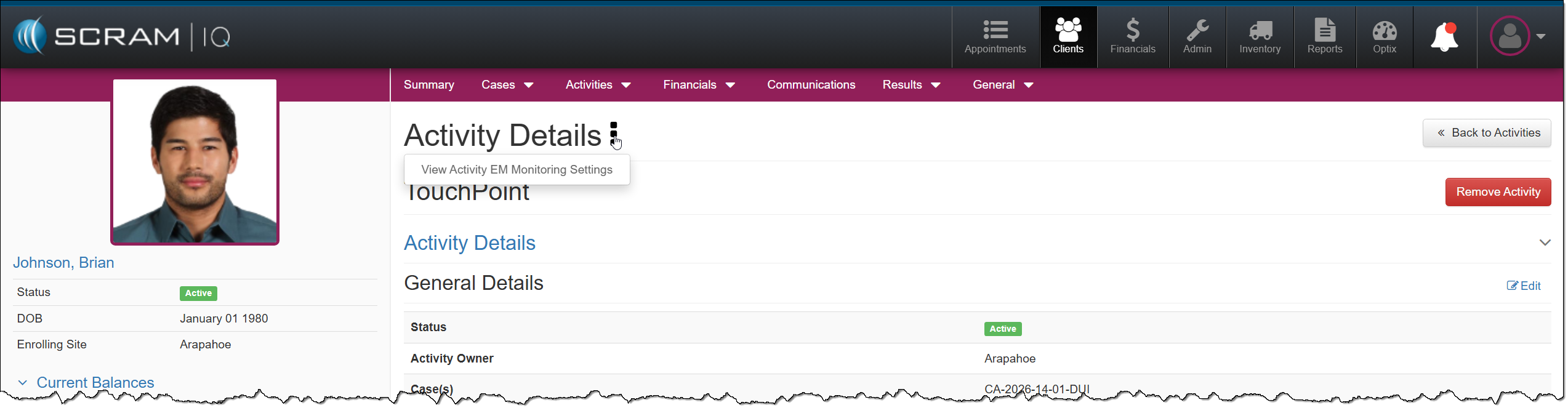
On the Activity EM Monitoring Settings page, you can view the current settings or select the Edit hyperlink to modify them.
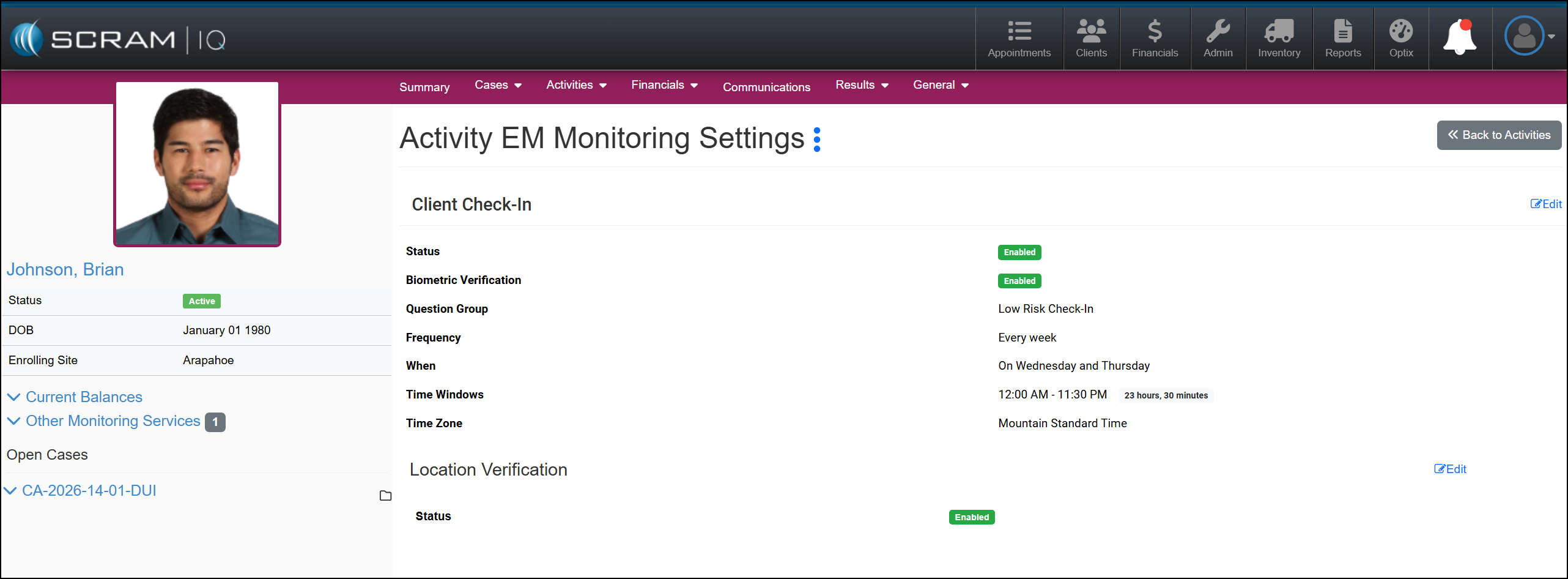
Select the ellipsis, and then the View Activity Details option to navigate back to the selected Activity Details page, or use the Back to Activities button to navigate back to the Active Activities page.
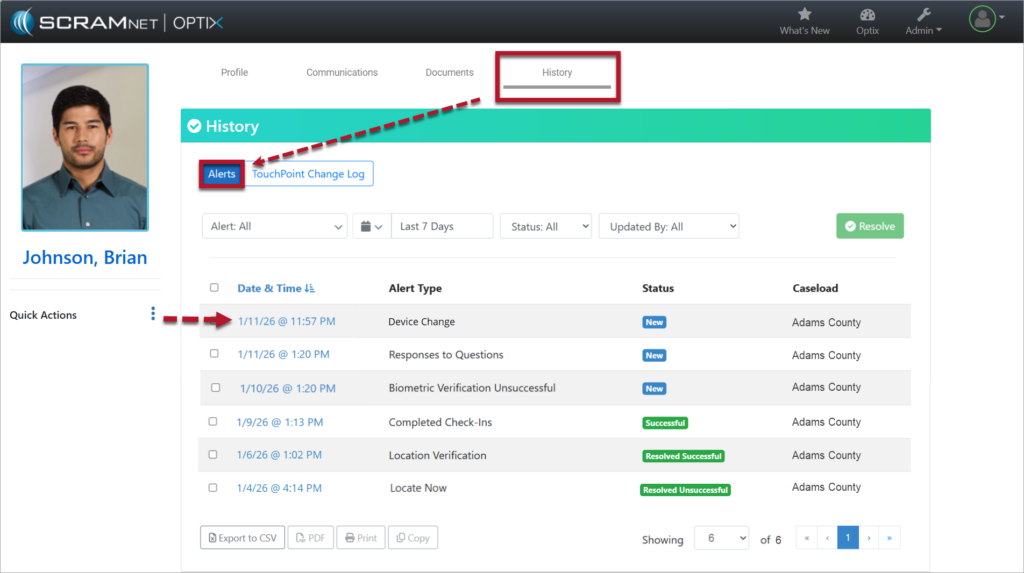
On January 28, 2026, SCRAM Systems will release an enhancement for your SCRAM TouchPoint caseload. This enhancement updates how alerts are displayed and managed in Optix. Alerts now appear individually in a list on the client’s History tab, providing clearer visibility into client activity. Agents may open alerts to view details, add notes, update statuses, resolve alerts individually or in bulk, and export alert records as needed.
TouchPoint Alert Types
TouchPoint Alerts include the following alert types:
- Pending Photo Review
- Biometric Verification Unsuccessful
- Missed Check-In
- Responses to Questions
- No GPS Location
- Location Services Disabled
- Push Notifications Disabled
- Device Change
- Locate Now
- Location Verification
- Location Failure
- Completed Check-Ins
Alert History Page
All TouchPoint Alerts are displayed in a list on the client’s History tab. Each alert on the History tab includes the following information:
- Date & Time
- Alert Type
- Status
- Caseload
Selecting the Date & Time hyperlink opens the Alert Details page for the selected alert.
Alert Details Page
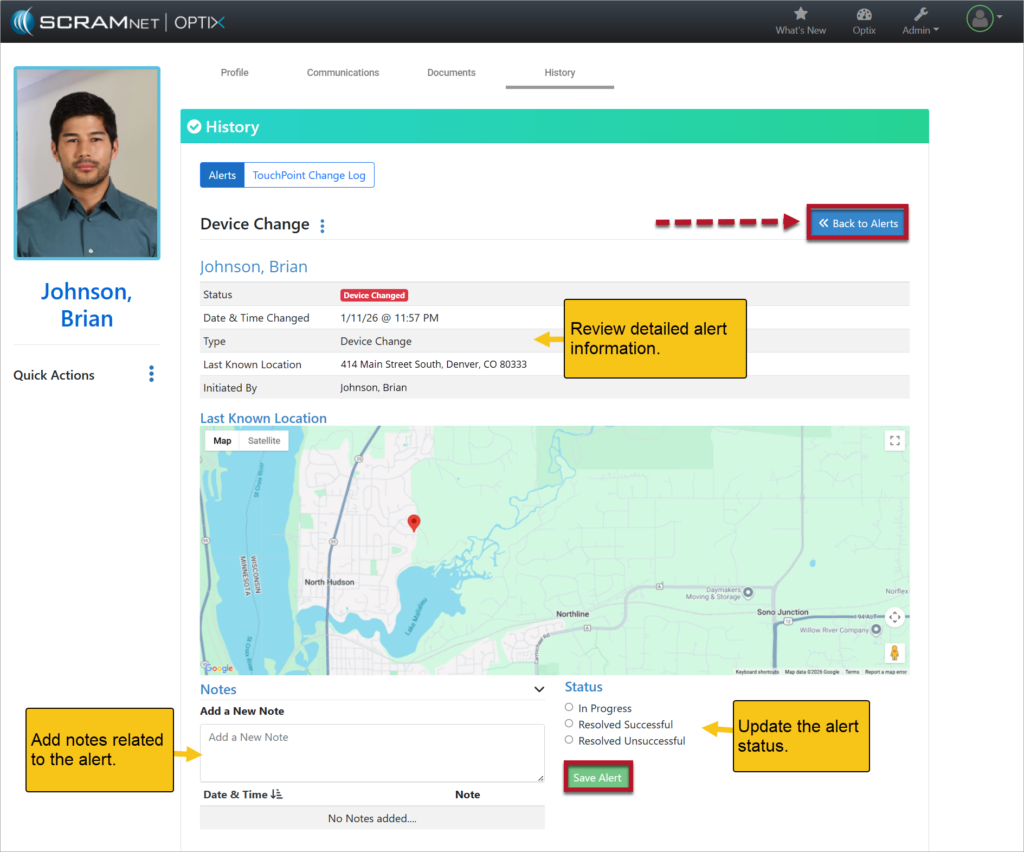
The Alert Details page provides additional information about the selected alert and allows agents to take action.
From this page, agents may:
- Review detailed alert information
- Add notes related to the alert
- Update the alert status
Available alert statuses include:
- In Progress
- Resolved Successful
- Resolved Unsuccessful – Use this status to quickly clear alerts from the Dashboard when no specific action is required
After updating the alert, select Save Alert followed by the <<Back to Alerts button to return to the full list on the History tab.
Bulk Resolution of Alerts
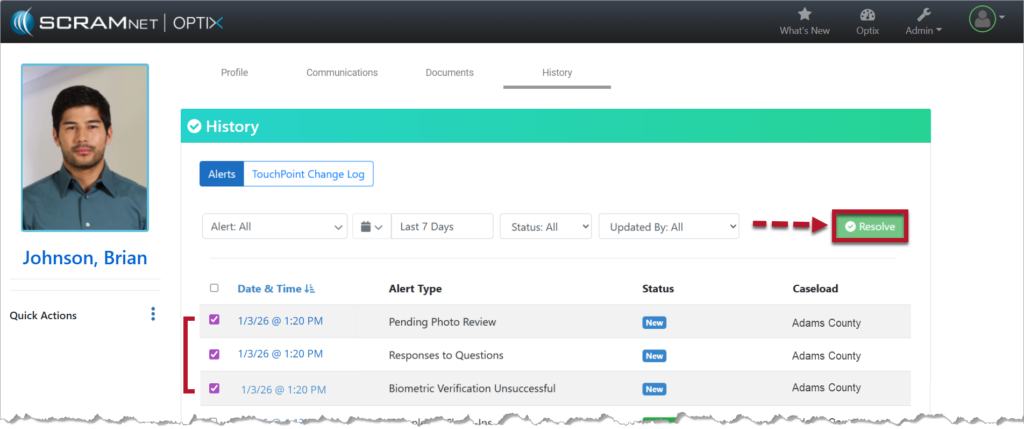
New bulk actions allow agents to resolve multiple alerts at once directly from the History page.
To bulk resolve alerts:
- Select the checkbox next to one or more of the alerts in the list.
- Select the green Resolve button.
- Select the Action from the Resolve Alerts pop-up window: Mark as Resolved Successful or Mark as Resolved Unsuccessful.
- Choose Confirm to complete the action.
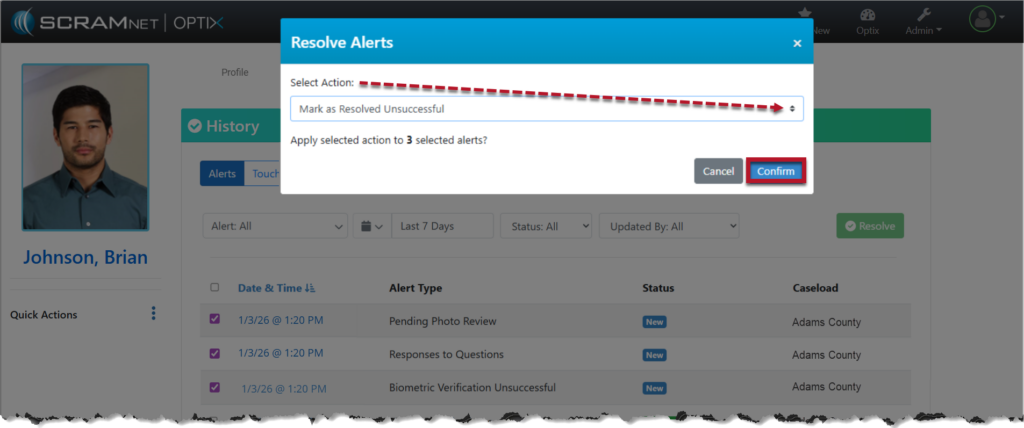
After the alerts are resolved as part of a bulk action, returning to an individual Alert Details page will display the message “Resolved via bulk status update” at the bottom of the alert information.
Multiple Alerts per Check-In
With the updated TouchPoint Alerts experience, a single check-in may generate multiple alerts if more than one issue occurs during that check-in. Each issue displays as its own alert on the History list.
For example, on the same date and time, a single check-in could generate multiple alerts, including:
- Pending Photo Review
- Responses to Questions
- Biometric Verification Unsuccessful
Although these alerts display individually, they are all tied to the same check-in. To fully resolve the check-in, agents must open the relevant alert(s) and complete all required actions on the Alert Details page. Once all required actions for that check-in are completed, the related alerts will resolve together. This provides clear visibility into each issue while maintaining efficient alert resolution.
Export, Print, and Copy Options
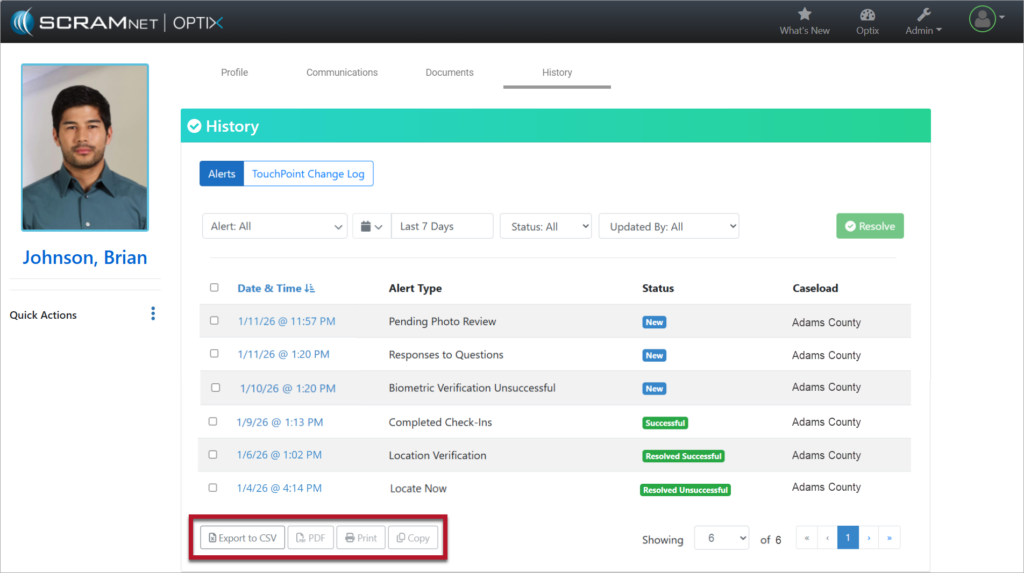
New options are available at the bottom of the client’s History tab to support reporting and recordkeeping.
The following actions are available:
- Export to CSV – By default, all alerts are exported into a CSV file that may be opened in Excel.
- PDF – Select the checkbox next to one or more alerts to export the selected records to a PDF.
- Print – Select the checkbox next to one or more alerts to print the selected records.
- Copy – Copy selected alerts and paste them into other applications such as Excel, Notepad, or Word.
Based on SCRAM GPS customer feedback, SCRAM Systems is introducing two new No Motion-related features in SCRAMNET GPS:
- New ‘No Motion Cleared’ Alert for SCRAM GPS 9 Plus Devices
- Ability to Include or Exclude No Motion Alerts from Alert Suspensions
|
SCRAMNET GPS deployments typically occur on Thursdays at 7:00 AM EST in the US, 10:00 PM AEST in Australia, and the following 12:00 AM EST (Friday) in Canada. Please refer to the official SCRAM Systems email communication associated with this release for more details. During the 15-minute deployment, you may not be able to access SCRAMNET GPS, but messages from the SCRAM GPS device will continue to be processed uninterrupted. |
New ‘No Motion Cleared’ Alert for SCRAM GPS 9 Plus Devices
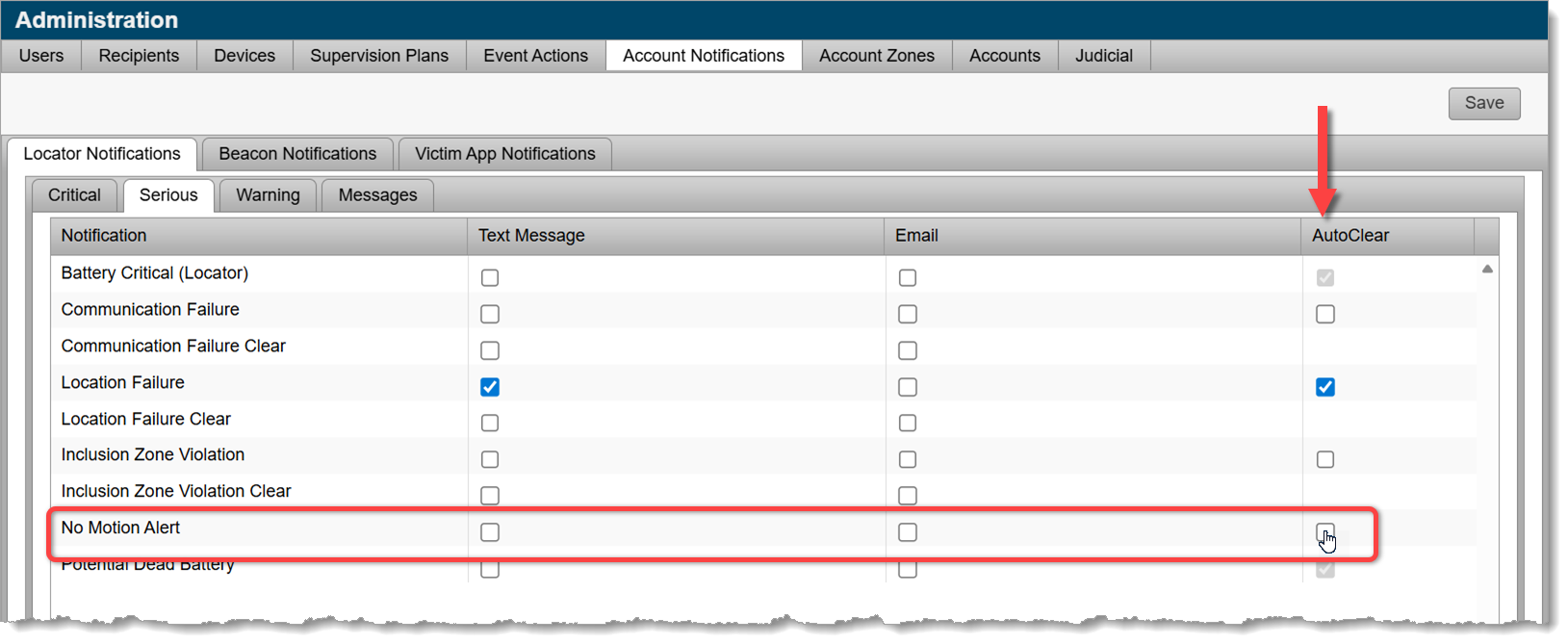
Based on customer feedback, we have added the ability to indicate when a No Motion alert on a SCRAM GPS 9 Plus device has auto-cleared. This displays a blue icon on the Dashboard and allows users to document how the alert was handled.

Administrators can enable this feature by selecting the No Motion Alert “AutoClear” checkbox in Account Notifications.
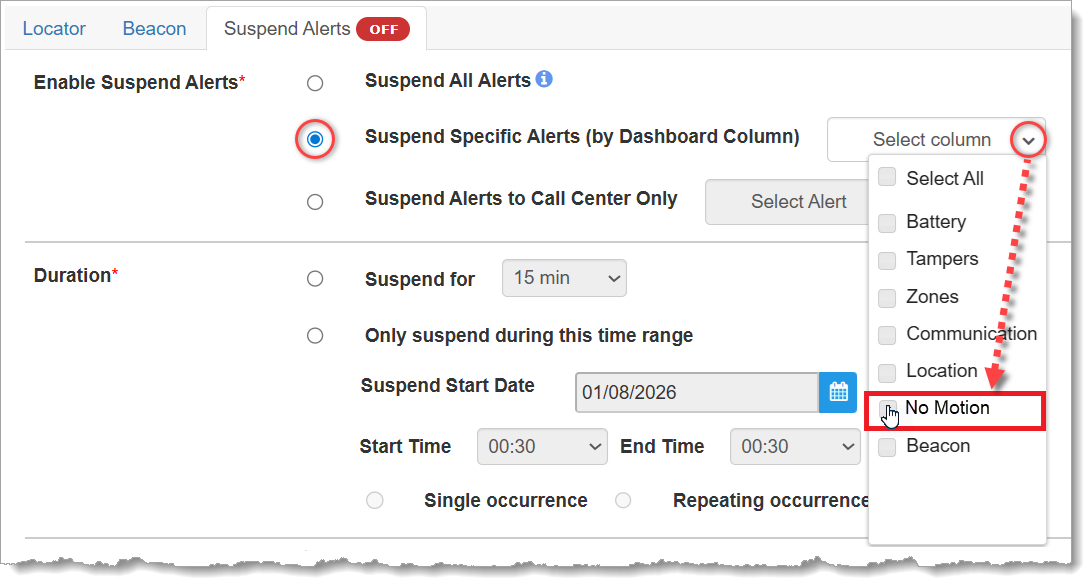
New No Motion Alert Suspension Feature
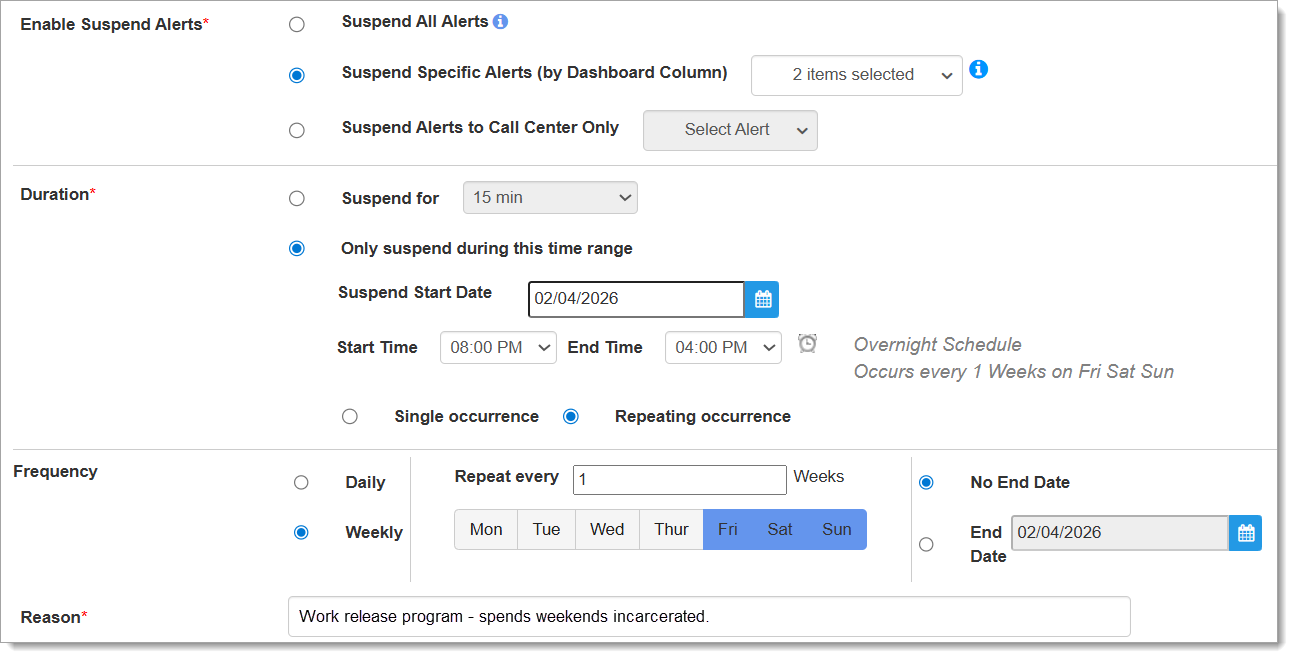
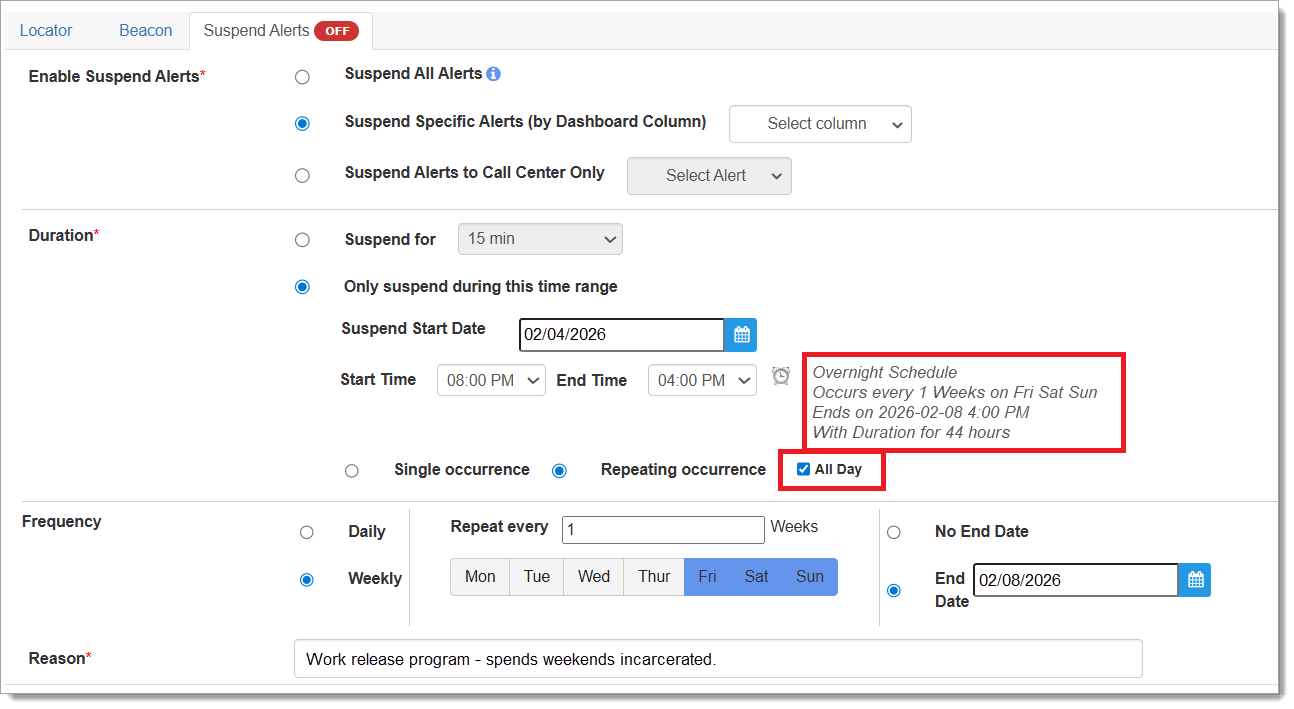
Under the suspend alerts section, SCRAMNET GPS users are now able to include or exclude No Motion alerts from the alert suspension process.