archives

On March 12, 2026, SCRAM Systems will release an enhancement to your TouchPoint Monitoring program. For clients who are enabled for the SCRAM TouchPoint Location Tracking service, their smartphone’s location data will be captured and stored during periods without network or internet connectivity. Once service is restored, the stored data will be transmitted to the system.

Information Your account must be enabled for location tracking for these instructions to work. Contact your SCRAM Systems Account Representative if you are interested in activating this service.

How It Works

For this example, the client’s Location Tracking service is configured to collect location data every 5 minutes.

From the Client Profile page, select Location Tracking Map from the Quick Actions dropdown ellipsis menu.
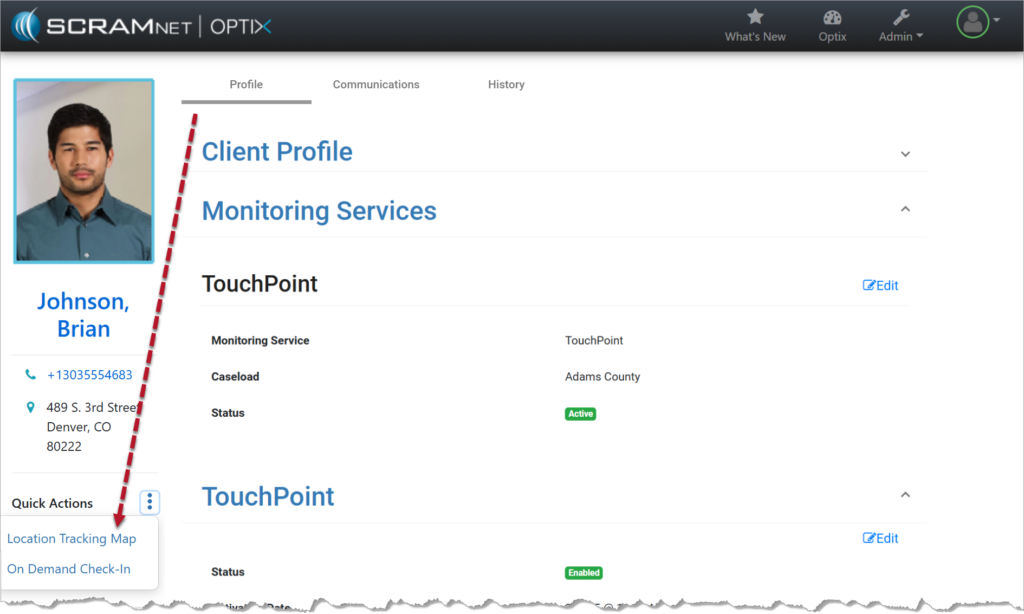
Client Profile Page

On the Location Tracking pop-up window:

When connectivity is available:

  • The location points are plotted on the map.
  • Each point is recorded as Successful.
  • The Location Tracking pop-up window reflects normal communication.
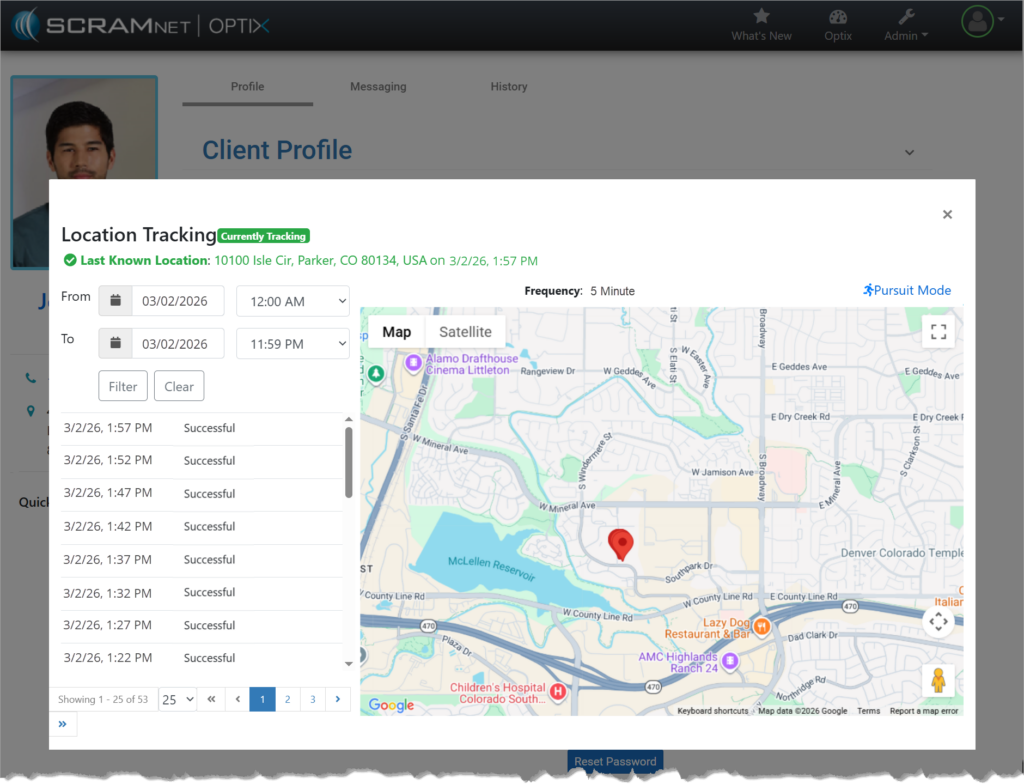
Successful Location Points

When connection is not available:

  • The location table will not indicate the last known location in bold.
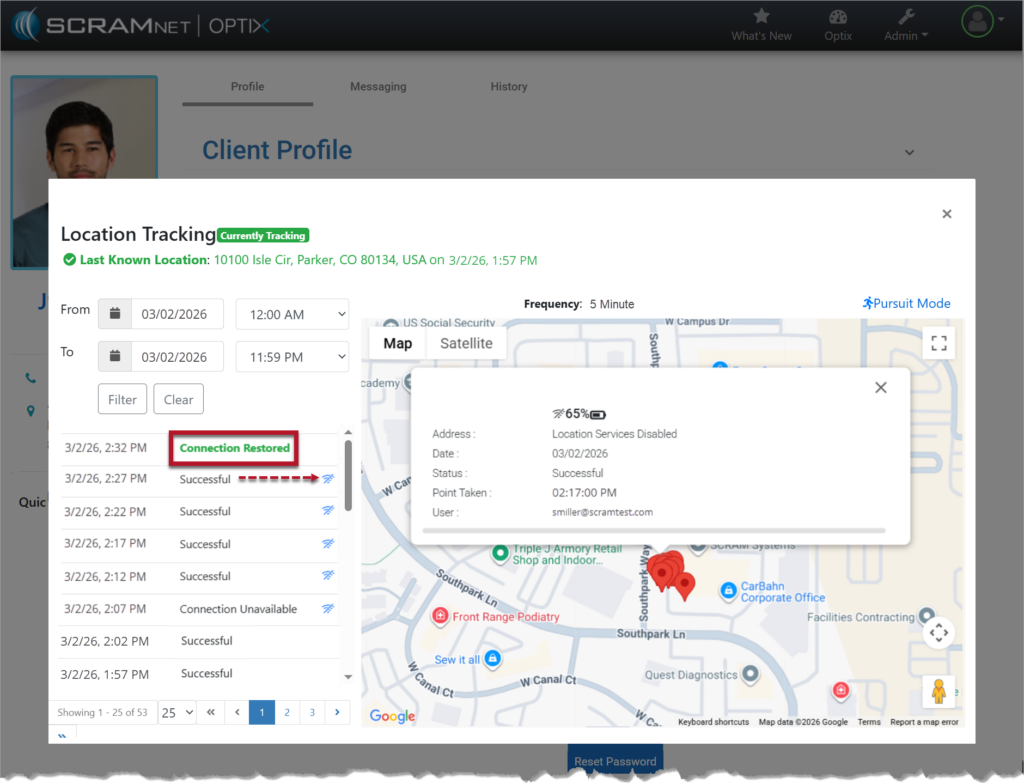
  • At the next location interval, in this case the 5-minute interval, the location table will display Connection Unavailable in red.
  • Additionally, a red Location Failure heading is displayed at the top of the pop-up window, displaying the last communication date and time.
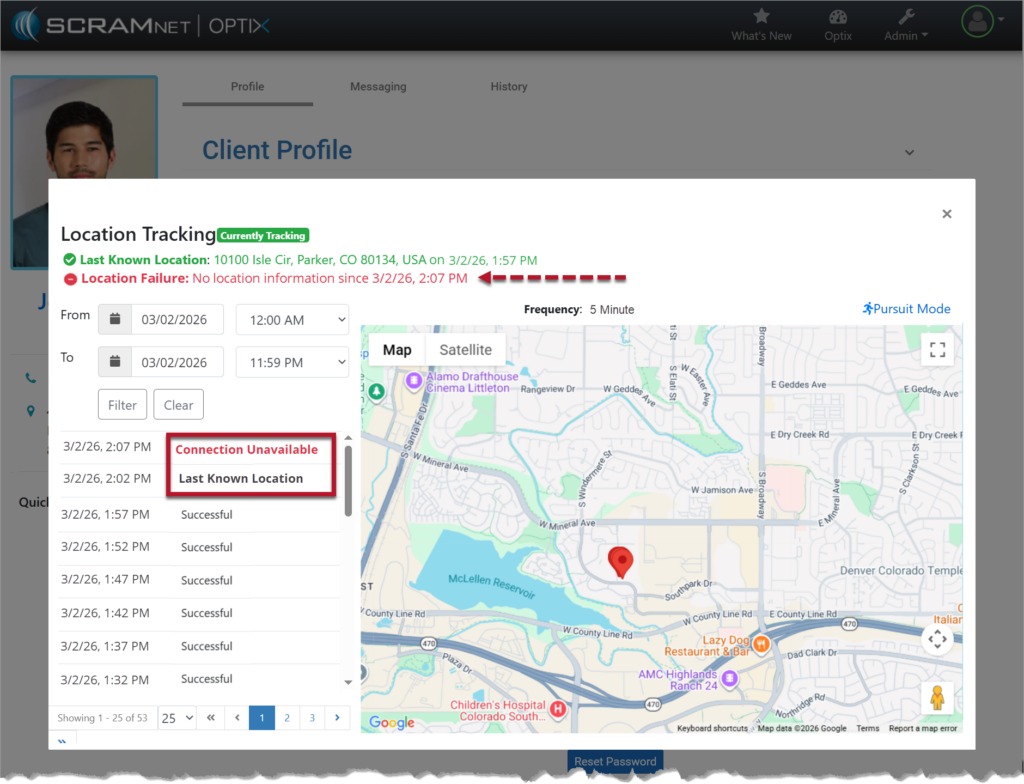
Connection Unavailable

Once the connection is reestablished:

  • The location data will automatically update on the map and on the location table.
  • The “Connection Unavailable” message will no longer display in bold or in red.
  • A “Connection Restored” message will appear bolded and in green on the location table with the date and time stamp of when communication was restored.
Information Status Updates: Location Tracking updates are tied to the frequency configured for the client. For example, location information is gathered and communicated every 5, 10, 15, 30, and 60 minutes. Any change in connectivity and location status will only display at the sent interval.
Connection Restored

Loss of Connectivity During Pursuit Mode

During the 15-minute Pursuit Mode window, if connectivity is lost the location table will display “Connection Unavailable,” and the red failure banner will display in the Location Tracking pop-up window.

If the device reconnects during the 15-minute Pursuit Mode session, location collection will resume automatically and continue at one-minute intervals for the remainder of the session.
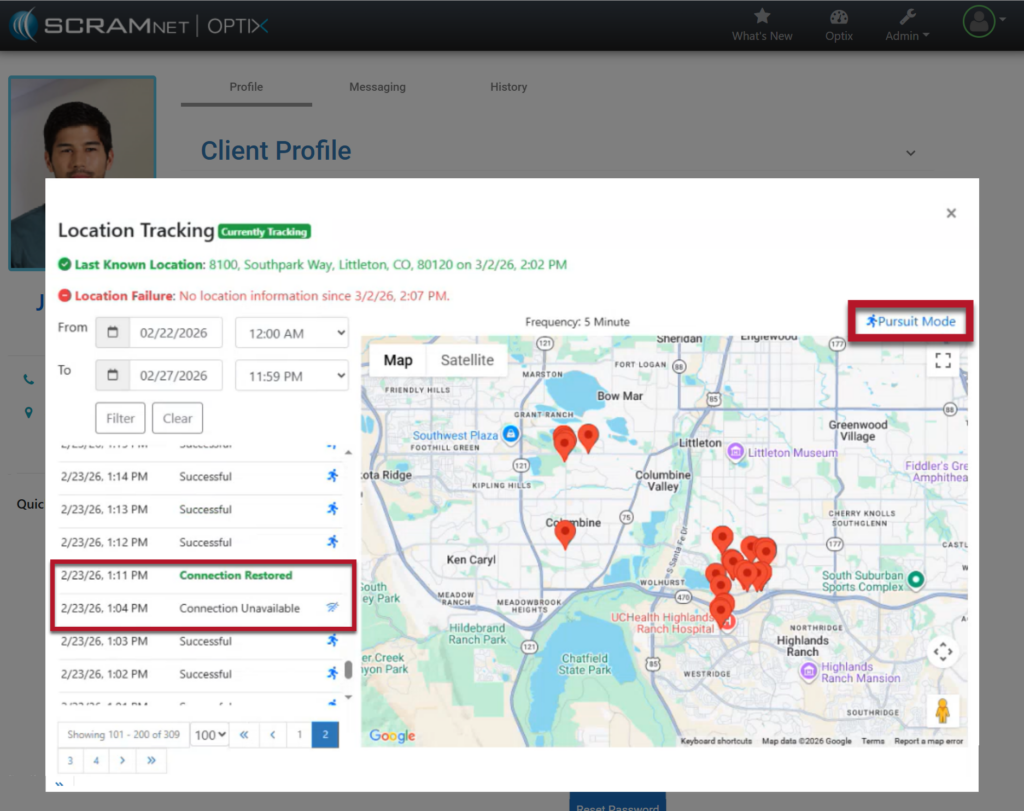
Pursuit Mode

Continue Reading

On February 4, 2026, SCRAM Systems will release an update that allows providers to control whether the GPS battery level is visible to clients in the TouchPoint Mobile app. This setting can be managed in SCRAM Optix or 24×7.

Enable the Display GPS Battery Level Setting in Optix

  1. In Optix, navigate to TouchPoint.
Optix Dashboard
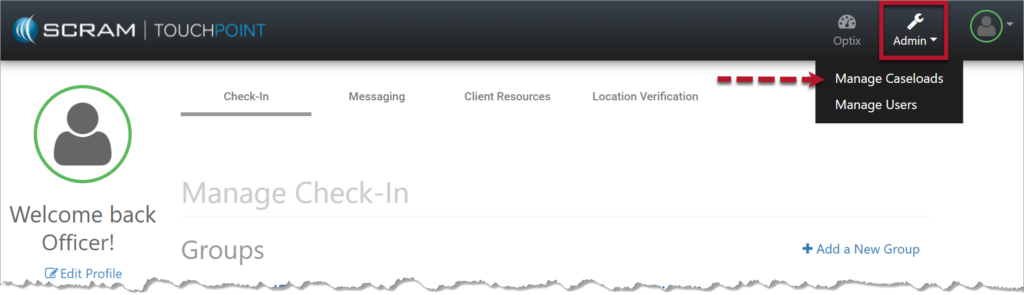
  1. Select the Admin tab from the top toolbar and then the Manage Caseloads option.
Manage Check-In Page
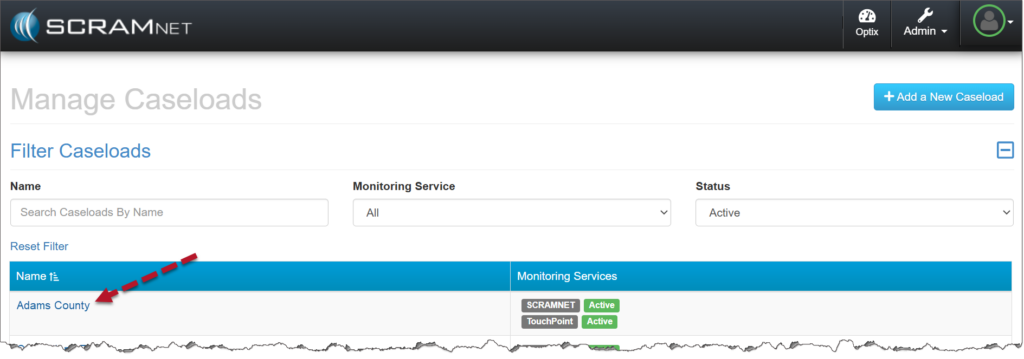
  1. Select the caseload.
Manage Caseloads Page
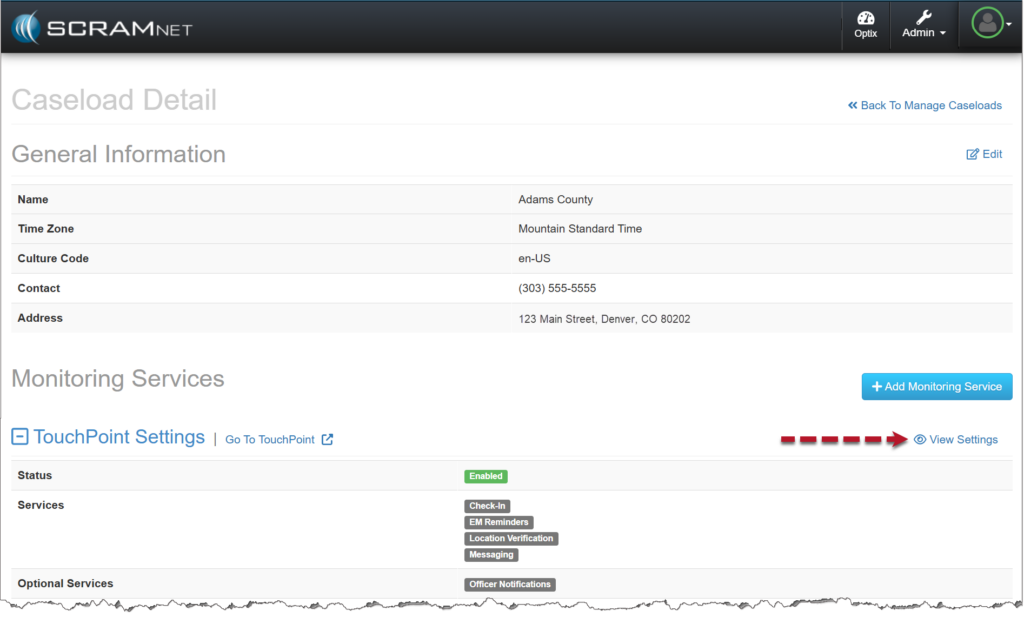
  1. From the Caseload Detail page, select the View Settings hyperlink.
Caseload Detail Page
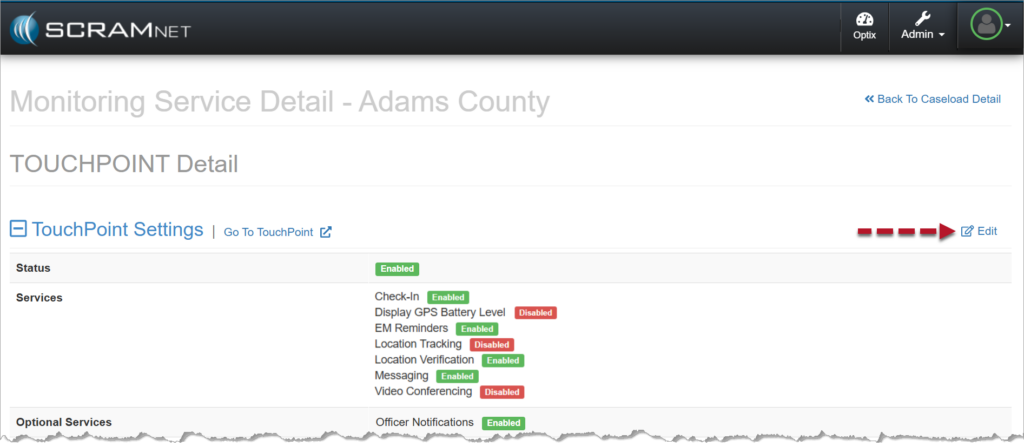
  1. Select the Edit hyperlink.
Monitoring Service Detail Page for the Caseload
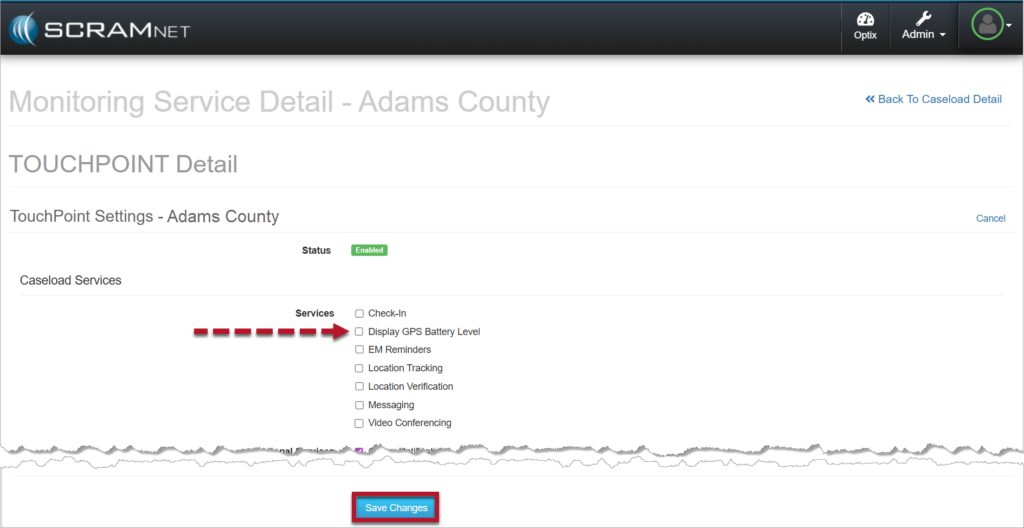
  1. Select the checkbox next to Display GPS Battery Level.
  2. Save your changes.
TouchPoint Settings for the Caseload

Once saved:

  • The setting will appear as Enabled under TouchPoint Settings on the TouchPoint Detail page for the caseload.
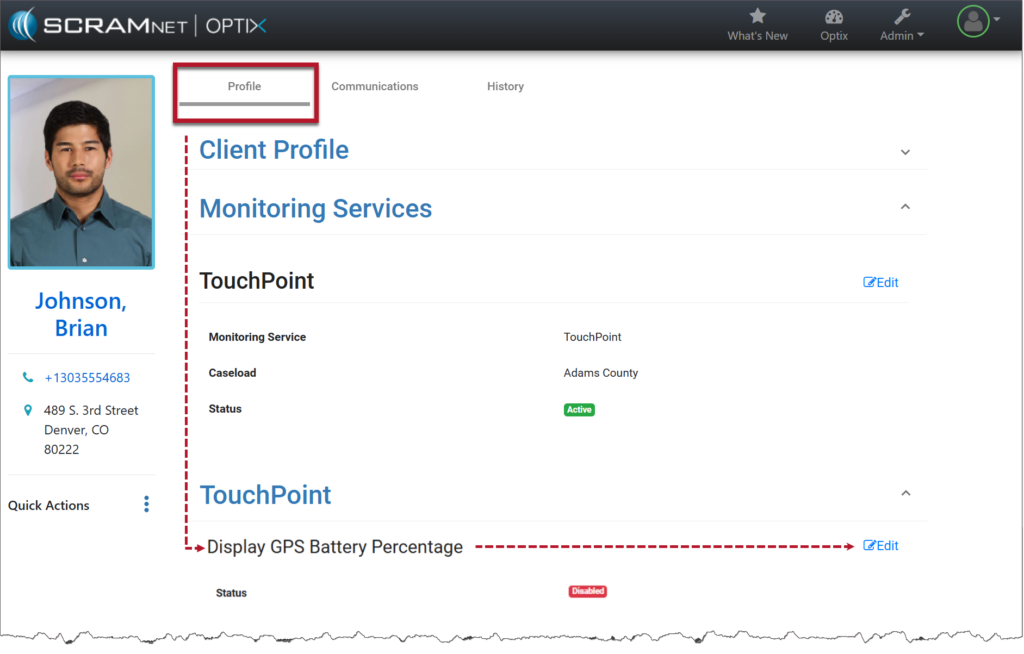
  • The Display GPS Battery Percentage option will be visible on the client’s Profile page in Optix.
  1. Enable the Display GPS Battery Percentage service for the client:
  • Select the Edit hyperlink on the client’s Profile page.
Client Profile Page
  • Change the Status from Disabled to Enabled.
  • Save your changes.
Enable the Service

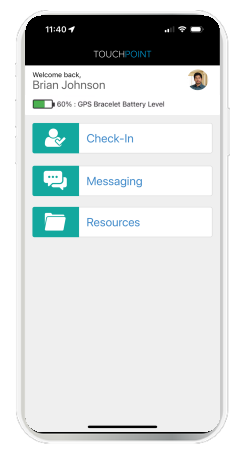
The client’s last reported SCRAM GPS bracelet’s battery level is displayed at the top of the home screen within the TouchPoint mobile application.
TouchPoint GPS Battery Level Display
NotesImportant Notes:
  • The Display GPS Battery Level option is only editable after a GPS device has been assigned to the client.
  • If the service is enabled for the caseload, the option will be visible, but it cannot be edited until a GPS device is assigned.

Disable the Display GPS Battery Level Setting Once Enabled in Optix

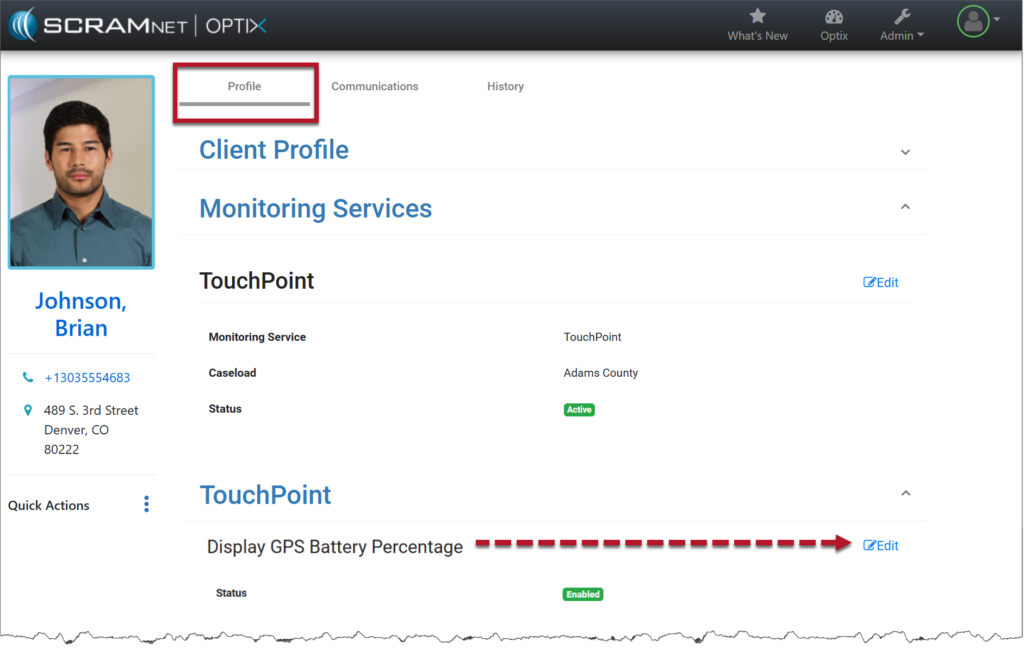
  1. From the client’s Profile page, select the Edit hyperlink next to Display GPS Battery Percentage.
Client Profile Page
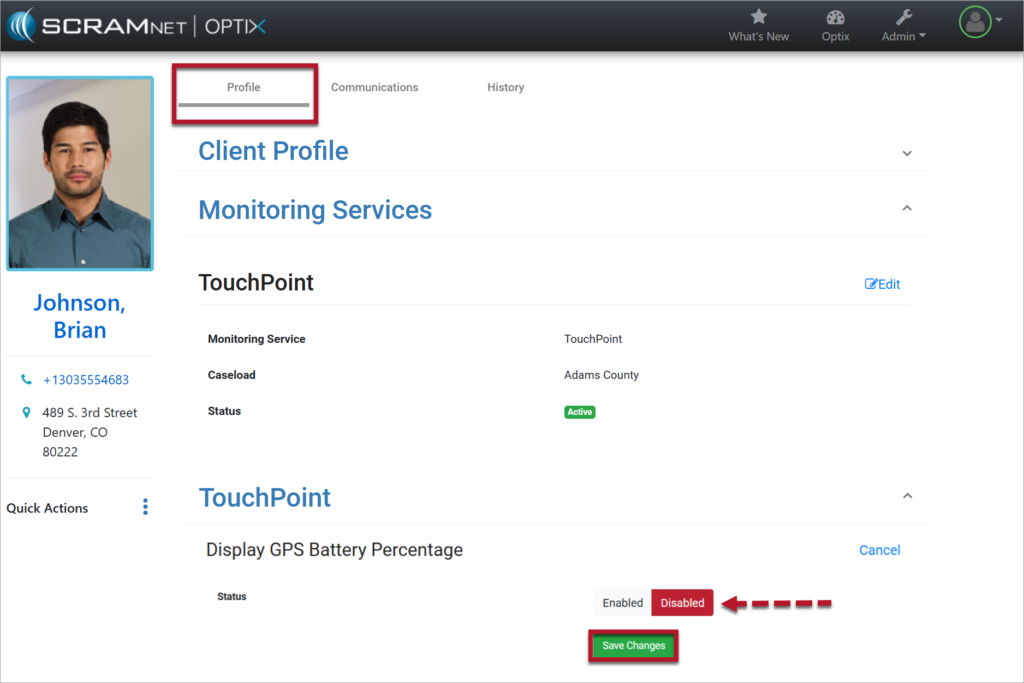
  1. Toggle the status to Disabled and select the Save Changes button.
Disable the Setting
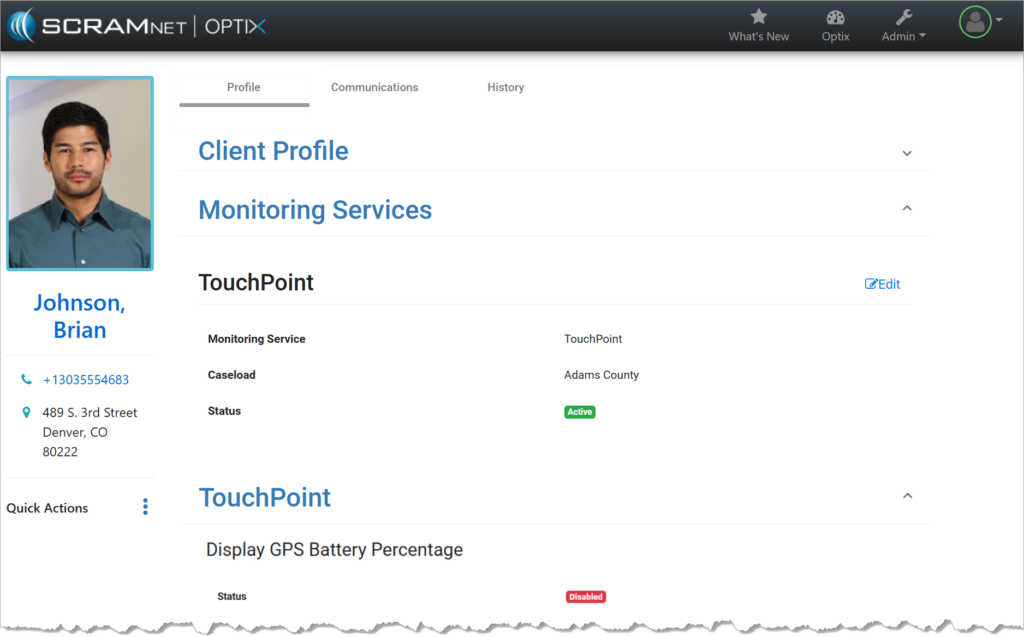
  • The Display GPS Battery Percentage setting has been disabled for the client.
Disabled Status
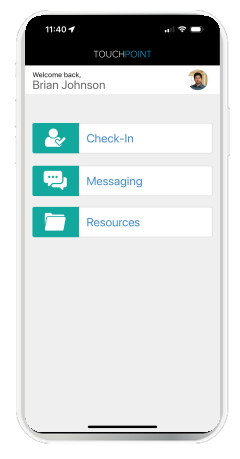
  • The SCRAM GPS bracelet’s battery level is no longer displayed at the top of the home screen within the TouchPoint Mobile application.
GPS Battery Level Not Displayed

Enable the Display GPS Battery Level Setting for a SCRAM 24×7 Client

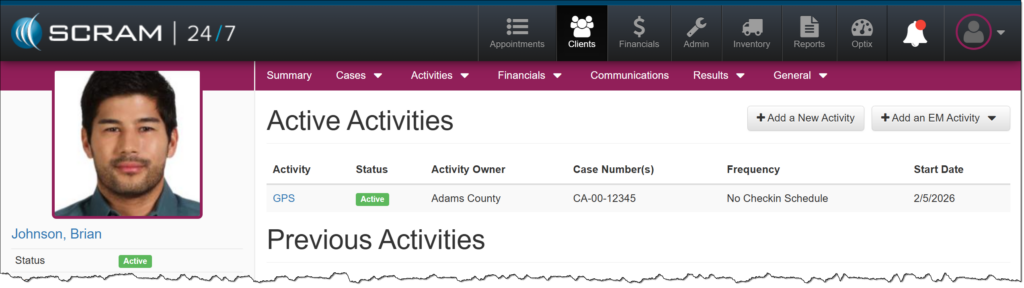
After adding a GPS Activity to a client, you may also add a TouchPoint Activity and enable the GPS Battery Level feature from within SCRAM 24/7.

SCRAM 24×7 GPS Activity

On the client’s Activities page:

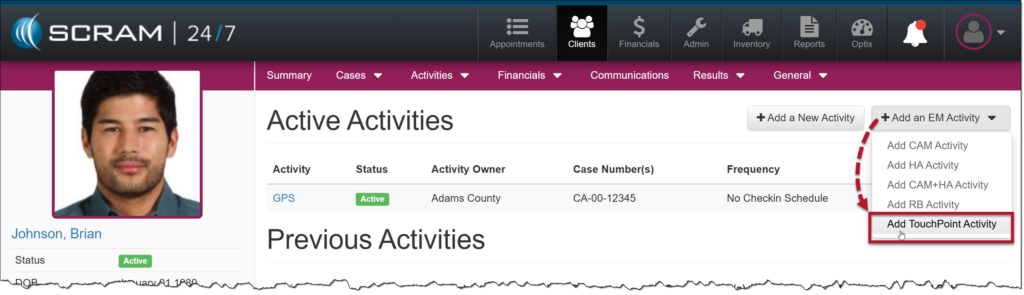
  1. Open the +Add an EM Activity dropdown menu, and then select the Add TouchPoint Activity option.
Add TouchPoint Activity Option
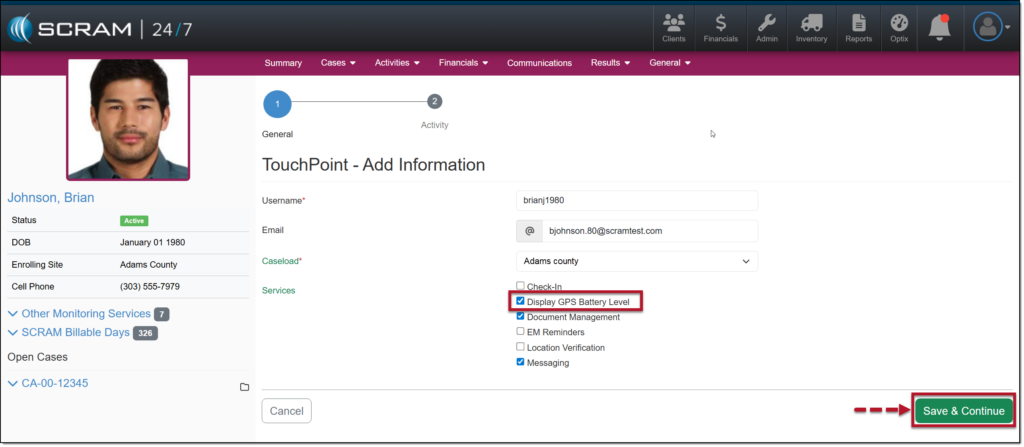
  1. On the TouchPoint – Add Information page, enter the TouchPoint details. This includes the client’s username for the mobile application, email address, and TouchPoint Caseload.
  2. Select the checkbox next to each TouchPoint service the client will be utilizing. To display the client’s GPS battery voltage in the mobile application, select the checkbox next to the Display GPS Battery Level option.
  3. Once you have made your selections, select the Save & Continue button.
TouchPoint Activity Details
Information When adding a TouchPoint Activity, the services and features available to select on dependent on the TouchPoint Caseload selected.
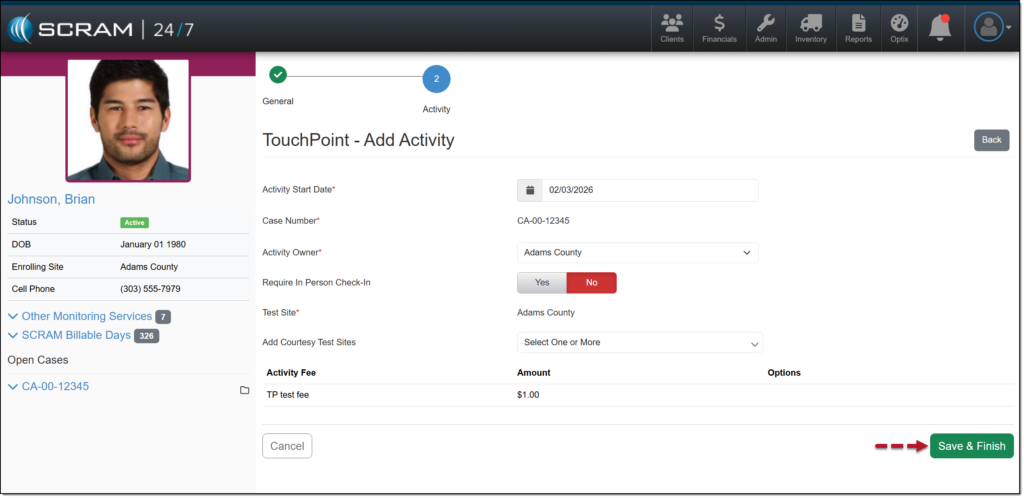
  1. Add the Activity Start Date and any additional monitoring requirements, and then select the Save & Finish button.
TouchPoint Activity Final Details

The TouchPoint Activity is now displayed on the client’s Activity page.

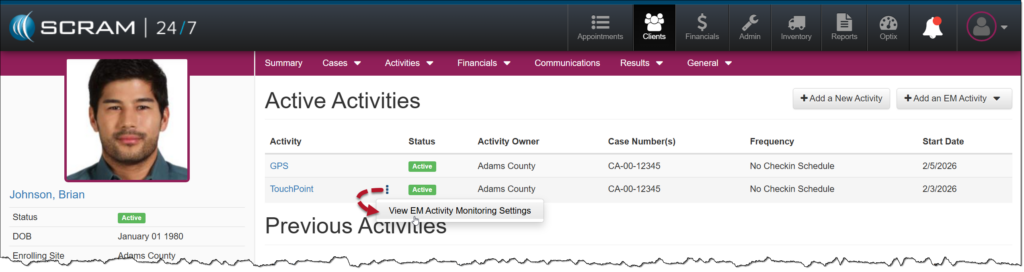
To view or edit the TouchPoint settings, select the ellipsis, and then the View EM Activity Monitoring Settings option.

View EM Activity Monitoring Settings

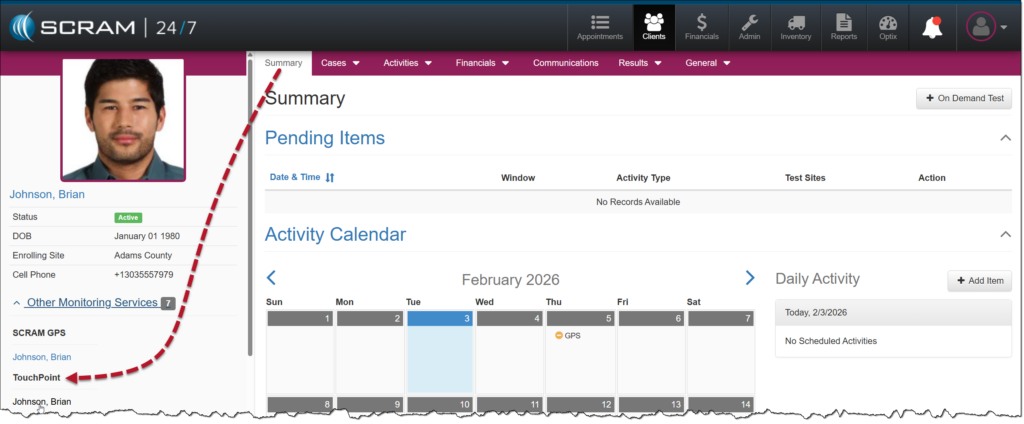
Or, you may navigate to the client’s TouchPoint Profile page in Optix by selecting their name hyperlink in the Other Monitoring Services section on the Summary page.

Other Monitoring Services – TouchPoint
Information The Display GPS Battery Level option is only editable after a GPS device has been assigned to the client.

Continue Reading

On January 28, 2026, SCRAM Systems will release an enhancement for your SCRAM TouchPoint caseload. This enhancement updates how alerts are displayed and managed in Optix. Alerts now appear individually in a list on the client’s History tab, providing clearer visibility into client activity. Agents may open alerts to view details, add notes, update statuses, resolve alerts individually or in bulk, and export alert records as needed.

TouchPoint Alert Types

TouchPoint Alerts include the following alert types:

  • Pending Photo Review
  • Biometric Verification Unsuccessful
  • Missed Check-In
  • Responses to Questions
  • No GPS Location
  • Location Services Disabled
  • Push Notifications Disabled
  • Device Change
  • Locate Now
  • Location Verification
  • Location Failure
  • Completed Check-Ins

Alert History Page

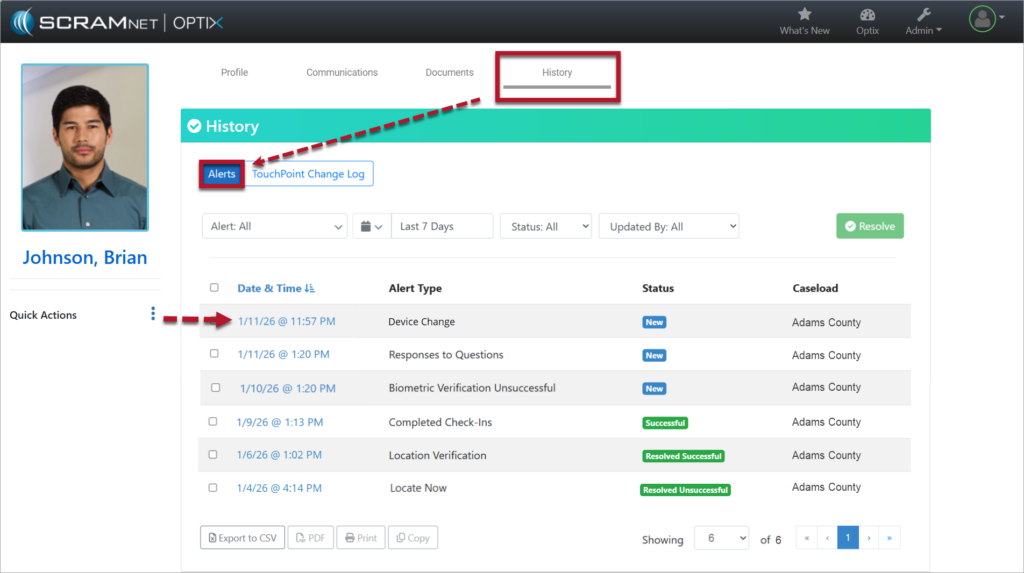
All TouchPoint Alerts are displayed in a list on the client’s History tab. Each alert on the History tab includes the following information:

  • Date & Time
  • Alert Type
  • Status
  • Caseload

Selecting the Date & Time hyperlink opens the Alert Details page for the selected alert.

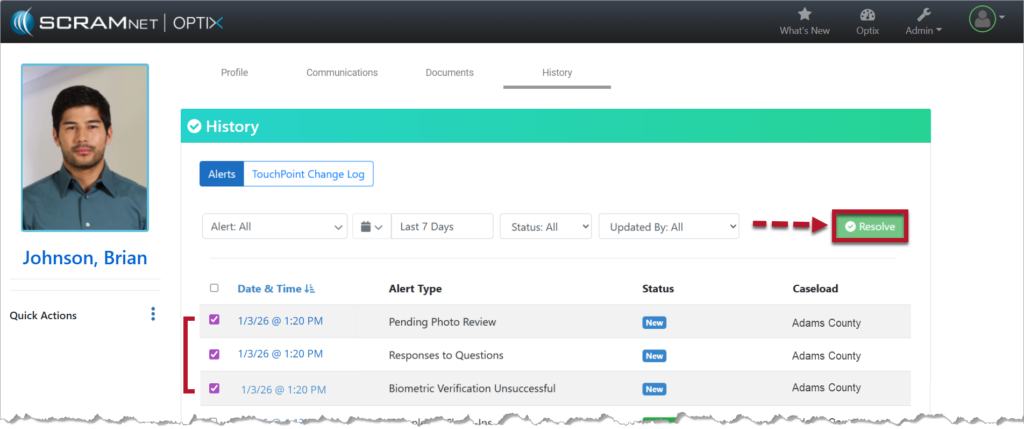
Alerts on the Client’s History Tab

Alert Details Page

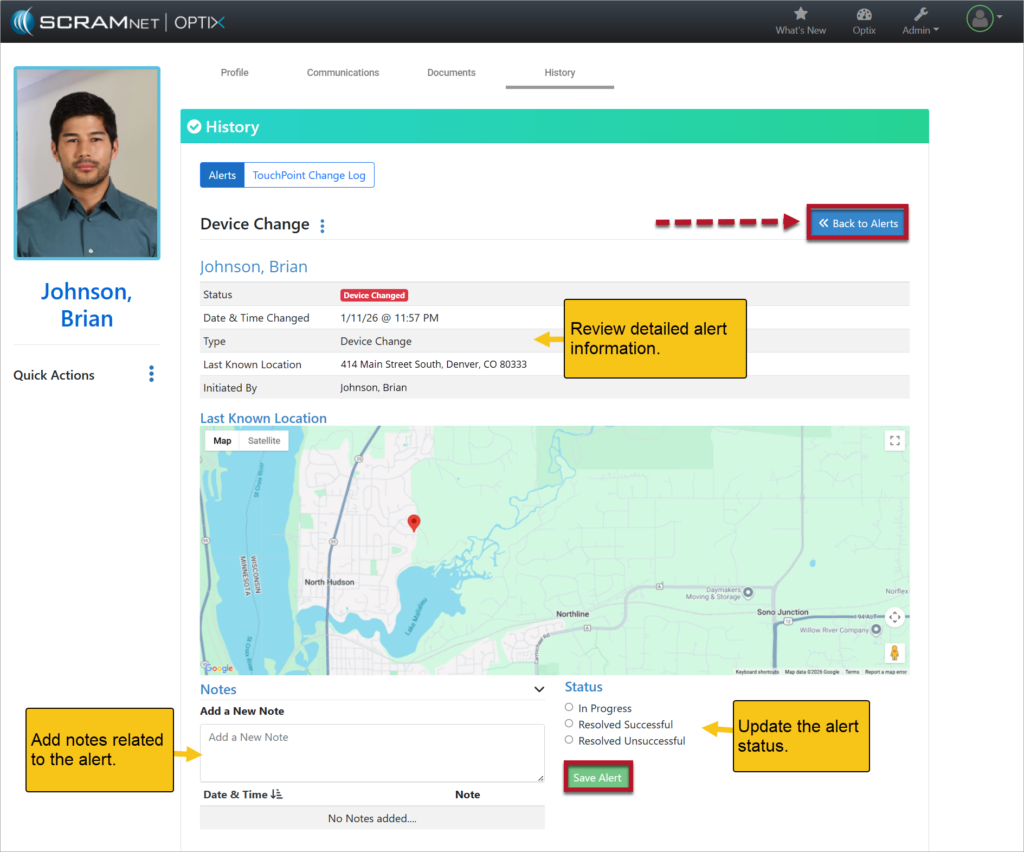
The Alert Details page provides additional information about the selected alert and allows agents to take action.

From this page, agents may:

  • Review detailed alert information
  • Add notes related to the alert
  • Update the alert status

Available alert statuses include:

  • In Progress
  • Resolved Successful
  • Resolved Unsuccessful – Use this status to quickly clear alerts from the Dashboard when no specific action is required

After updating the alert, select Save Alert followed by the <<Back to Alerts button to return to the full list on the History tab.

Alert Details Page

Bulk Resolution of Alerts

New bulk actions allow agents to resolve multiple alerts at once directly from the History page.

To bulk resolve alerts:

  • Select the checkbox next to one or more of the alerts in the list.
  • Select the green Resolve button.
Resolve Multiple Alerts
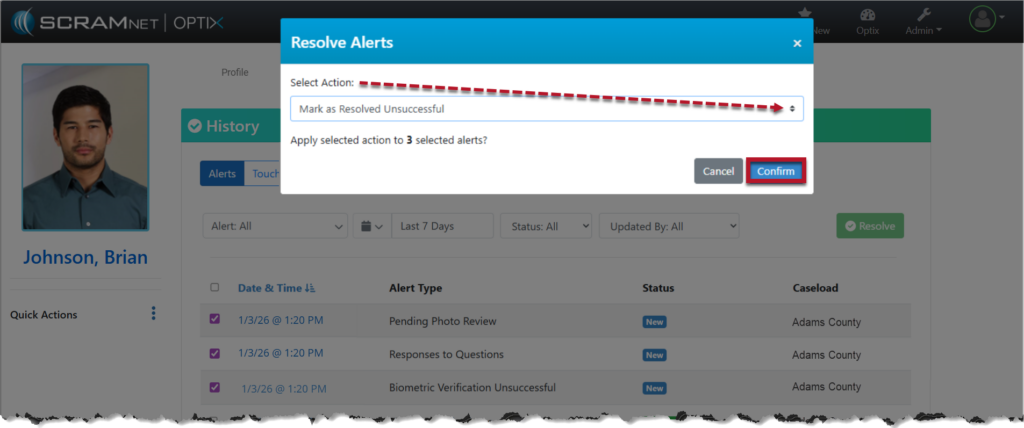
  • Select the Action from the Resolve Alerts pop-up window: Mark as Resolved Successful or Mark as Resolved Unsuccessful.
  • Choose Confirm to complete the action.
Resolve Alerts Pop-Up Window

After the alerts are resolved as part of a bulk action, returning to an individual Alert Details page will display the message “Resolved via bulk status update” at the bottom of the alert information.

Multiple Alerts per Check-In

With the updated TouchPoint Alerts experience, a single check-in may generate multiple alerts if more than one issue occurs during that check-in. Each issue displays as its own alert on the History list.

For example, on the same date and time, a single check-in could generate multiple alerts, including:

  • Pending Photo Review
  • Responses to Questions
  • Biometric Verification Unsuccessful

Although these alerts display individually, they are all tied to the same check-in. To fully resolve the check-in, agents must open the relevant alert(s) and complete all required actions on the Alert Details page. Once all required actions for that check-in are completed, the related alerts will resolve together. This provides clear visibility into each issue while maintaining efficient alert resolution.

Export, Print, and Copy Options

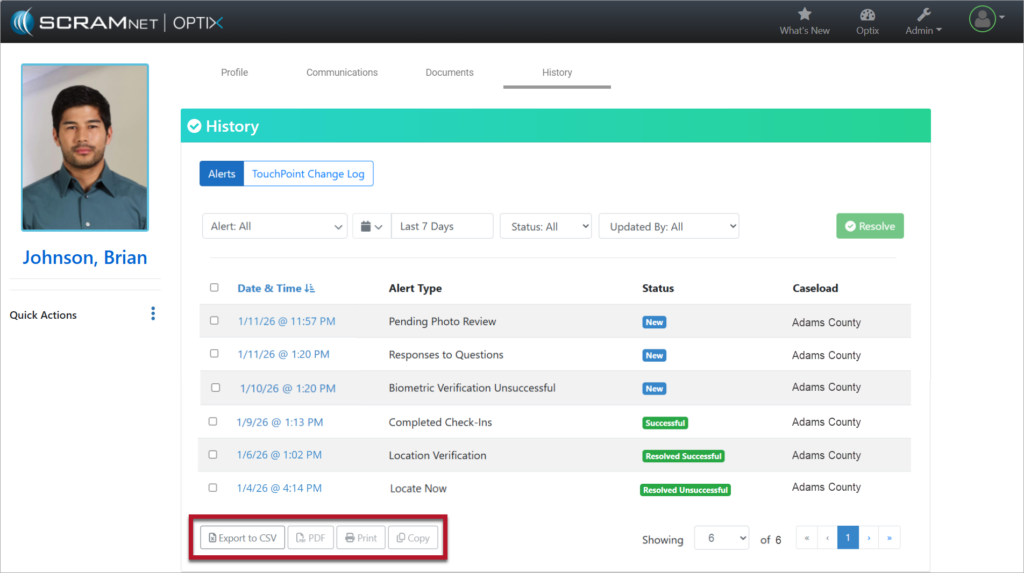
New options are available at the bottom of the client’s History tab to support reporting and recordkeeping.

The following actions are available:

  • Export to CSV – By default, all alerts are exported into a CSV file that may be opened in Excel.
  • PDF – Select the checkbox next to one or more alerts to export the selected records to a PDF.
  • Print – Select the checkbox next to one or more alerts to print the selected records.
  • Copy – Copy selected alerts and paste them into other applications such as Excel, Notepad, or Word.
Export, Print, and Copy Options

Continue Reading

Today, December 18th, 2025, SCRAM Systems released an enhancement for your SCRAM TouchPoint Monitoring program. With this update, clients enrolled in both SCRAM GPS monitoring and SCRAM TouchPoint may now view their GPS bracelet’s battery level within their TouchPoint mobile app.

TipsThe latest version of the TouchPoint app is available to clients in the app stores. As a best practice, SCRAM Systems recommends that all TouchPoint app users enable automatic app updates on their smartphones to make this process easier.

What’s New

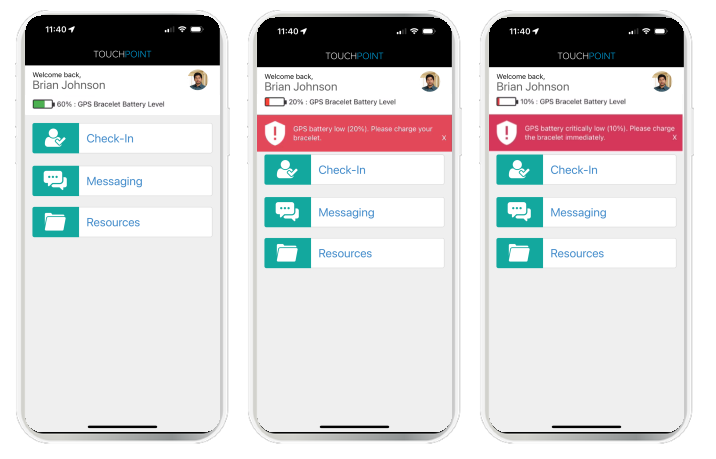
  • The client’s last reported SCRAM GPS bracelet’s battery level is displayed at the top of the home screen within the TouchPoint mobile application.
  • A red banner with charging instructions for the client will display on the Home screen within the app when the device requires charging. The banners will display when the device’s battery level is:
    • Below 20%, indicating a Battery Low alert.
    • Below 10%, indicating a Critically Low Battery alert.
TouchPoint GPS Battery Level Display

Important Reminder

The battery level shown in the client’s TouchPoint mobile app is for reference only. The client should not rely solely on the app’s display to manage charging. To remain compliant and avoid interruptions in monitoring, clients must continue to charge their GPS device regularly, following program instructions.

Information The battery level shown in the TouchPoint mobile app may not exactly match the battery level displayed on the GPS Dashboard in the agent view. In TouchPoint, battery levels are shown in 10% increments. For example, if the GPS Dashboard shows a battery level of 66%, the TouchPoint app will display 70%.

Continue Reading

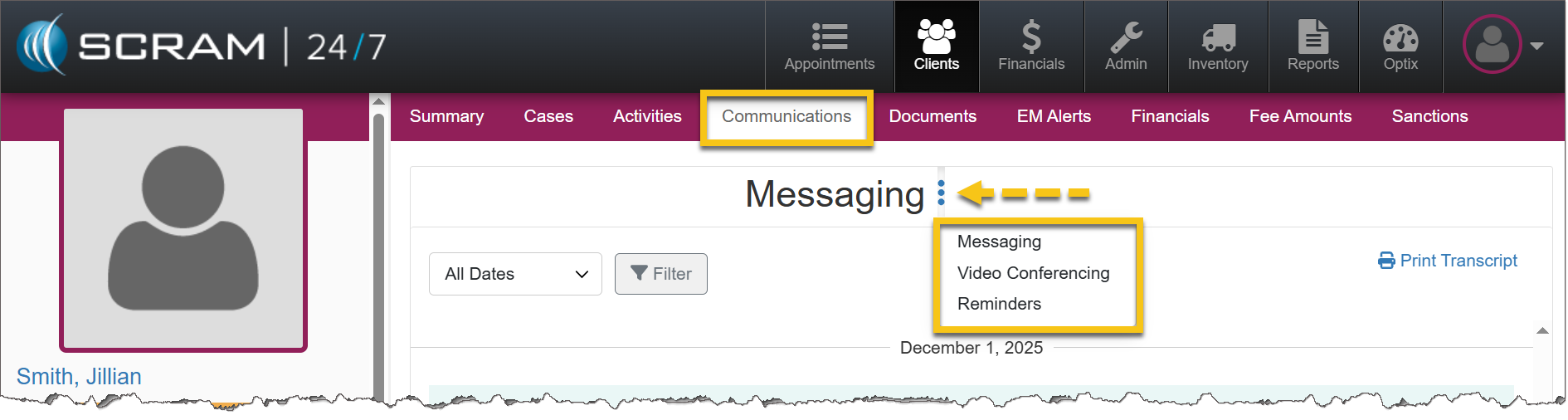
On December 11, 2025, SCRAM Systems will release an enhancement for your SCRAM 24/7 and TouchPoint Monitoring programs. With this update, 24/7 users may view the historical activity for the services connected to TouchPoint Activity communication. TouchPoint users will find Electronic Monitoring Reminders, Messaging, and Video Conferencing in one consolidated place under the Communications tab in Optix.

SCRAM 24/7 Communications Tab

In a previous update, SCRAM Systems enabled 24/7 users to complete all messaging functions within SCRAM 24/7 without navigating to Optix. With a recent update, users are able to view the historical activity associated with services connected to TouchPoint Activity communication.

  1. The Communications tab becomes available once the TouchPoint activity has been added. If TouchPoint has never been added, this tab will not appear.
  2. After the TouchPoint activity has been added – whether it remains active or has been disabled – the Communications tab will continue to display historical activity for Messaging, Video Conferencing, and Reminders.
  3. Service availablility determines whether users may interact with each option in the dropdown menu. For example, if Messaging is not enabled, users may view historical messages, but may not send new messages.
Information If Video Conferencing has not been enabled for the account, that option will not display.
Communications Tab in SCRAM 24/7 (click to enlarge)
Information Would you like to learn more about the benefits of the SCRAM TouchPoint Mobile application? Contact your Account Manager for details on getting started.

Optix Communications Tab

With this enhancement, users will find a consolidated view of communication and monitoring information under the Communications tab. This tab will contain:

  • Electronic Monitoring Reminders
  • Messaging
  • Video Conferencing

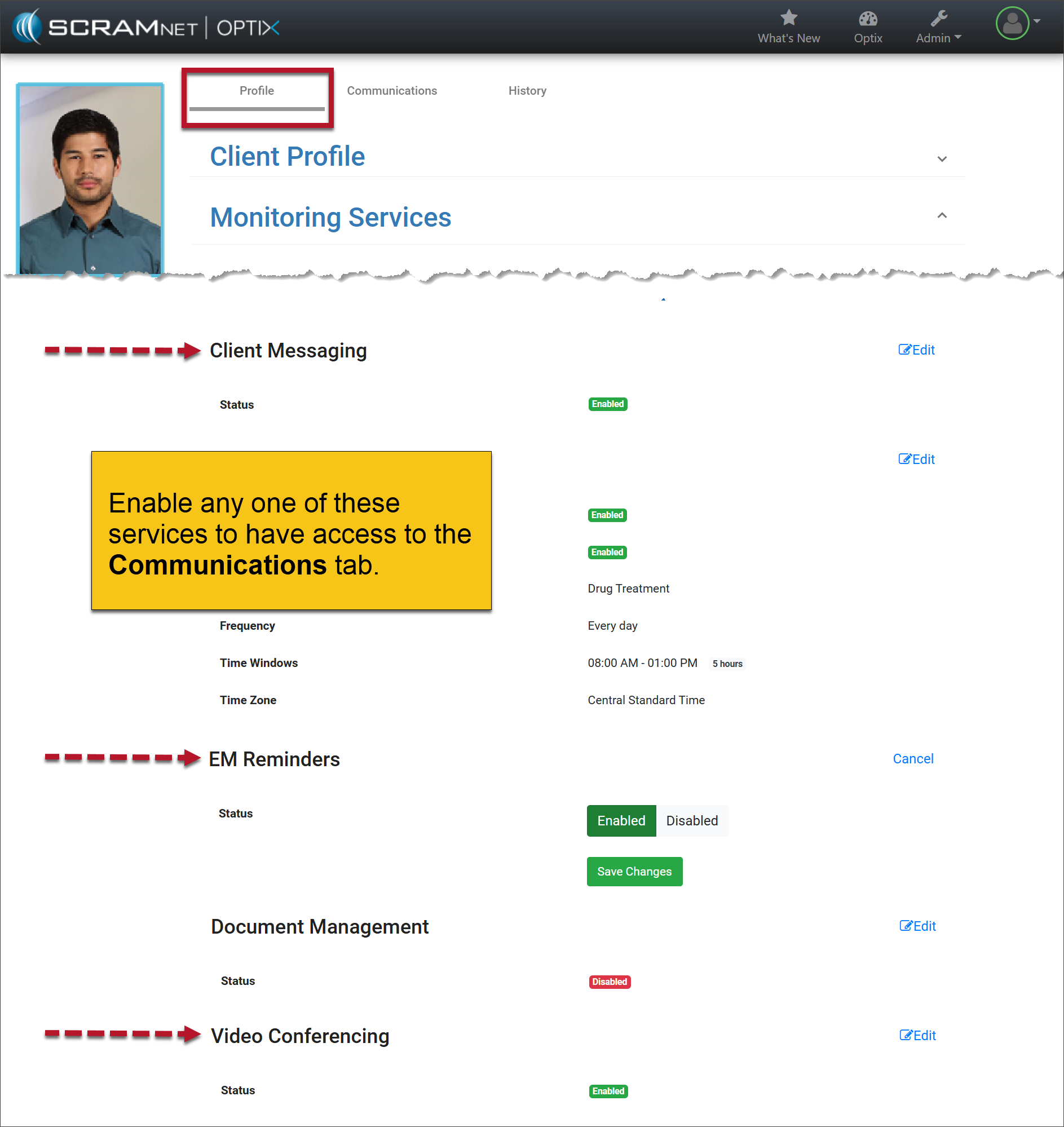
Enable the Service(s)

The Communications tab is available once any of the services is enabled.

Client Profile Page in Optix (click to enlarge)

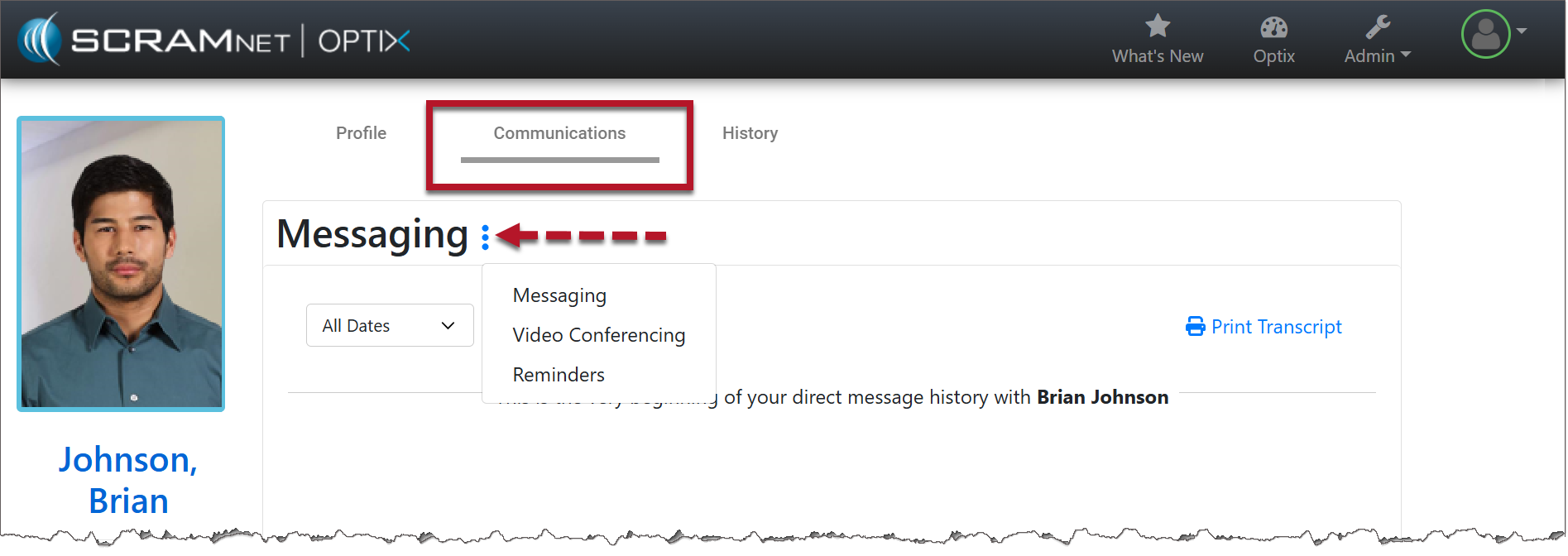
Communications Tab

  1. Select the Communications tab.
  2. Open the More (ellipsis) menu next to Messaging.
  3. Select the desired service.
    • If the services are later disabled, users may still view the historical activity associated with those features. However, they will no longer be able to interact with the service or perform any new actions.
Information If Video Conferencing has not been enabled for the account, that option will not display.
Communications Tab in Optix (click to enlarge)
Information Your account must be enabled for video conferencing for these instructions to work. Contact your SCRAM Systems Account Representative if you are interested in activating this service.

Continue Reading

On 10/2/2025, SCRAM Systems will release an enhancement for your SCRAM Nexus caseload. This enhancement allows users to record a client’s Education and Military Experience directly within the Profile section.

Information If you don’t see the enhancement in SCRAM Nexus, please clear your cache and cookies and refresh your browser window.

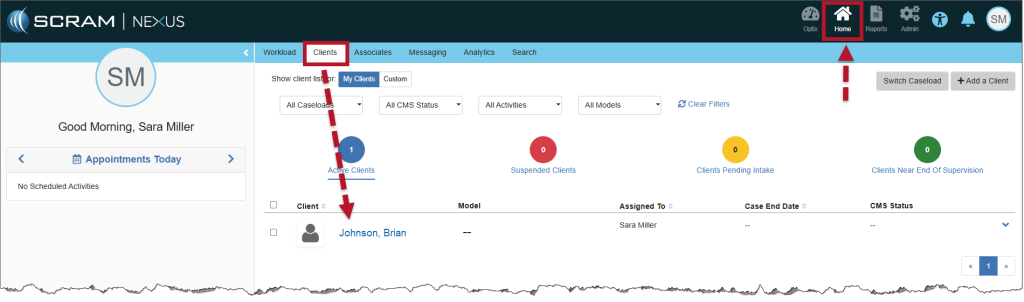
Access the Client’s Profile Page

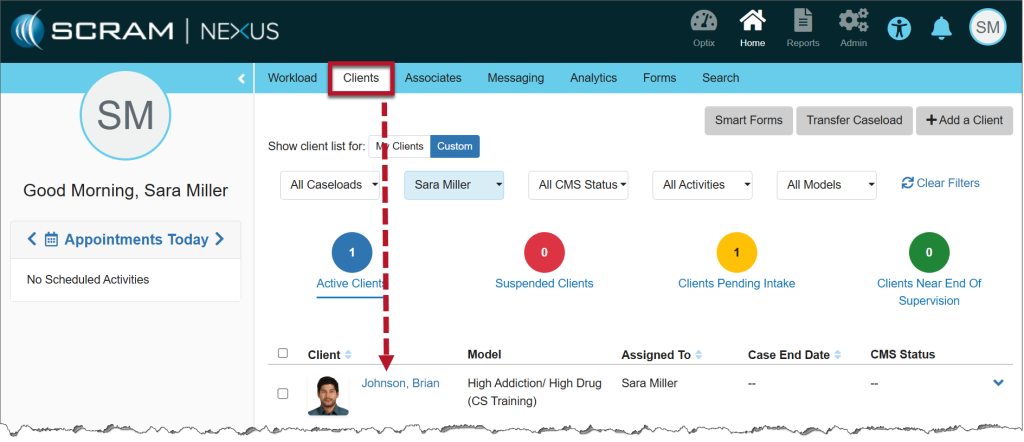
  1. Select the client’s name hyperlink from the Clients tab on the Home page.
Home Page, Clients Tab
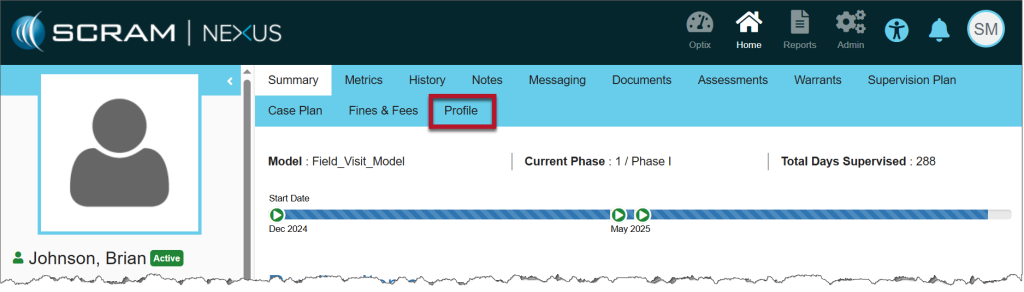
  1. From the client’s Summary page, open the Profile tab.
Client’s Summary Page

Add Education Information

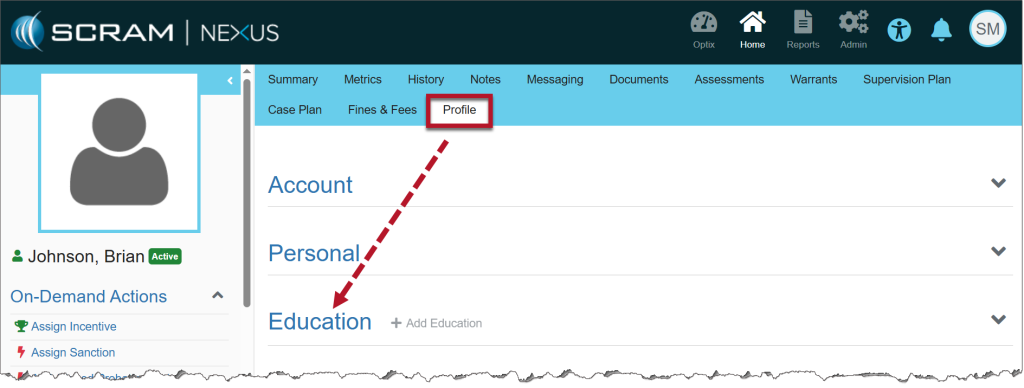
  1. On the Profile page, scroll to the Education section and select the Education heading to expand it.
Profile Tab, Education heading
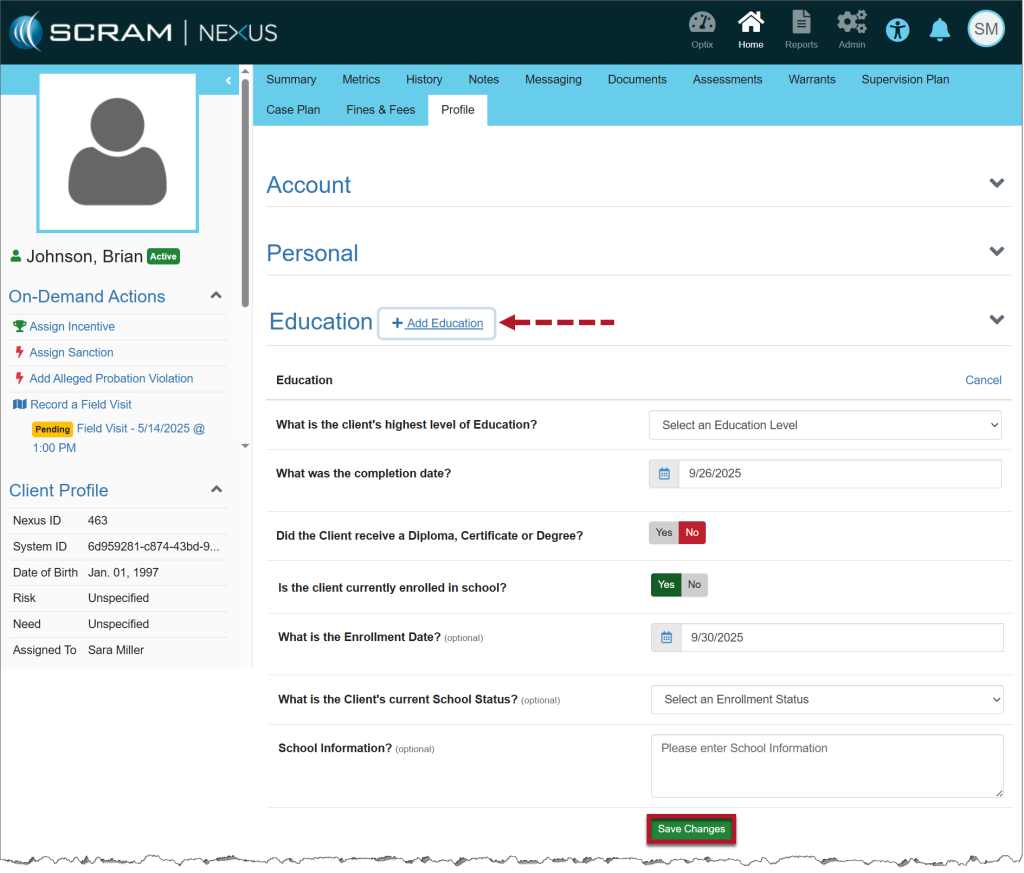
  1. Select the +Add Education link.
  • The related question and answer options will display.
  • Some questions will trigger additional fields. For example, toggling Yes for “Is the client currently enrolled in school?” reveals optional follow-up questions.
  • Enter the relevant client information.
  • Fields marked Optional may be left blank.
  1. Select Save Changes to add the information to the client’s Profile.
+Add Education Link

Add Military Education

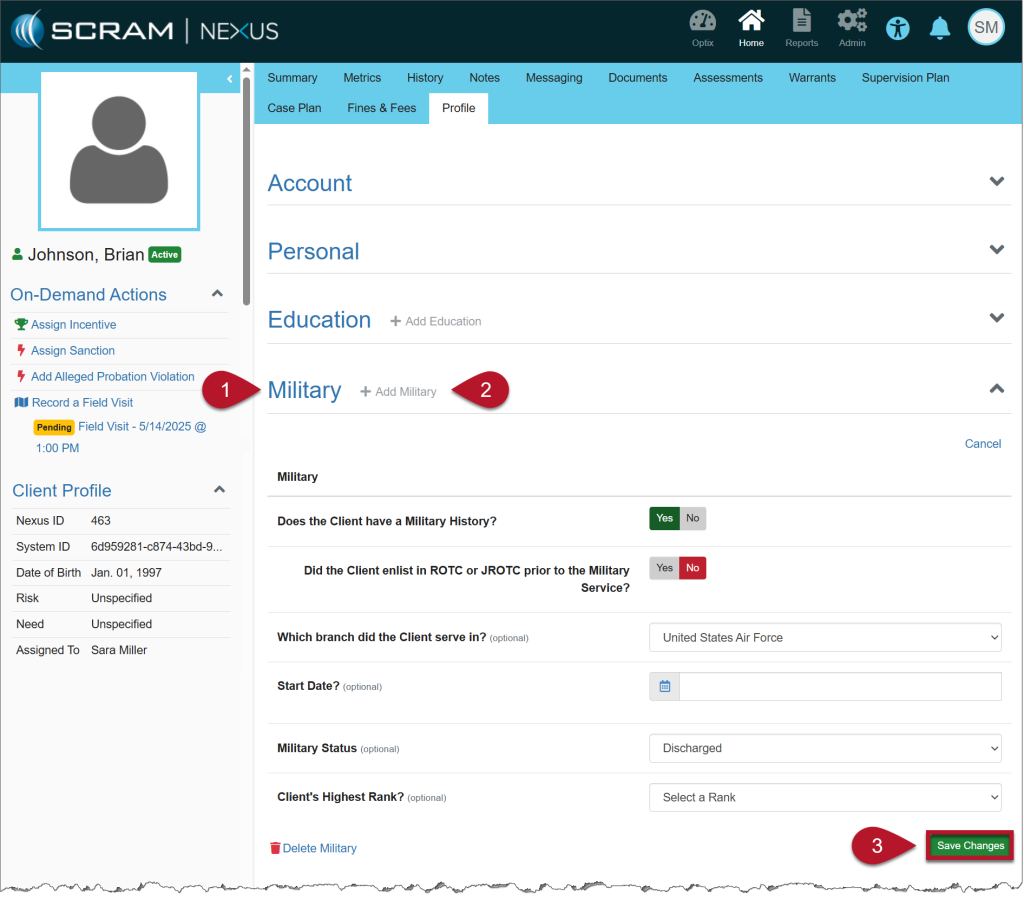
  1. Select the Military heading to expand it.
  2. Select the +Add Military link.
  • The first question will display: Does the Client have a Military History?
  • If Yes is selected, additional fields will appear for you to complete.
  • If No is selected, choose Save Changes to record the response.
  • Fields marked Optional may be left blank.
  1. Select Save Changes to add the information to the client’s Profile.
Military Heading

View Changes

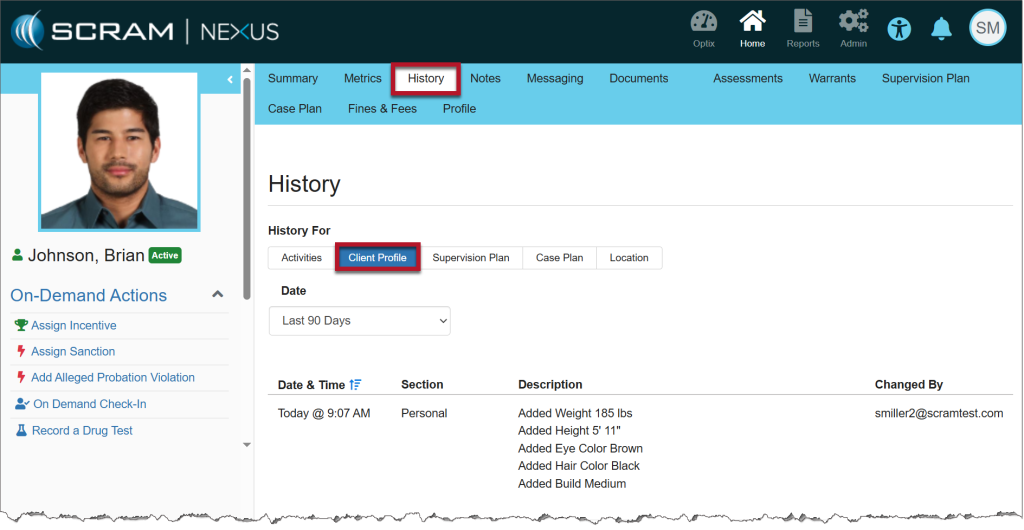
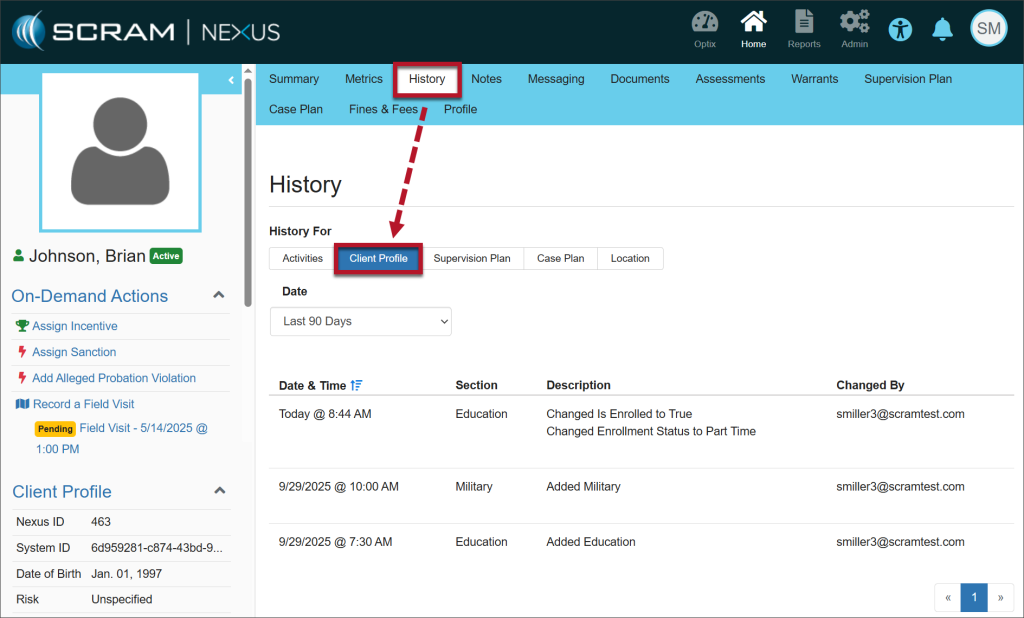
Any edits or additions will appear in the History tab, Client Profile.

History for Client Profile Page

Continue Reading

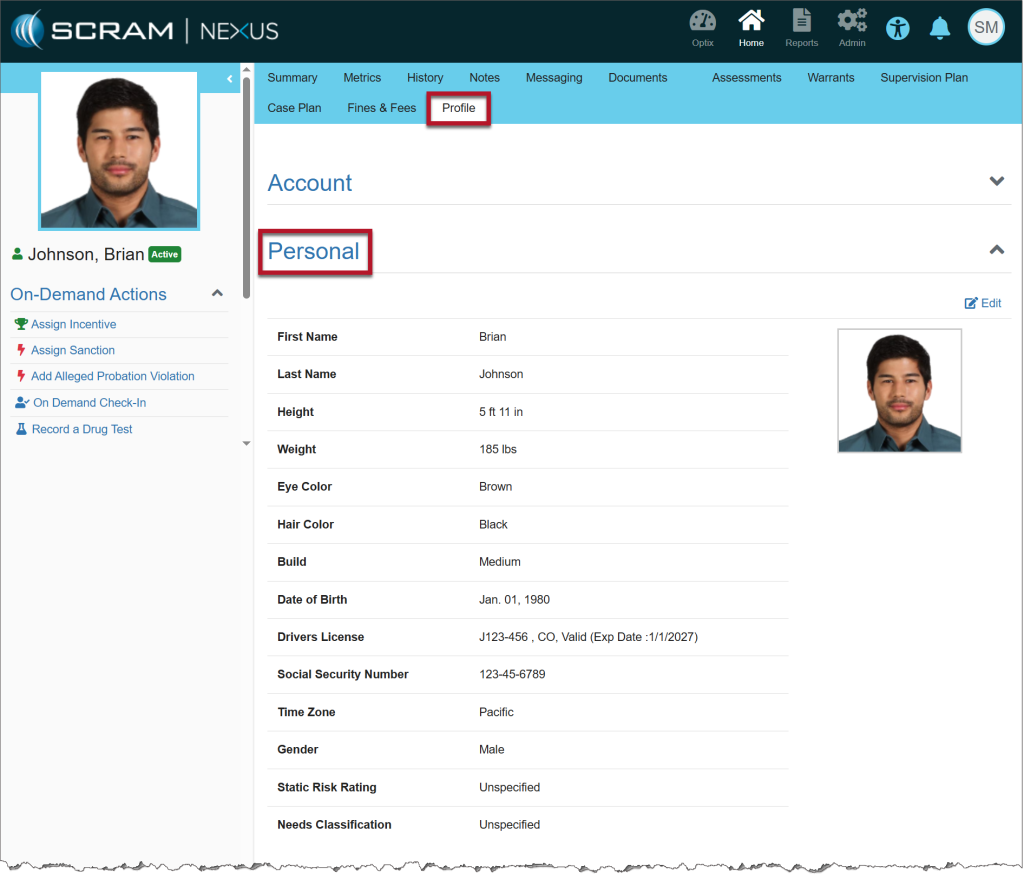
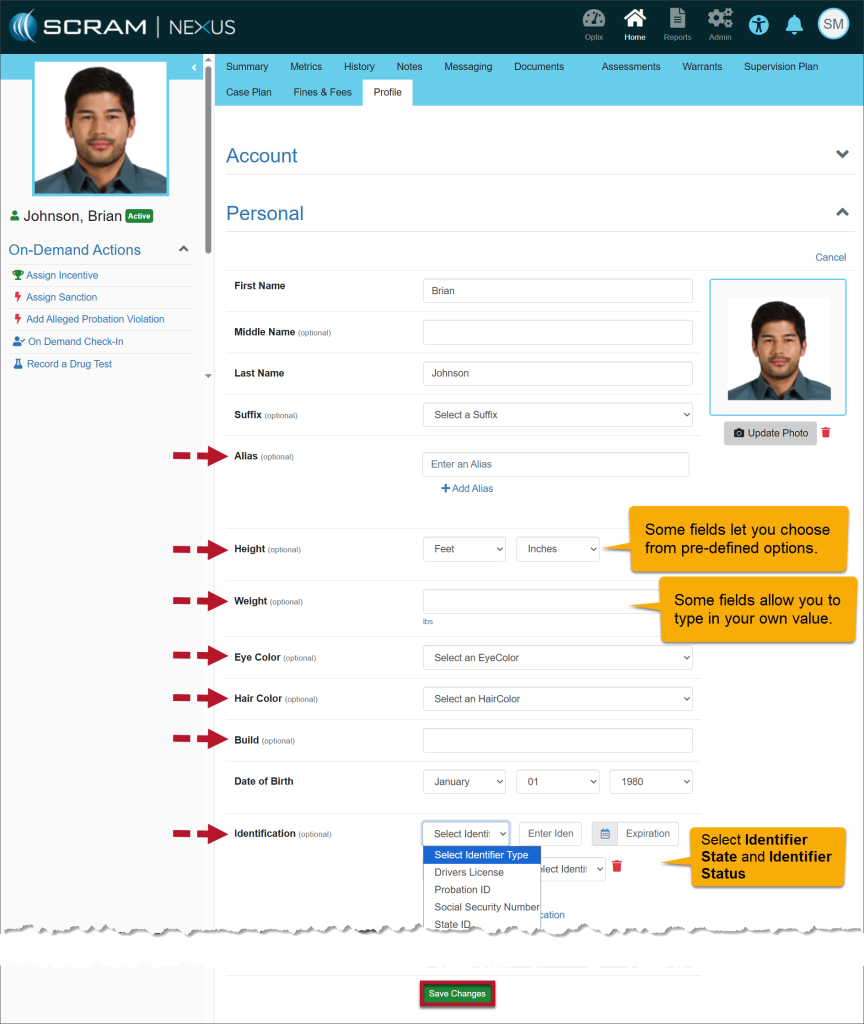
On August 21, 2025, SCRAM Systems will release an enhancement for your SCRAM Nexus Caseloads. With this improvement, the Personal section of the client’s Profile page has been expanded to include new optional identifying attributes, along with additional identification details.

To Edit the Client’s Profile

  1. From the Clients tab in Nexus, select the client’s name hyperlink.
Nexus Clients tab – Click to enlarge
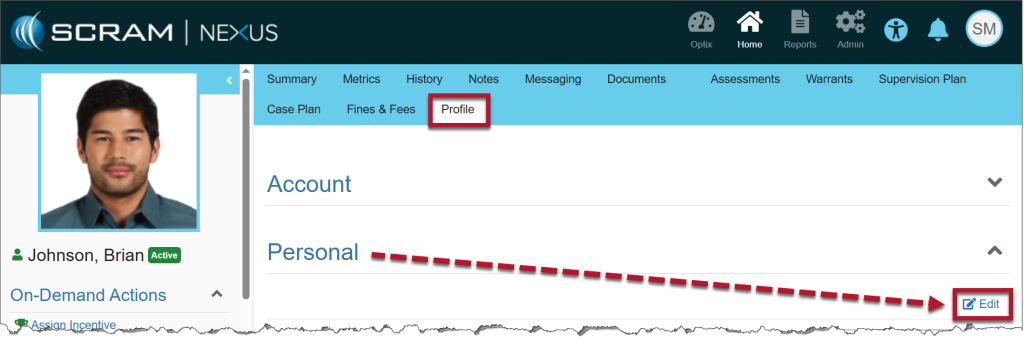
  1. Select the Profile tab and then select the Edit hyperlink in the Personal section.
Nexus Profile tab – Click to enlarge
  1. Add or edit all required fields, then enter any additional details in the new optional fields.
Nexus Profile page
  1. After making any updates, select the Save Changes button.
  2. Once saved, the details entered are displayed under the Personal heading.
Saved Information on the Profile page

All updates made to the client’s profile may be viewed on their History page, Client Profile sub-tab.

Nexus History, Client Profile sub-tab

Continue Reading

Information Your account must be enabled for location tracking for these instructions to work. Contact your SCRAM Systems Account Representative if you are interested in activating this service.

To Set Up Location Tracking at the Caseload Level:

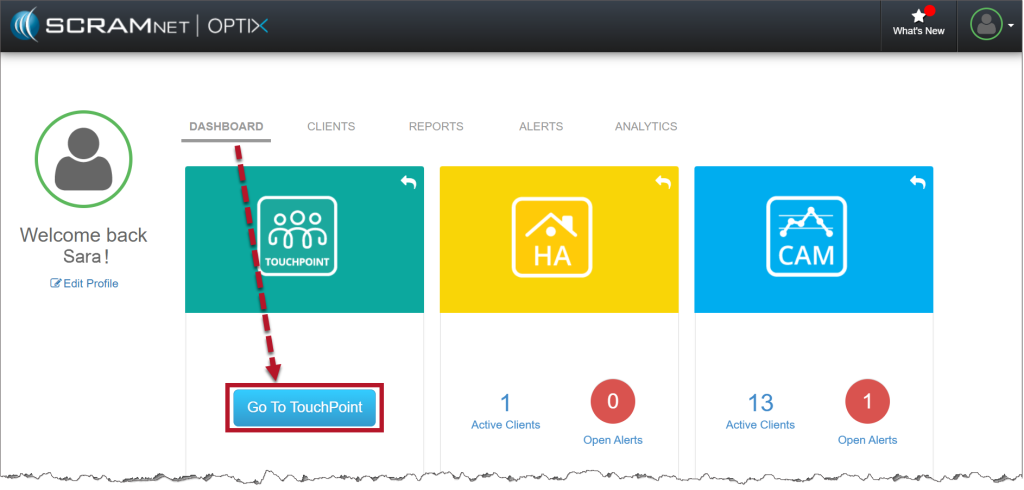
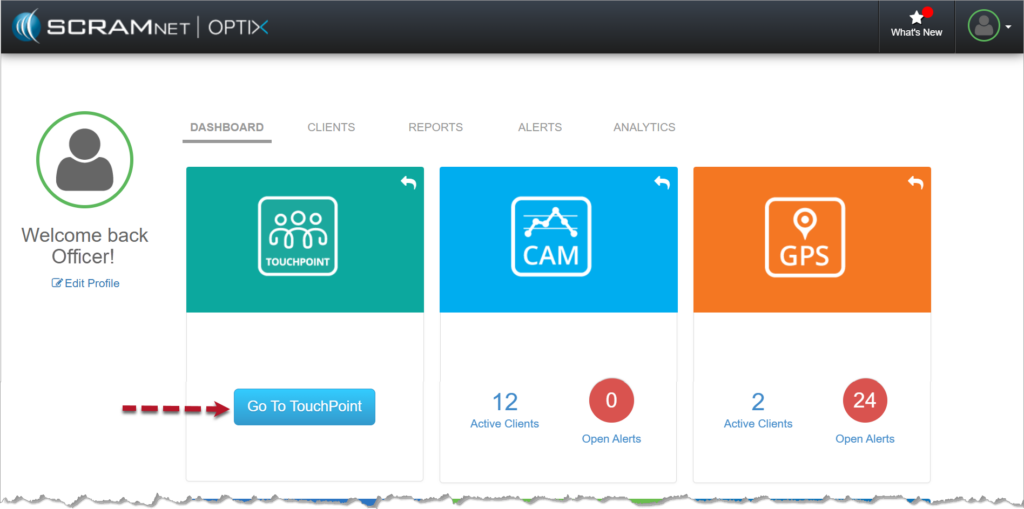
  1. On the Optix Dashboard, select Go to TouchPoint.
Optix Dashboard
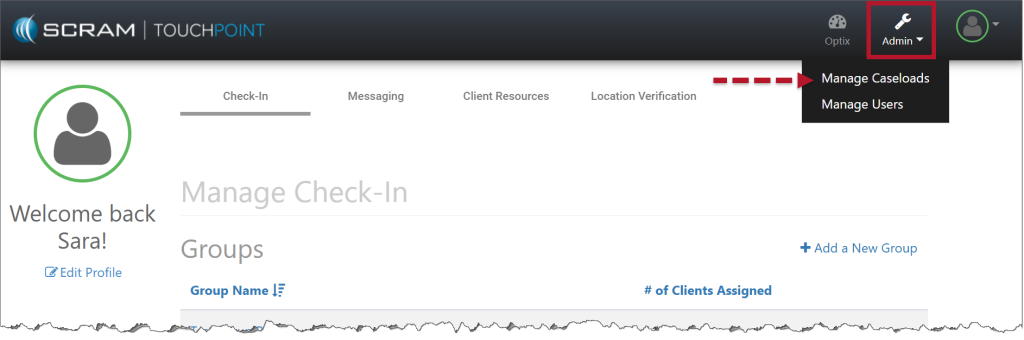
  1. From the TouchPoint Check-In page, select the Admin dropdown menu, and choose Manage Caseloads.
Manage Check-In Page
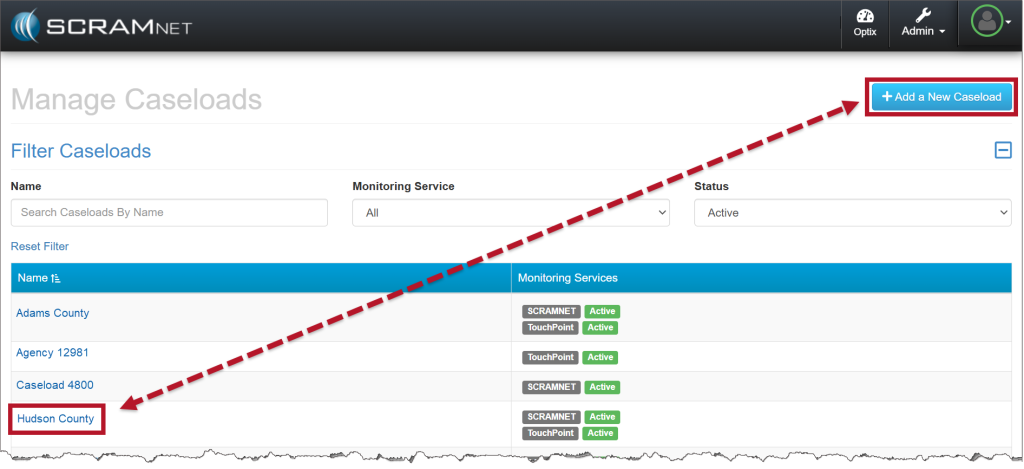
  1. Select the Add a New Caseload button to create a new caseload or select an existing caseload to add this feature.
Manage Caseloads Page
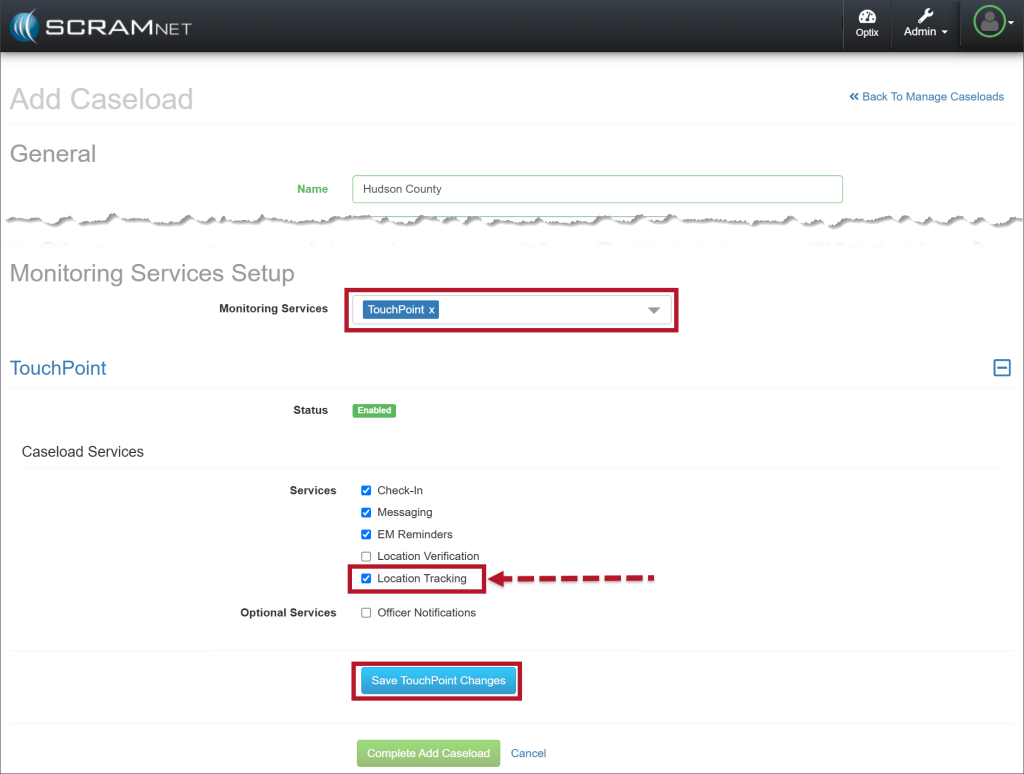
  1. When adding a new Caseload or editing an existing Caseload, in the Monitoring Services section, select the checkbox next to the Location Tracking option located in the Caseload Services section.
Important! When selecting the Caseload Services, Location Verification and Location Tracking cannot be enabled simultaneously.
  1. To finish, select the Save TouchPoint Changes button.
Monitoring Services Setup Page
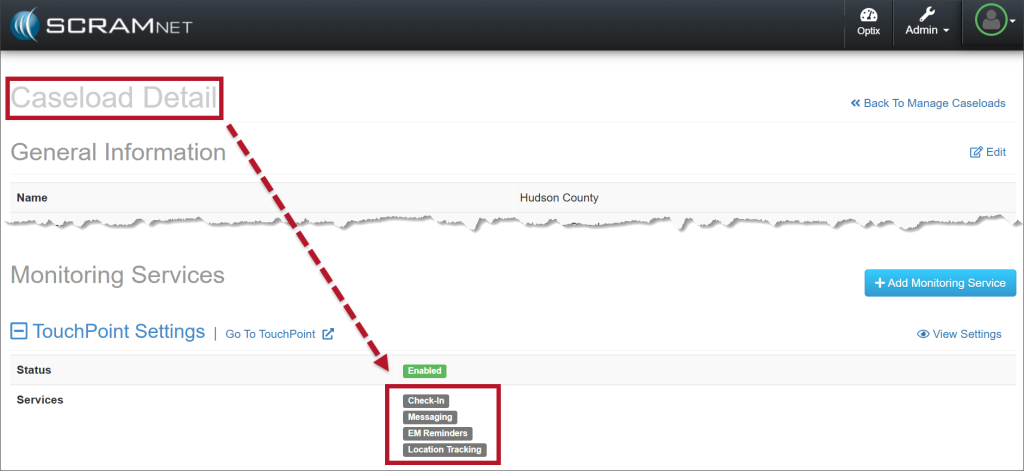
  1. Once saved, the Caseload Detail page will display the enabled services.
Caseload Details Page

Enabling Location Tracking for Clients

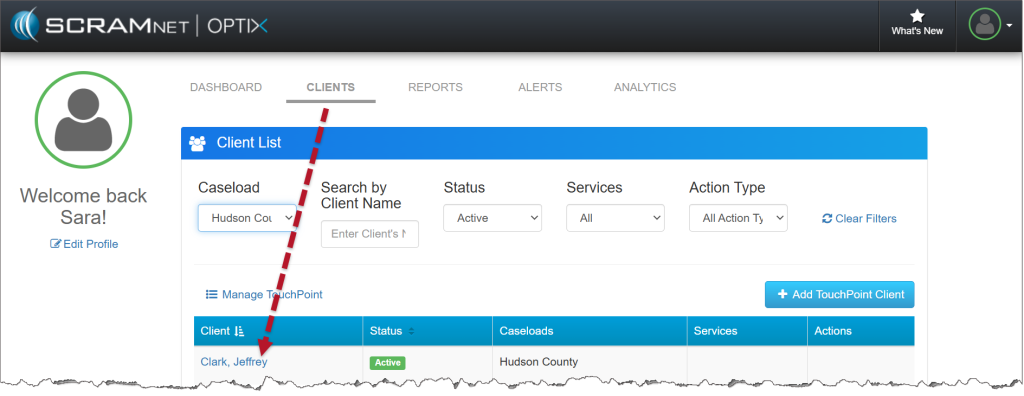
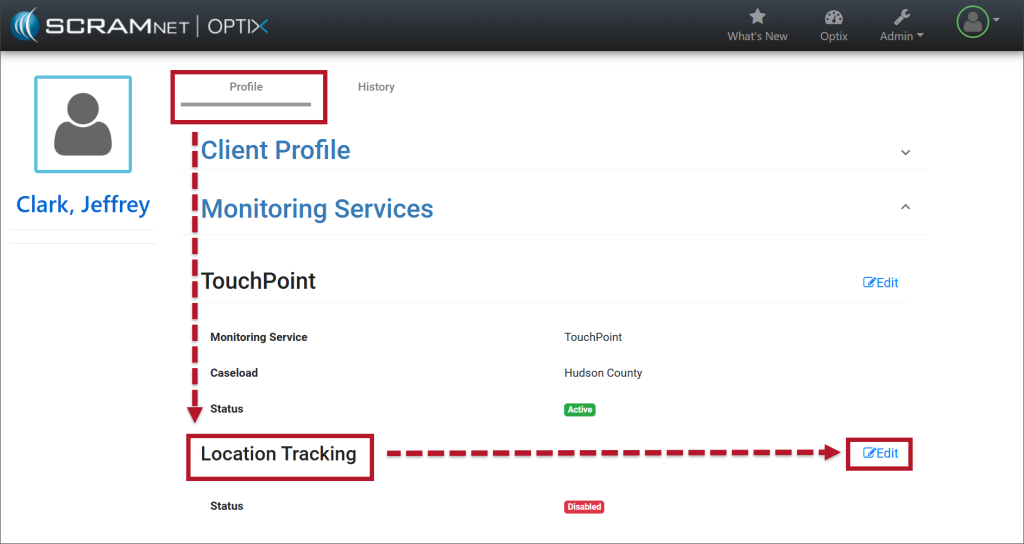
  1. Once your Caseload is enabled for Location Tracking, you may enable this service for clients on their Client Profile page. For existing clients, on the Optix Clients page, select their name hyperlink.
Optix Client Page
  1. In the Monitoring Services section, select the Edit hyperlink to the right of the Location Tracking monitoring service.
Monitoring Services on the Client Profile Page
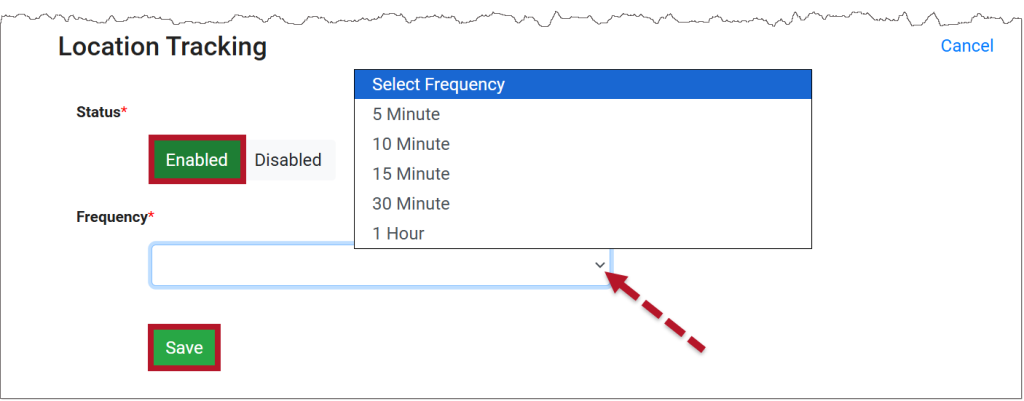
  1. Select the Enable button and then set the frequency – “how often” you want the client’s smartphone to provide a location point.
  2. Select the Save button.
Location Tracking Options

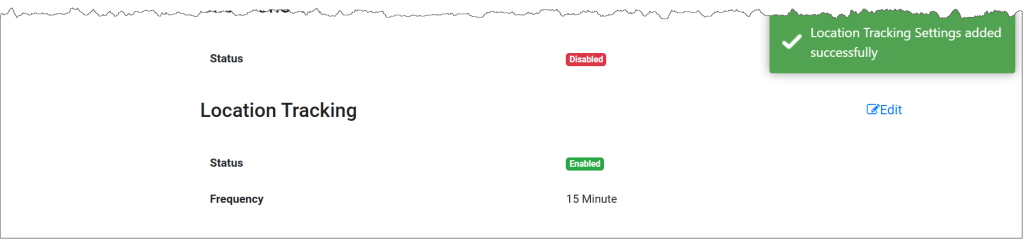
Once saved, a pop-up verifying the Location Tracking setting was successfully enabled for the client will display on the page.

Location Tracking Added Successfully

Accessing the Location Tracking Information

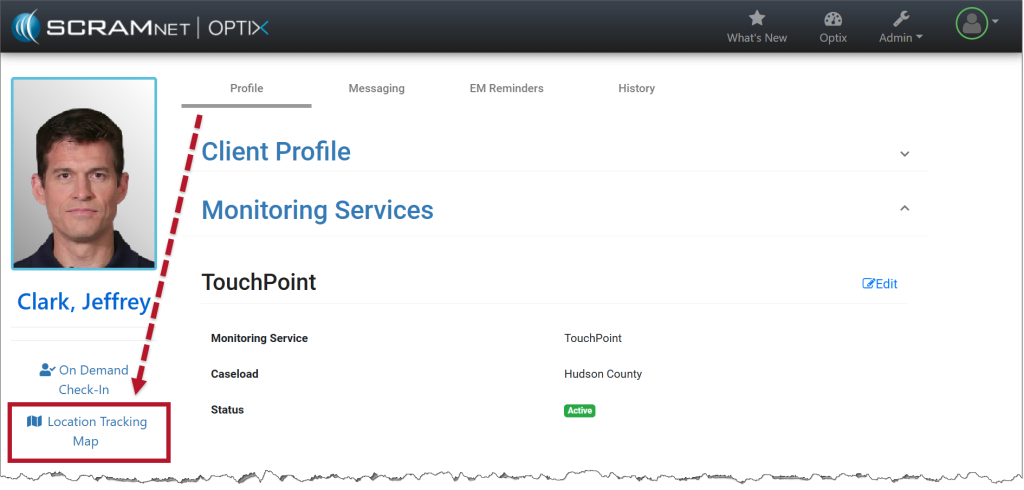
The Location Tracking information may be accessed by selecting that hyperlink on the Client Profile page.

Link to Location Tracking Map

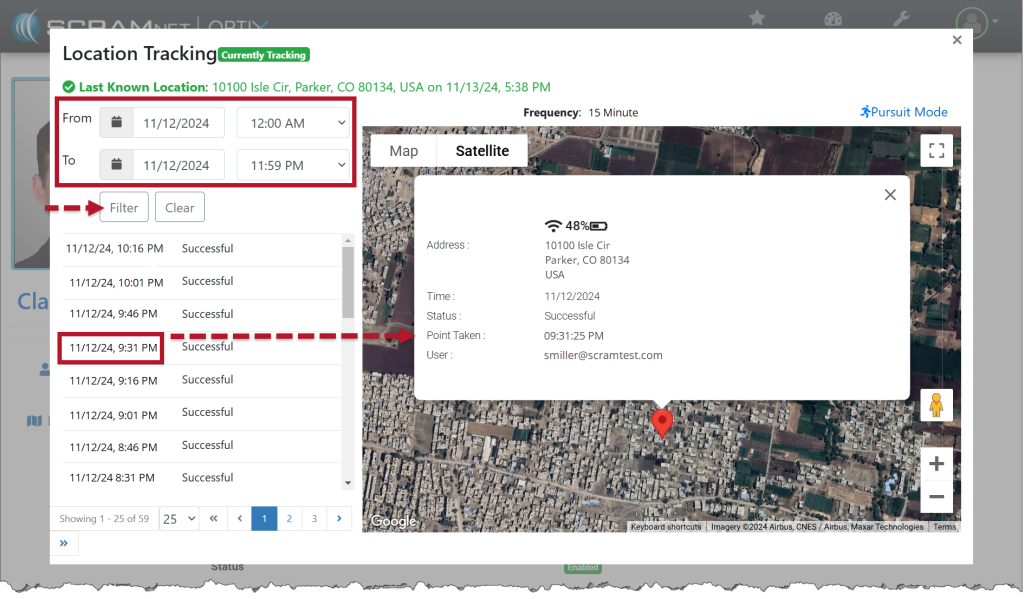
On the Location Tracking pop-up window:

  • The client’s last known location is displayed.
  • The “From” and “To” calendar and time fields allow you to customize the location information displayed on the pop-up. You are limited to a seven-day selection.
  • Select a specific date and time from the list to bring that location point into focus on the map.
  • Hover over the location point on the map to view the location’s details. This includes the location’s address, status, phone battery strength, and user name assigned to the client.
Location Tracking Pop-Up

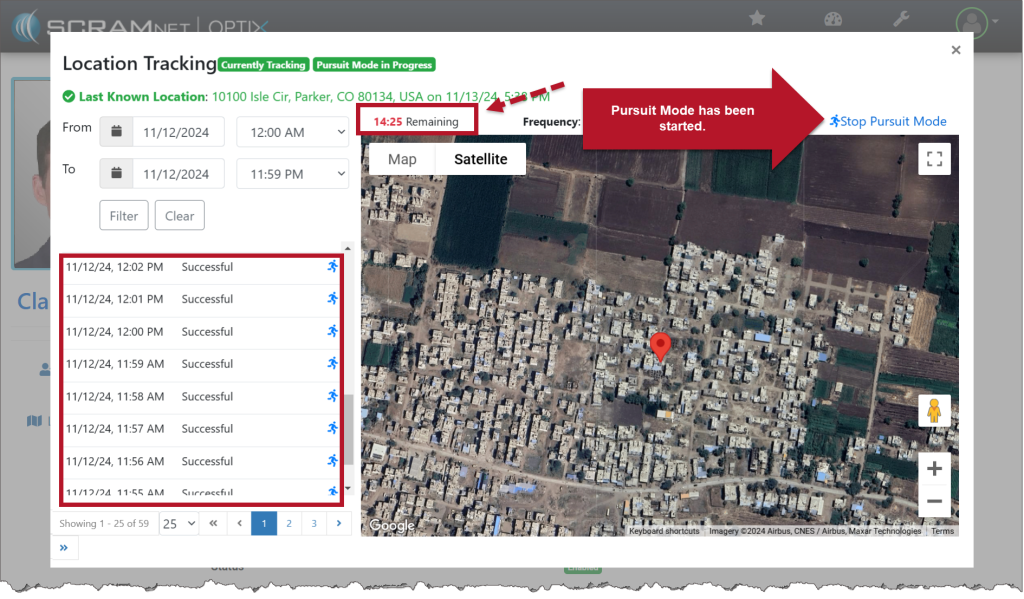
Pursuit Mode Feature

In some scenarios, real-time tracking of a client may be needed. “Pursuit Mode” temporarily overrides the saved location frequency for the client and updates the frequency to one location point every minute. The system will continue to gather a location point every minute for a total duration of 15 minutes or until manually ended by selecting the Stop Pursuit Mode option.

As the location information is received, the map and location data are updated in real-time on the pop-up.

Location Tracking Pop-Up

Continue Reading

On February 27, 2025, SCRAM Systems will release two enhancements for your SCRAM Nexus caseloads:

  1. Ad Hoc Reporting allows for multiple options in building dynamic reports using data already entered from the Nexus database. Reports may be customized to fit the requirements necessary for the monitoring of clients.
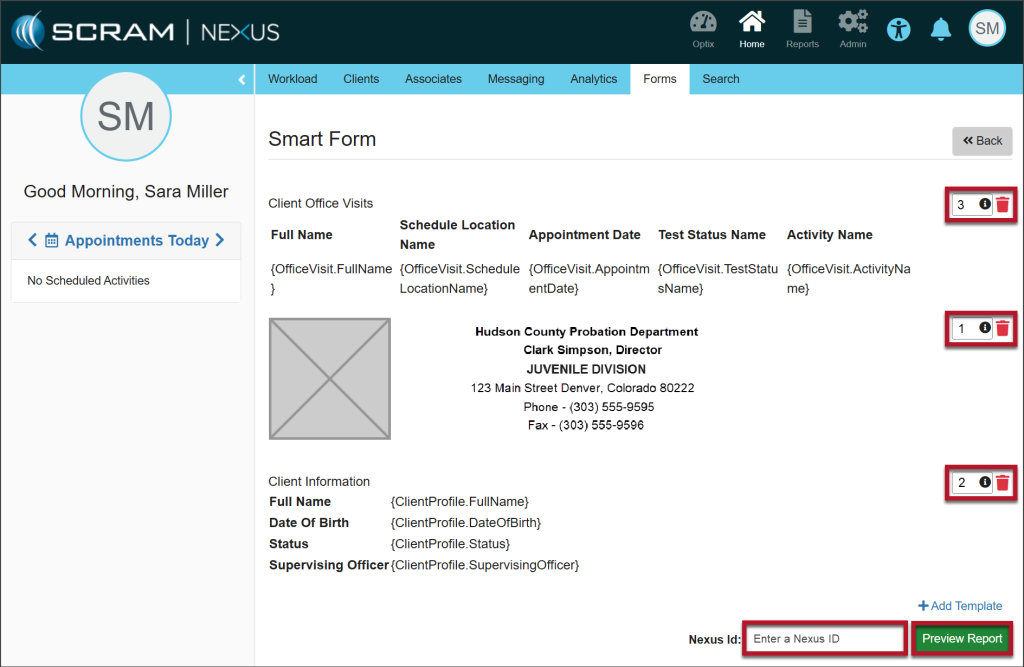
  2. Smart Forms allows users to create, maintain, and customize the official forms they use to communicate with the courts. Some information the forms use is static, for example, content originating from the courts, and some needs to be personalized to the client. The forms can be customized to include information on a single client or on multiple clients.

SCRAM Nexus Ad Hoc Reporting

Customizing a Report

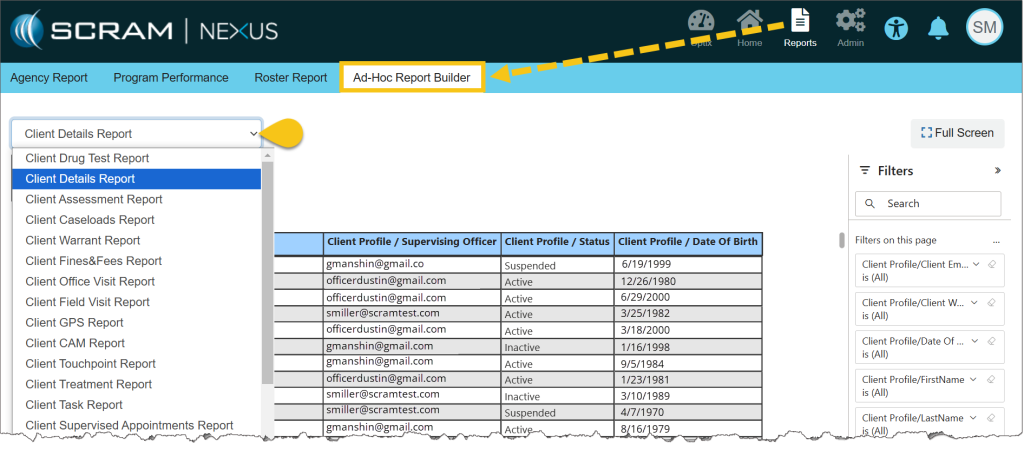
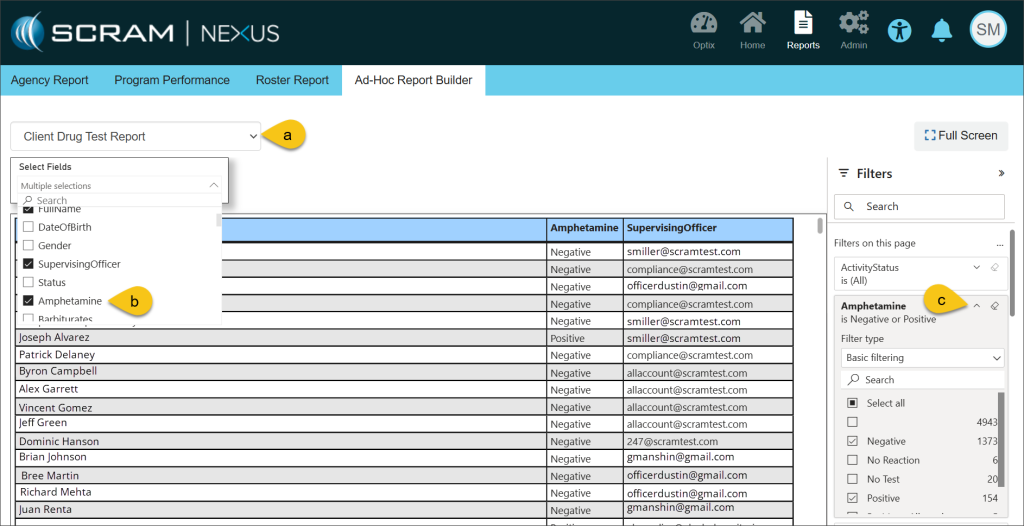
From the Reports menu, select the Ad Hoc Report Builder tab, and then select the desired Report Type from the dropdown menu.

Ad Hoc Report Builder Tab

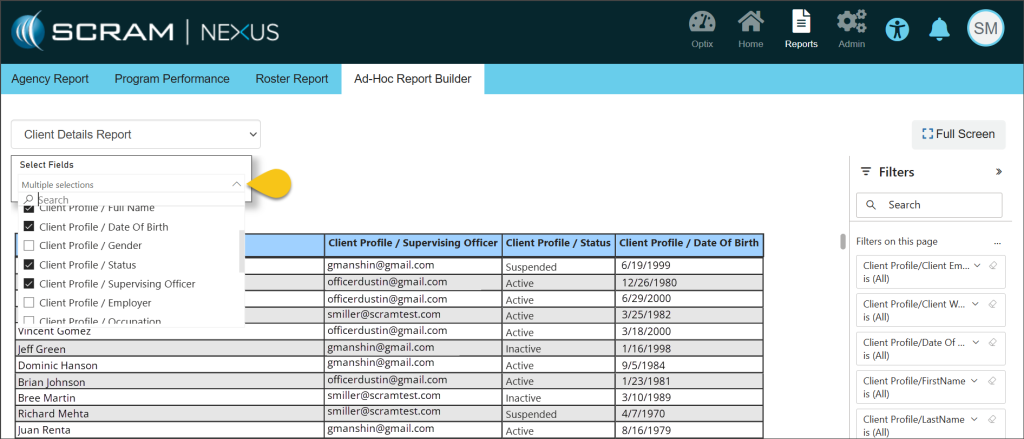
Once a report is selected, use the Select Fields dropdown list to choose the data fields that will be included in the report. The selected fields will show as titles of the columns in the report. As each choice is selected, the report will dynamically populate.

Select Fields Dropdown

Further customization is available using the Filters section on the right side of the page. These advanced filters allow you to add more conditions for the information that will be displayed on the report. For example, choosing the Client Drug Test Report with the field of Amphetamine selected, allows you to filter the report even further to only show clients who have tested negative or positive for amphetamines.

Additional Filters

Printing a Report

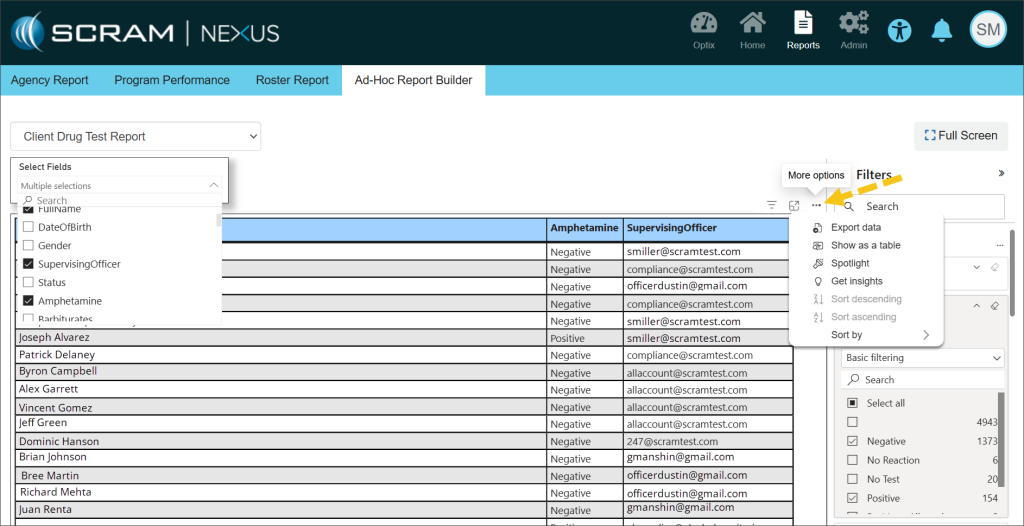
Hovering your mouse over any field in the table uncovers more options for viewing the information contained in the report. Selecting the More Options ellipsis (…) allows for exporting and printing your report in Excel.

More Options

SCRAM Nexus Smart Forms

Customizing a Smart Form

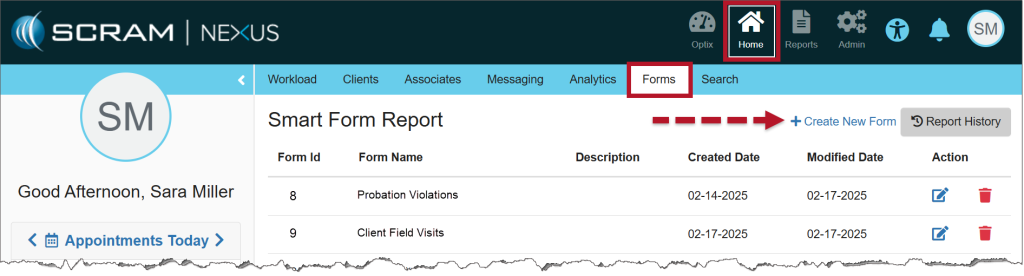
  1. From the Home menu, select the Forms tab, and then select the +Create New Form hyperlink.
Smart Form Report
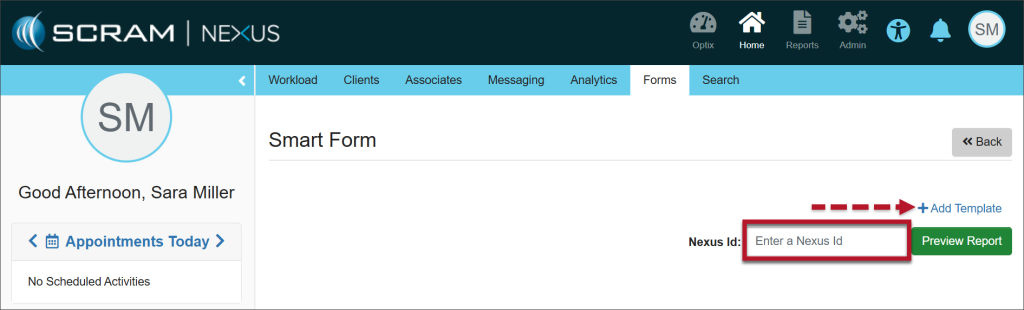
  1. Enter the client’s Nexus Id (Find the Nexus Id) and select the +Add Template hyperlink.
Select +Add Template
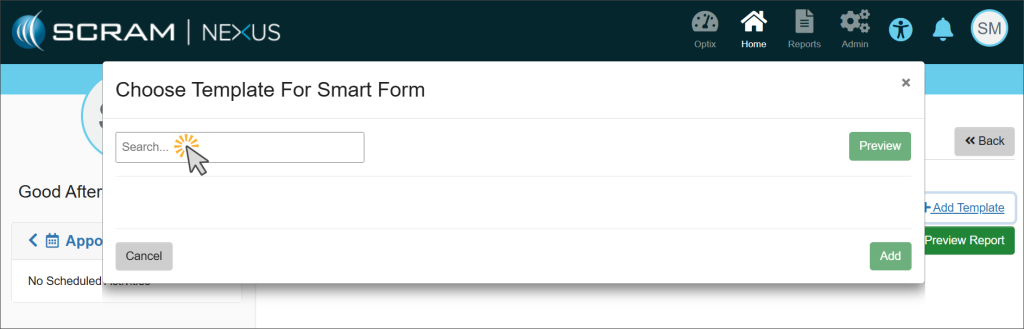
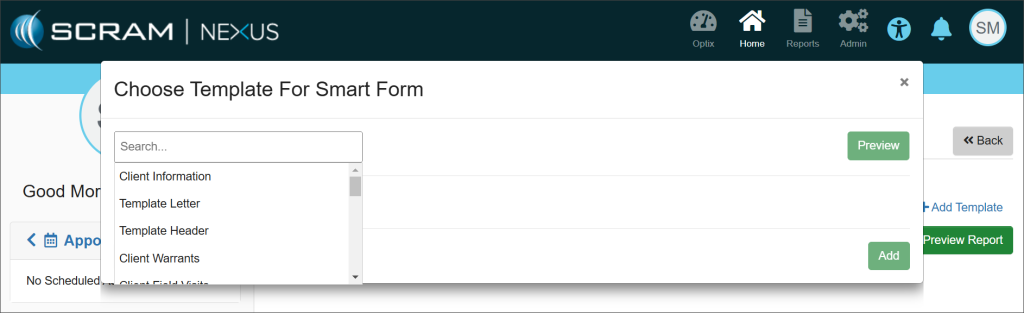
  1. A Choose Template for Smart Form pop-up window will display. Select the Search field to activate a dropdown menu of template choices and select the desired template.
Select the Search Field
Choose the Desired Template
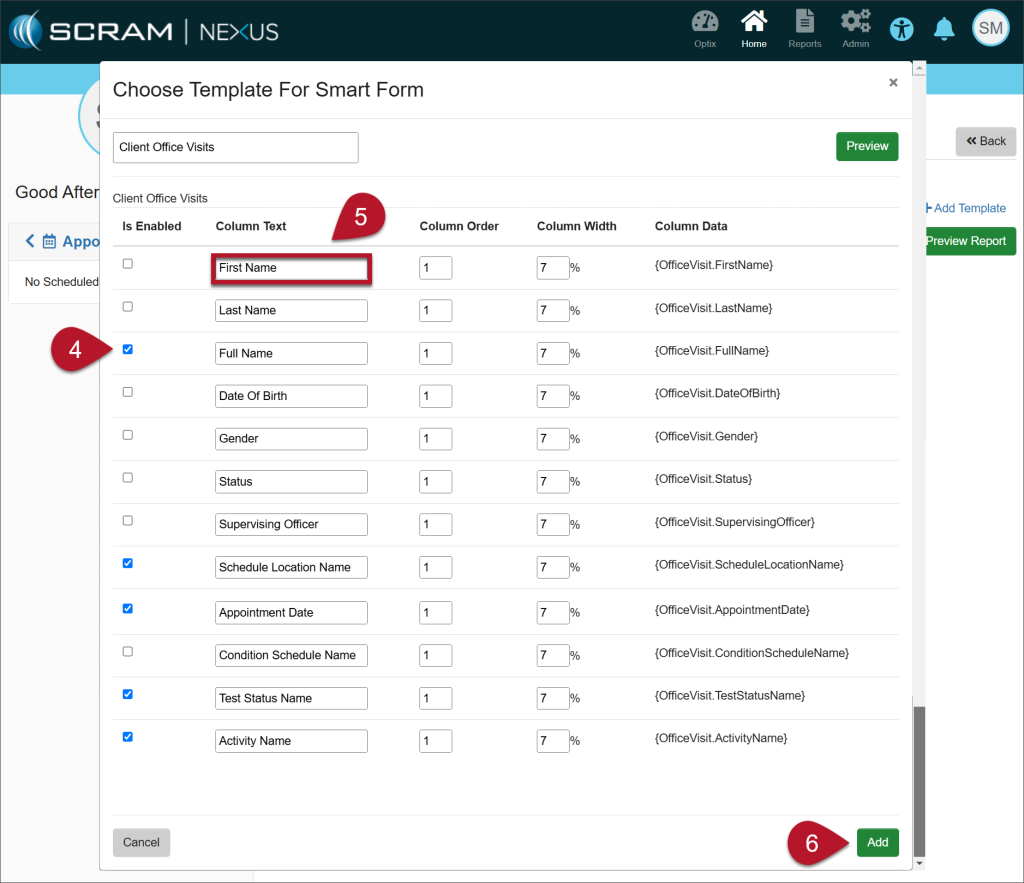
  1. Select the checkboxes of the attributes necessary to include on the form.
  2. Each template is editable. Edit the text contained in any Column Text field to change the information. This gives you the ability to customize the headings as they will appear on the report output.
  3. Once you have made your changes, select the Add button.
Deselect the columns you do not need, edit the Column Text headings, if desired, and then select Add.
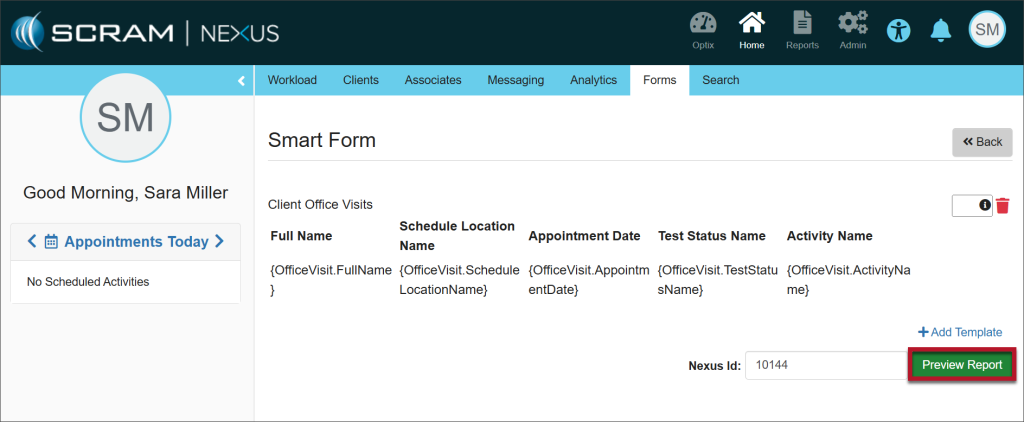
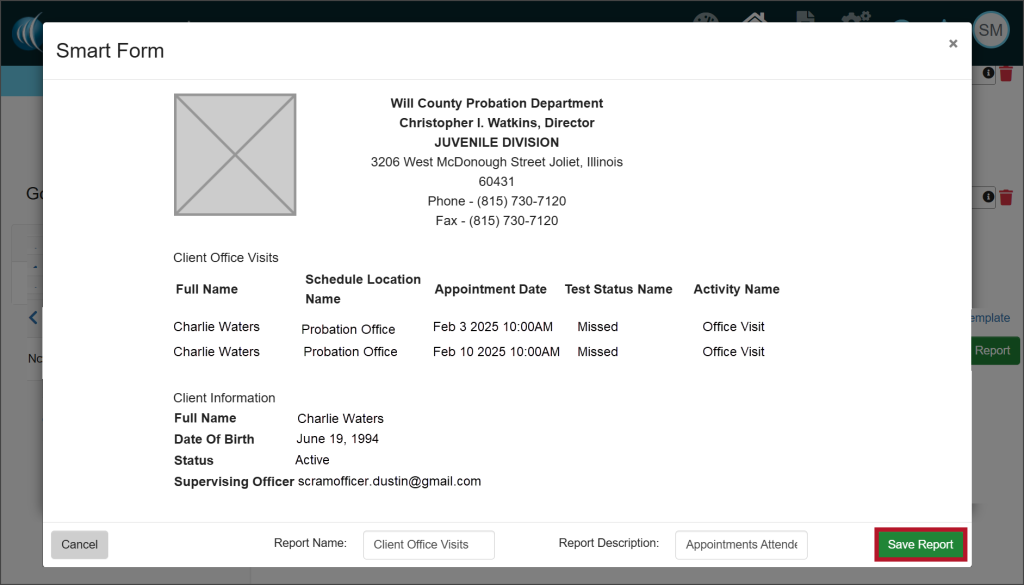
  1. Select the Preview Report button.
Preview the Report
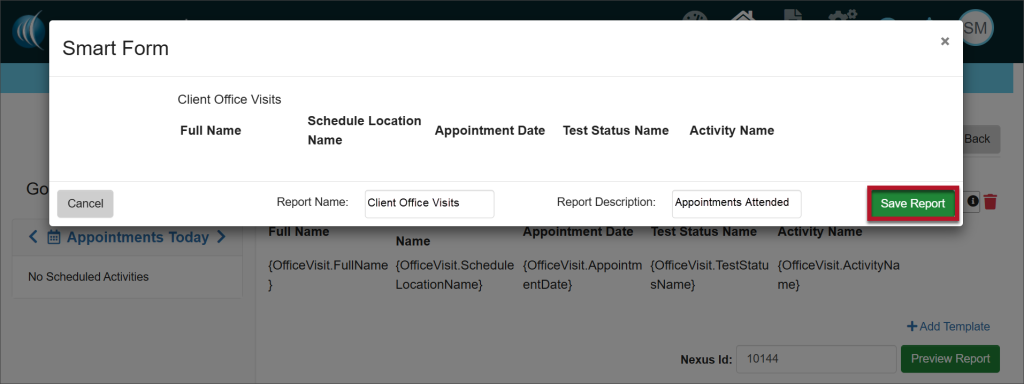
  1. From the Preview, add a report name and description. Select the Save Report button.
Add a Report Name and Description
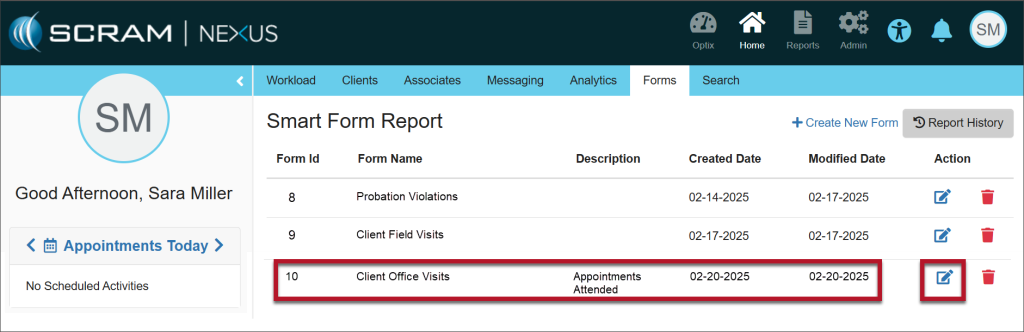
  1. A green Success banner will indicate that the Smart form was saved successfully. The form has been saved in the Smart Form Report section. To continue customizing the form, select the Edit icon under the Action heading.
Saved Form
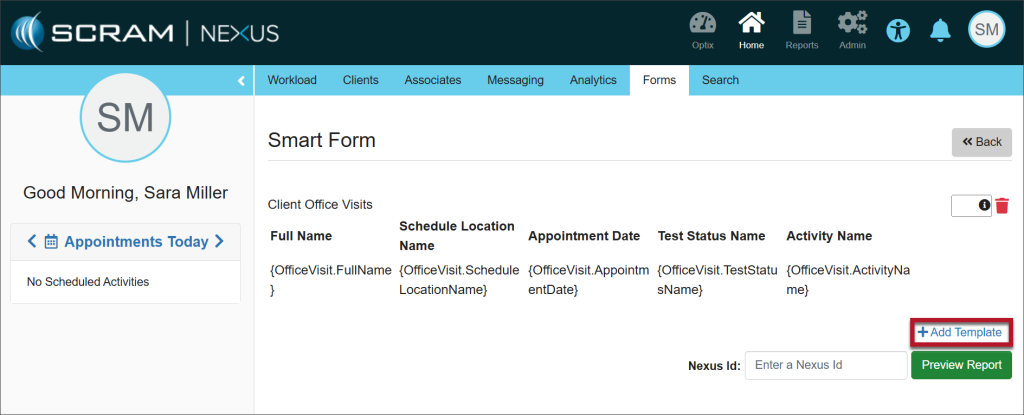
  1. Re-enter the client’s Nexus Id and select the +Add Template hyperlink to continue adding components to the saved form.
Add Template
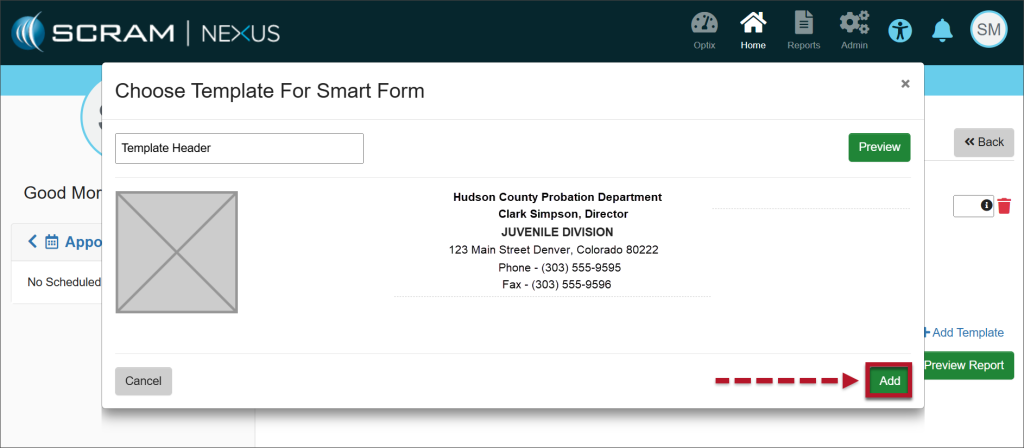
  1. Select the Add button to add the new template to the existing report.
Add Button

Final Edits to the Form

Once the information has been customized to meet your needs, you have the ability to adjust the order of the sections on your form.

  1. Add numbers to the fields on the right side of the page to order the sections in the sequence you’d like them to appear on the form.
  2. Enter the client’s Nexus Id.
  3. Select Preview Report to view the final product.
Change the Order of the Sections
  1. Select the Save Report button. The green Success banner indicates that the Smart Form was added successfully.
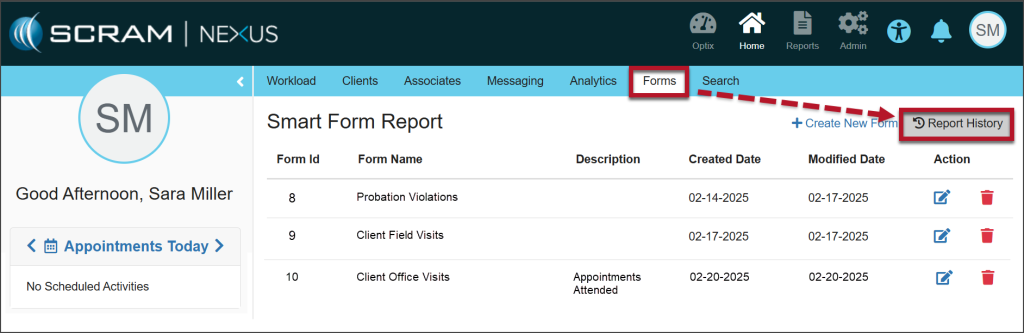
  1. The form is available to run from the Forms tab. Select the Report History button to access the form.
Access the New Form
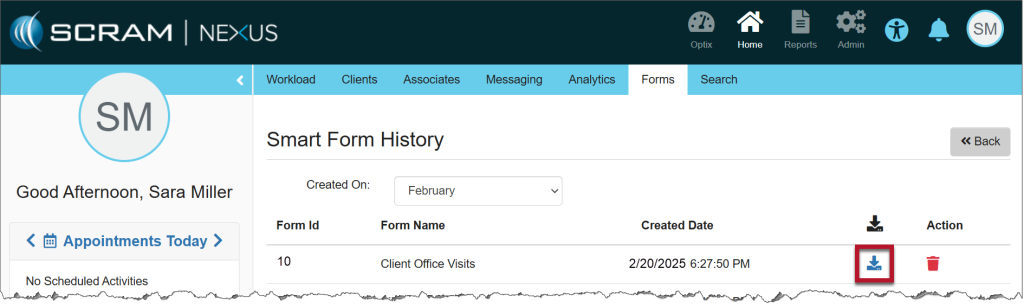
  1. Select the download icon next to the Form Name.
Download the Form
  1. Acknowledge that you want to download the Smart Form.
  2. The document will be available in your Downloads folder.

One Form, Multiple Clients

The form for a single client can also be shared with multiple clients using the Mass Transfer feature.

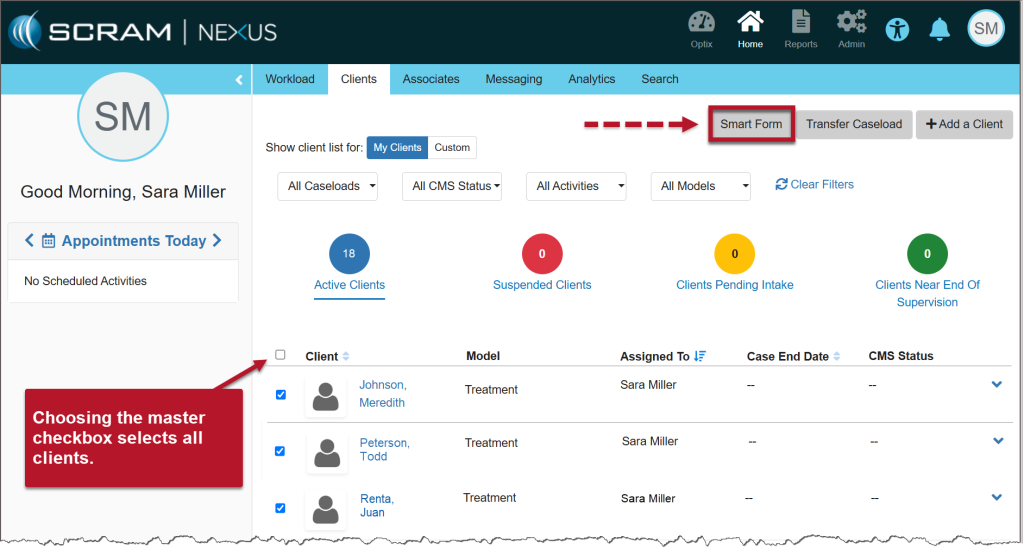
  1. Select the checkbox next to each of the clients that you want to send the form to.
  2. Select the Smart Form button.
Smart Form Button
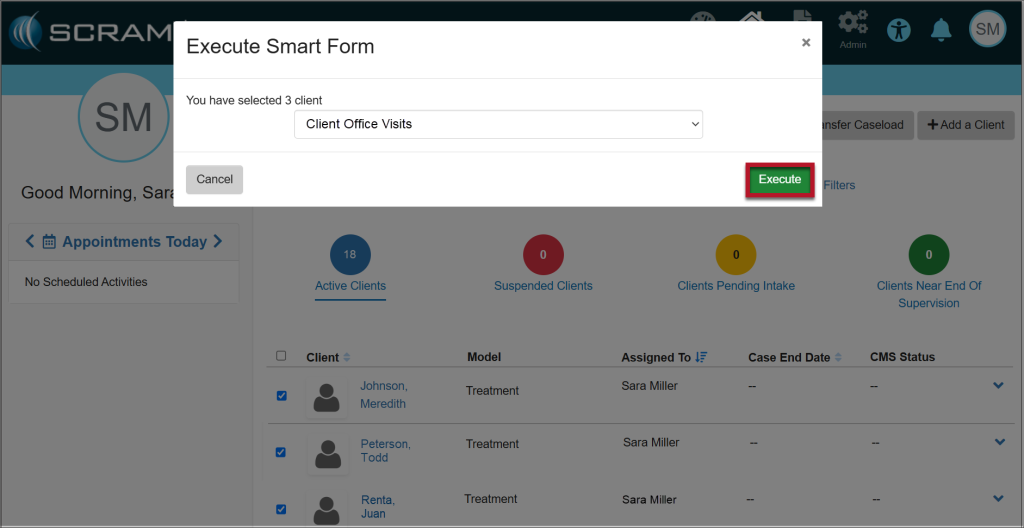
  1. The Execute Smart Form pop-up displays a dropdown of forms you have created. Choose the form you want to use for the selected clients and select the Execute button.
Execute Smart Form
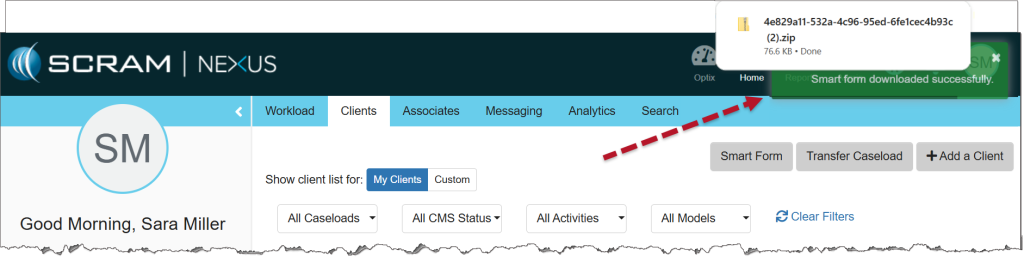
  1. A green Success banner will indicate that the Smart Form was downloaded successfully. The document for each client will be available as a .zip file in your Downloads folder.
Smart Form Downloaded Successfully

Continue Reading

On February 18, 2025, SCRAM Systems will release three enhancements for your SCRAM TouchPoint Caseloads. These enhancements include:

  1. An option to disable Biometric Verification for clients who log in to TouchPoint for Check-Ins.
  2. For Messaging services, as soon as one user marks a message as read, it eliminates the need for all users to mark the same passage as read. Each message will be stamped with the username, date, and time read.
  3. In an effort to ensure that clients are using the latest version of the SCRAM TouchPoint mobile application, a reminder banner will be displayed on the client’s smartphone.
Information Your account must be enabled for video conferencing for these instructions to work. Contact your SCRAM Systems Account Representative if you are interested in activating this service.
Important! As a best practice, we recommend you encourage your clients to enable automatic app updates. This ensures they are always using the latest version of the TouchPoint app.

Optional Biometric Login

For customers who do not require biometric verification when logging into TouchPoint, an option will be available to disable the setting.

Disabling Biometric Verification

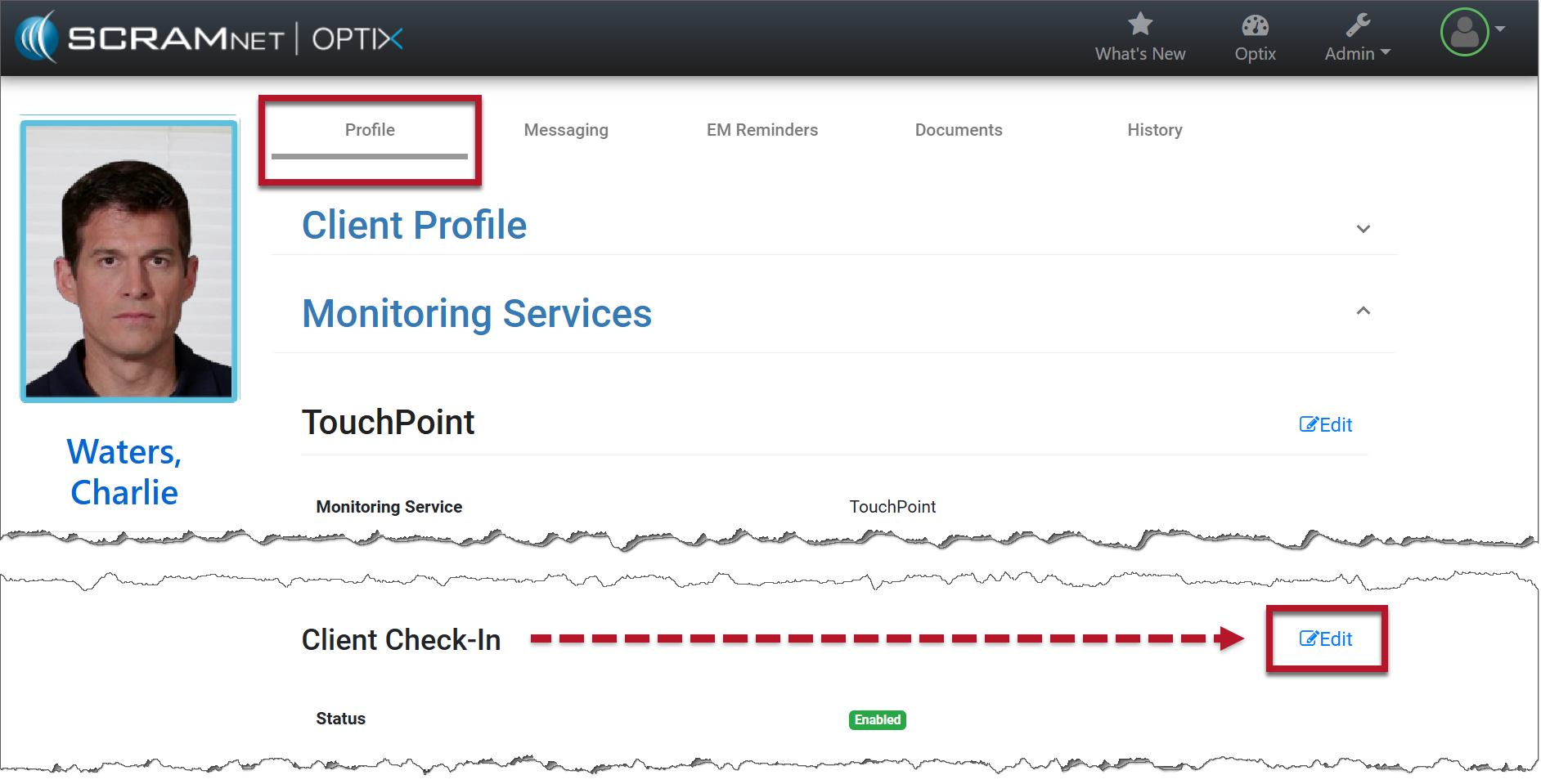
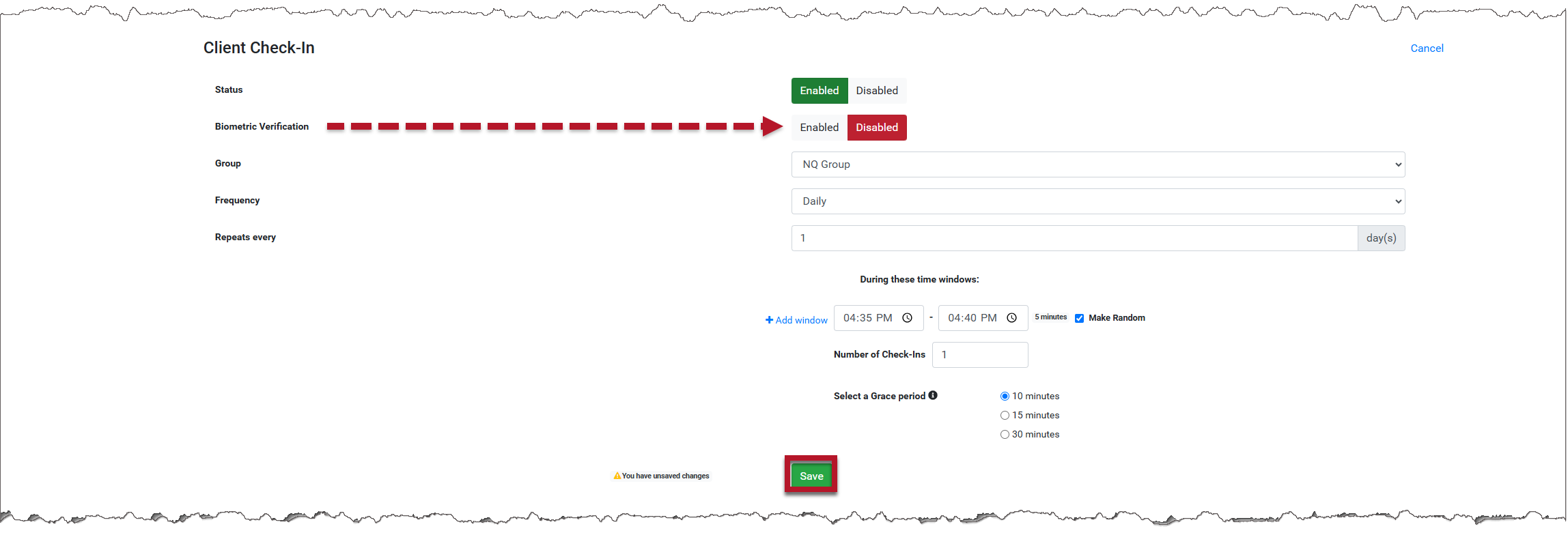
  1. From the client’s Profile page in Optix, select the Edit hyperlink for Client Check-In.
Client Profile Page
  1. Toggle the Status of the Biometric Verification from Enabled to Disabled and save your changes.
Toggle Button to Disabled
  1. Biometric Verification has been disabled. When the user logs in to TouchPoint on their smartphone, biometric verification will not be required. The Check-In questions will be the first thing they see.
Biometric Verification Disabled
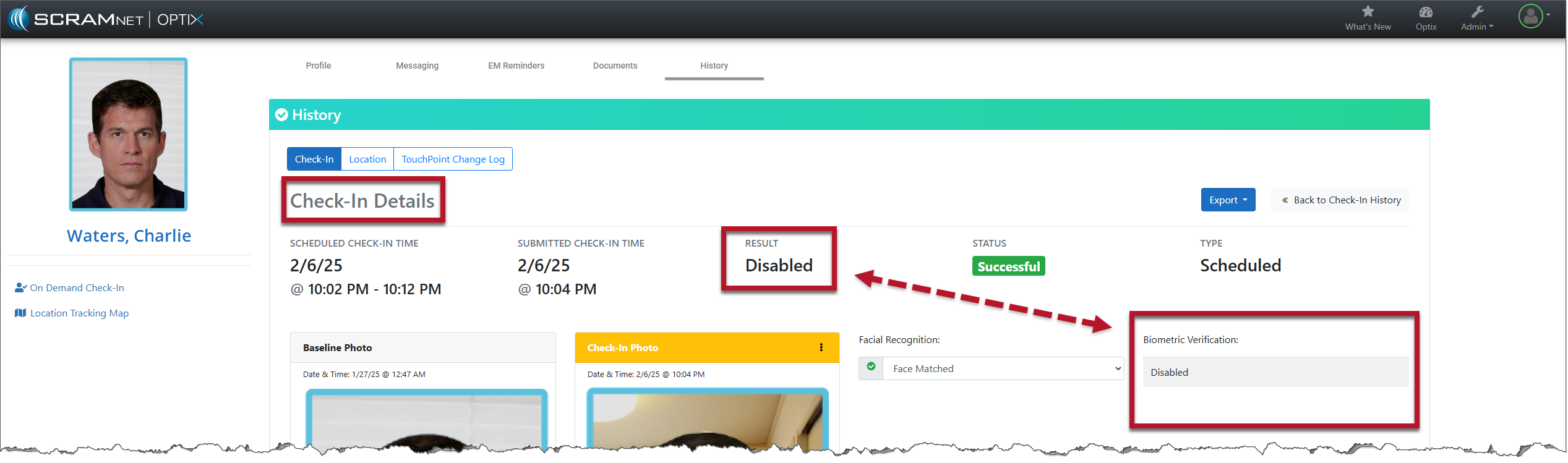
  1. The Check-In Details page will also display “Disabled” for Biometric Verification.
Check-In Details Page

TouchPoint Read Messages

Once a user reads a message in TouchPoint, that message will be marked as read for all users.

Mark Messages as Read

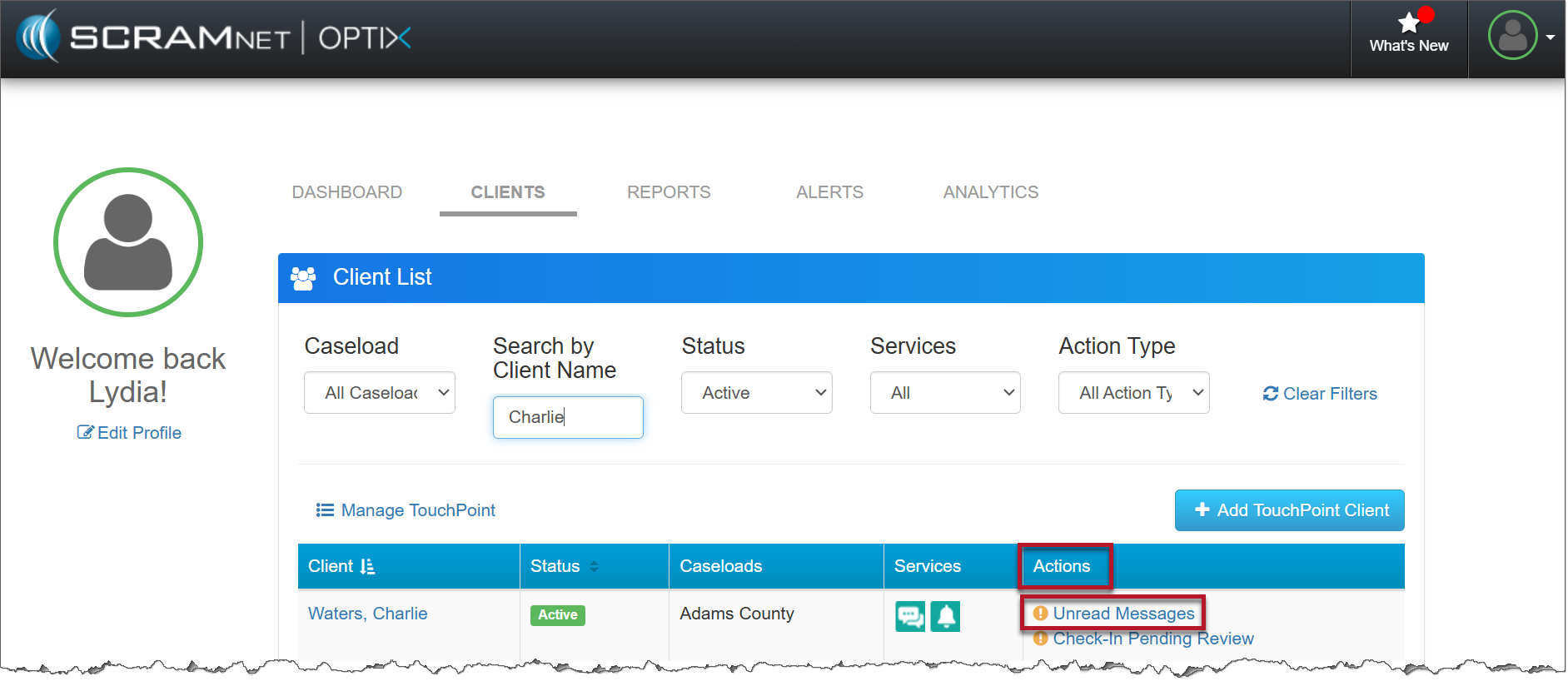
When a user receives a message from a client, an Unread Message alert appears in the Actions column on the Client List page. Select the Unread Messages hyperlink.

Client List Page

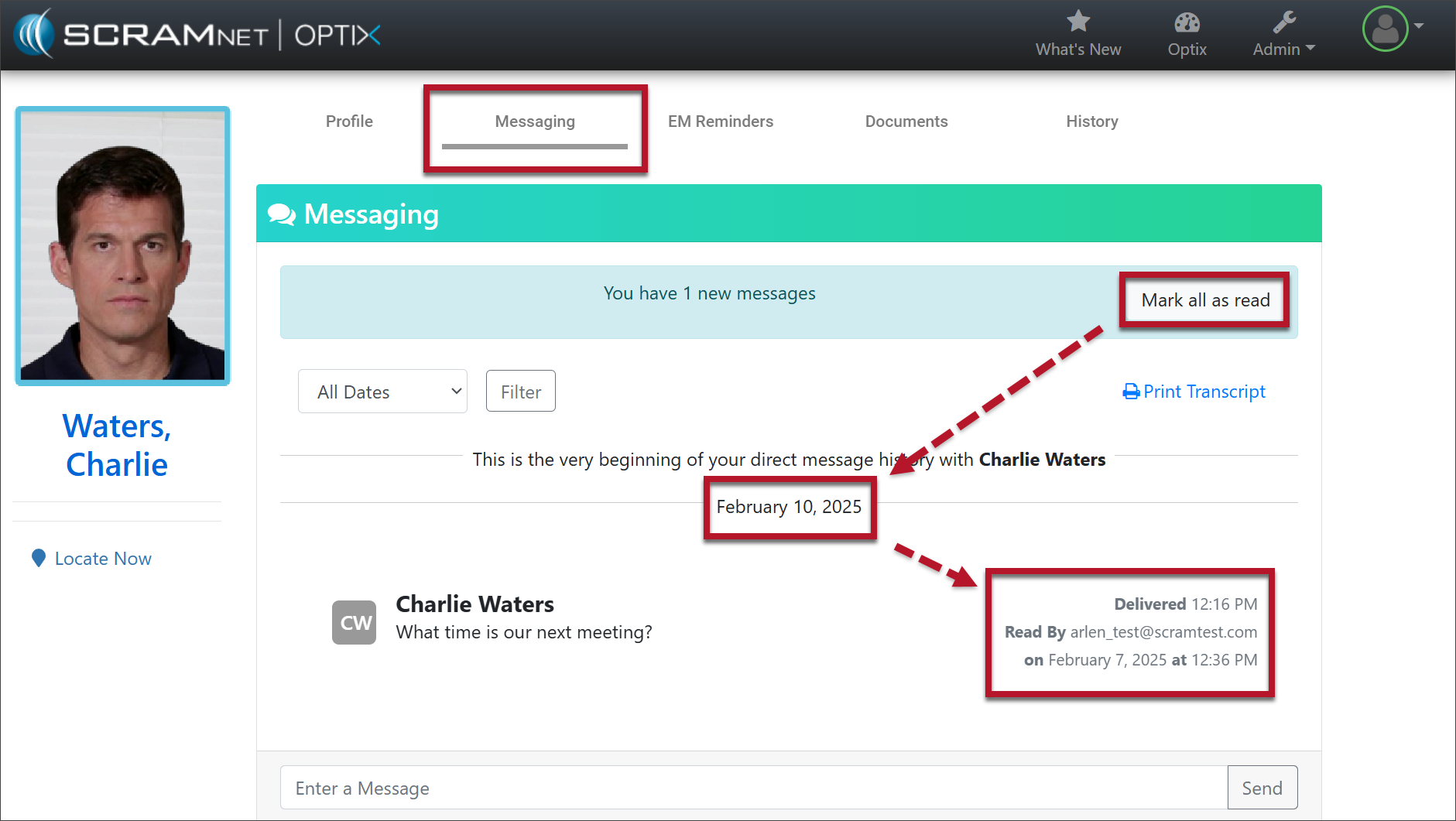
The new message displays on the Messaging tab. Selecting the Mark all as read button:

  • Removes the Unread Message alert from the Actions column for all users.
  • Displays a “Read By” receipt to all users that shows the username, date, and time of the message read.
Messaging Tab with Read Receipt

Update to Latest Version of TouchPoint Application

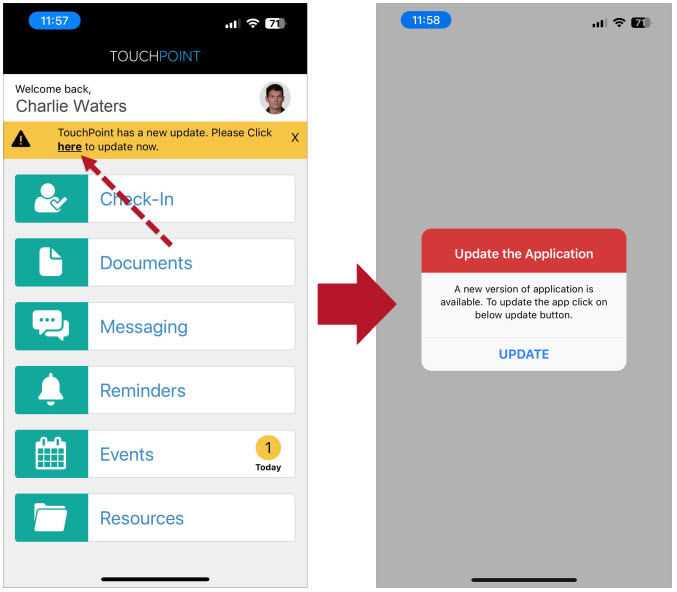
To ensure your client is using the most recent version of the TouchPoint Mobile Application, a reminder banner will be displayed when logging in to TouchPoint. Selecting the link will take the client to the Google Play store or Apple App Store to download and install the update.

If clients select the x in the banner, it will close the alert. The next time the client logs in, the banner will reappear until the app is updated.

TouchPoint’s New Update Banner

Continue Reading