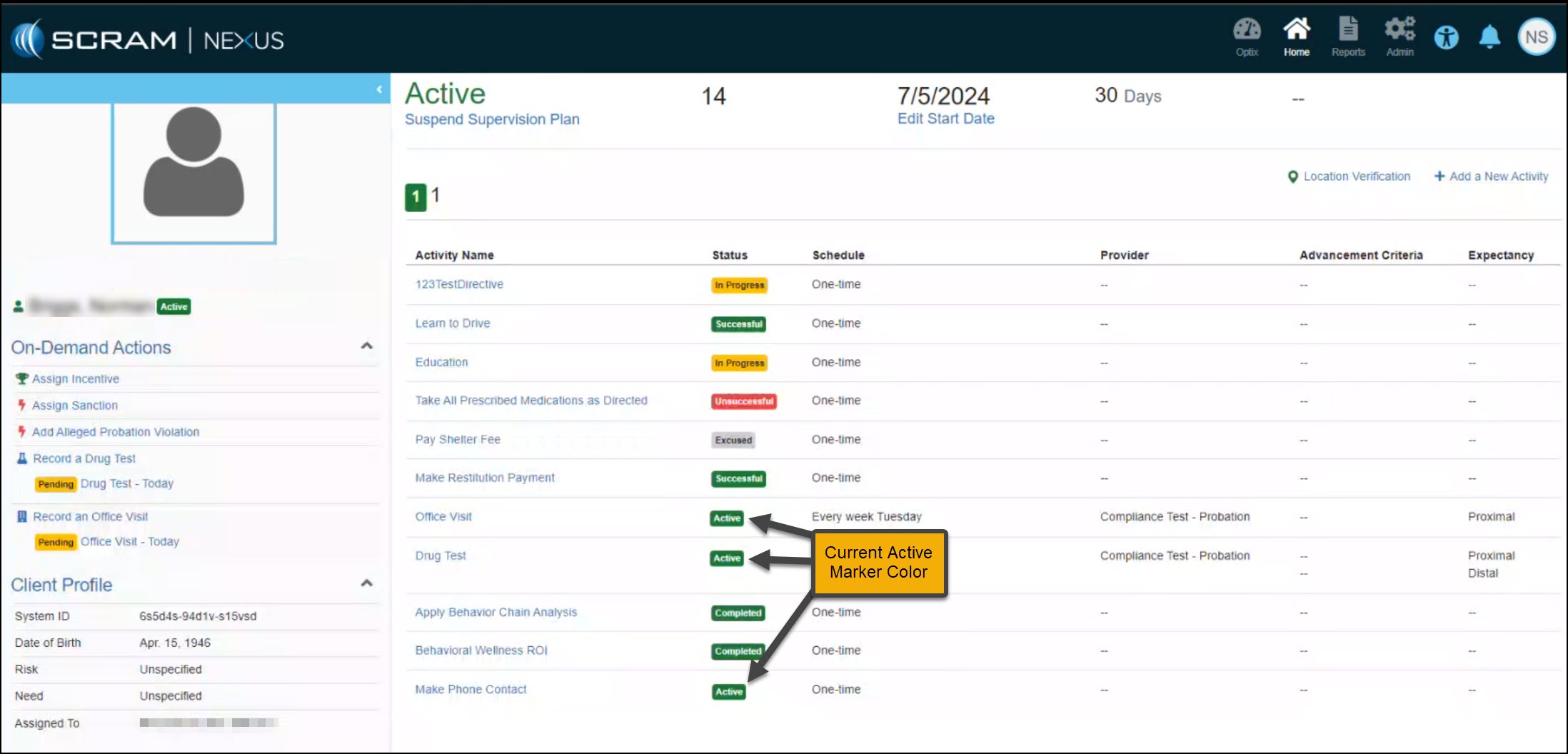
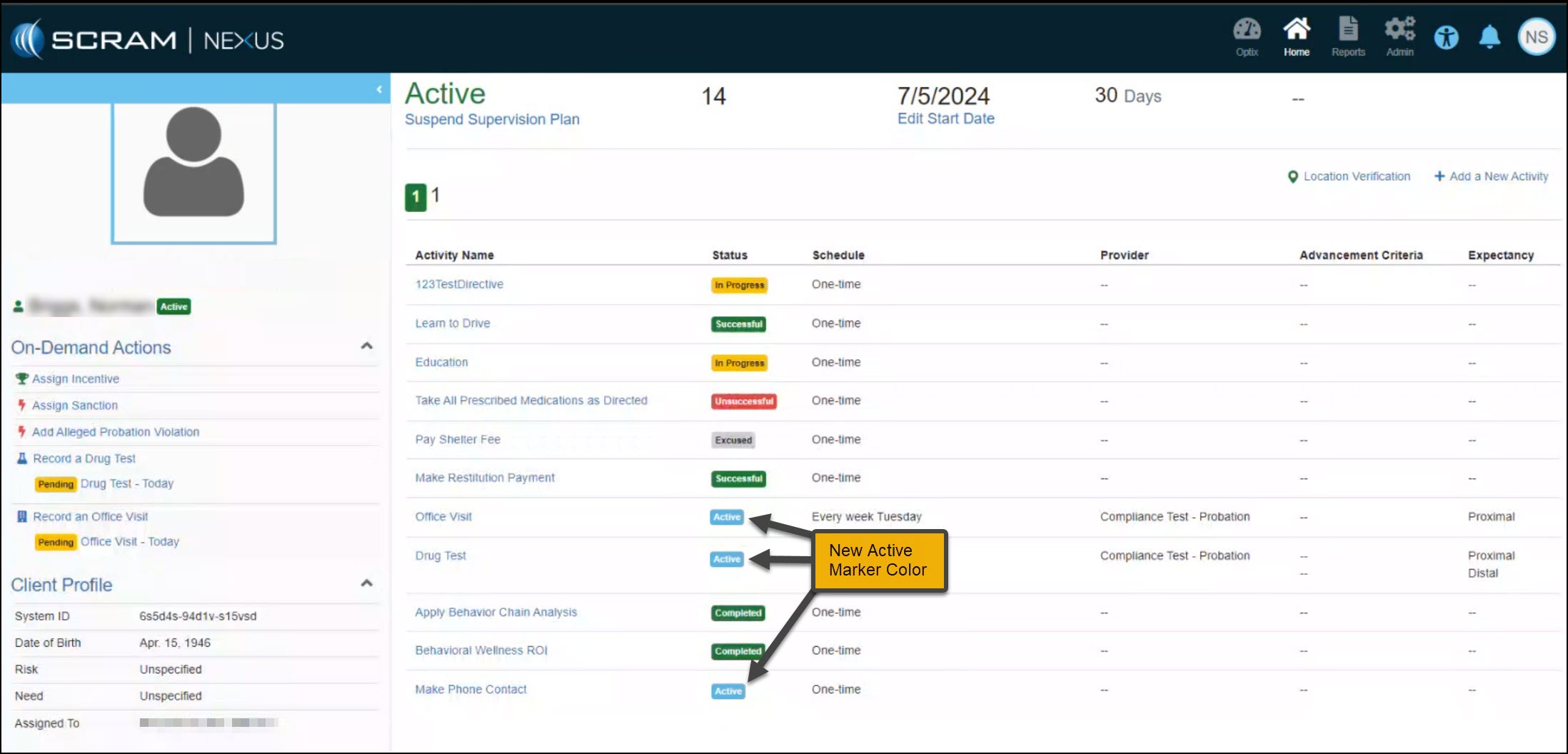
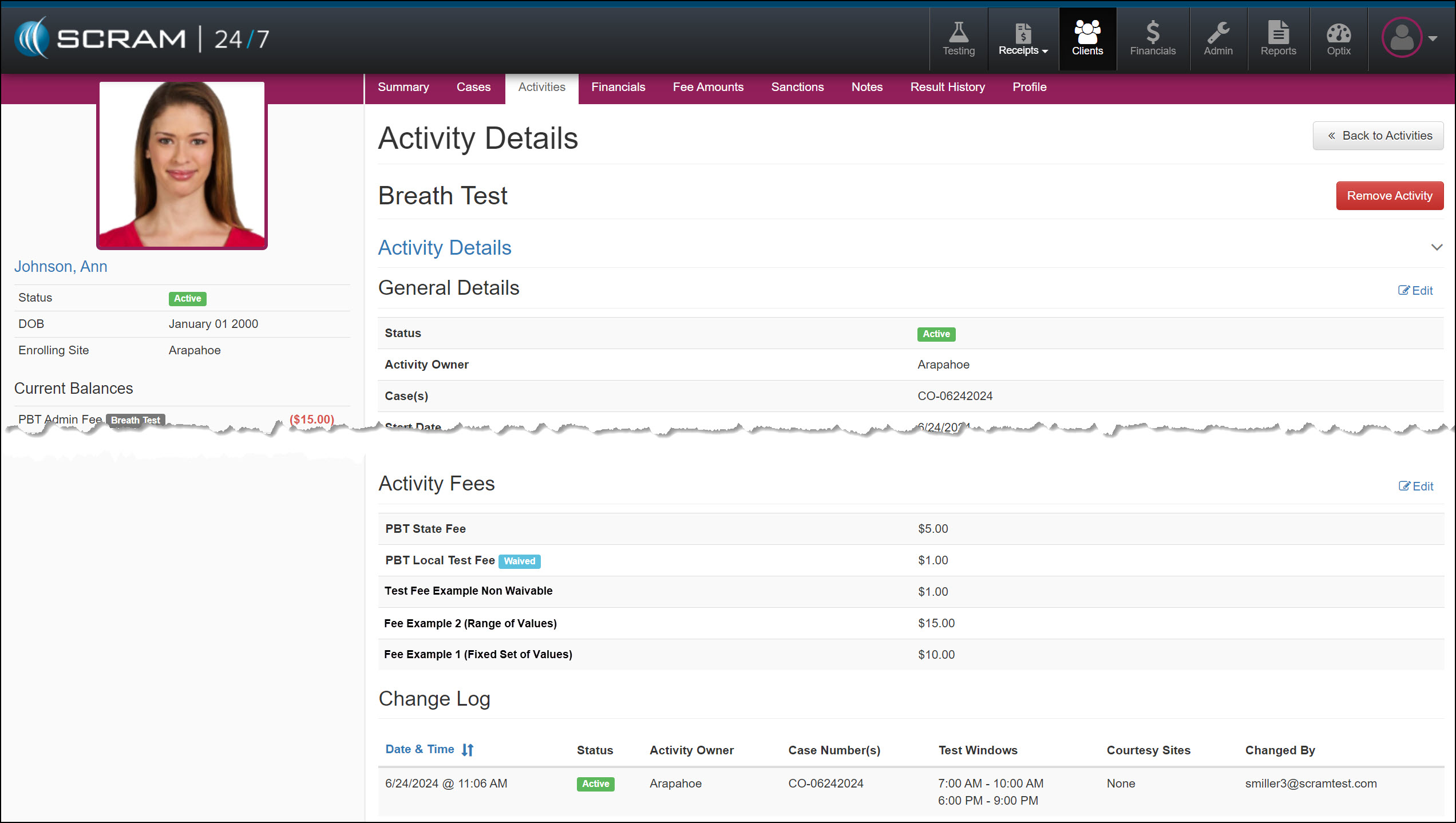
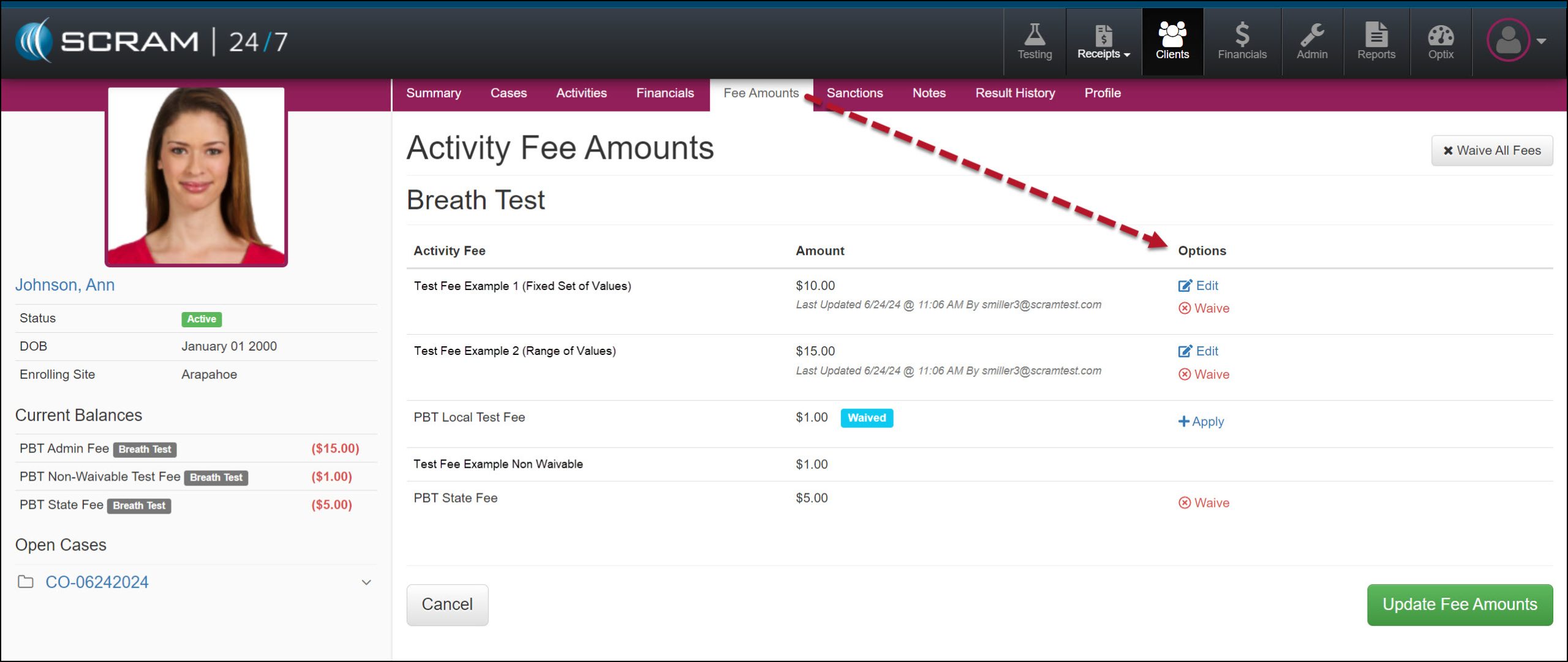
On July 25, 2024, SCRAM Systems will release an enhancement to help you identify the Active, Successful, and Completed status markers for Activities within a Supervision plan. Currently, all three (3) status markers are green. With this enhancement, the Active marker will now be light blue.
If you don’t see the enhancement in SCRAM Nexus, please clear your cache and cookies and refresh your browser window.
Nexus Active Status Markers in Green – click to enlargeNew Active status Markers in Blue – click to enlarge
This color enhancement is reflected throughout the SCRAM Nexus software.
On July 11, 2024, SCRAM Systems will release enhancements for your client Check-In and Document-sharing Caseloads. Specifically:
You may now eliminate the requirement for the client to answer questions during a TouchPoint Check-In.
Clients may send Word and PDF documents, as well as images, by utilizing the Documents feature within the TouchPoint mobile application.
The latest version of the TouchPoint app will be available to clients in the app stores. As a best practice, SCRAM Systems recommends that all TouchPoint app users enable their smartphones to automatically update their apps to make this process easier.
Not seeing the enhancement in SCRAM Optix? Clear your cache and cookies and refresh your browser window.
No Question Check-In Group
When a client is not required to answer questions during a TouchPoint check-in, you may remove that requirement for current Check-In Groups or create a new Check-In Group with the questions removed.
New Check-In Group
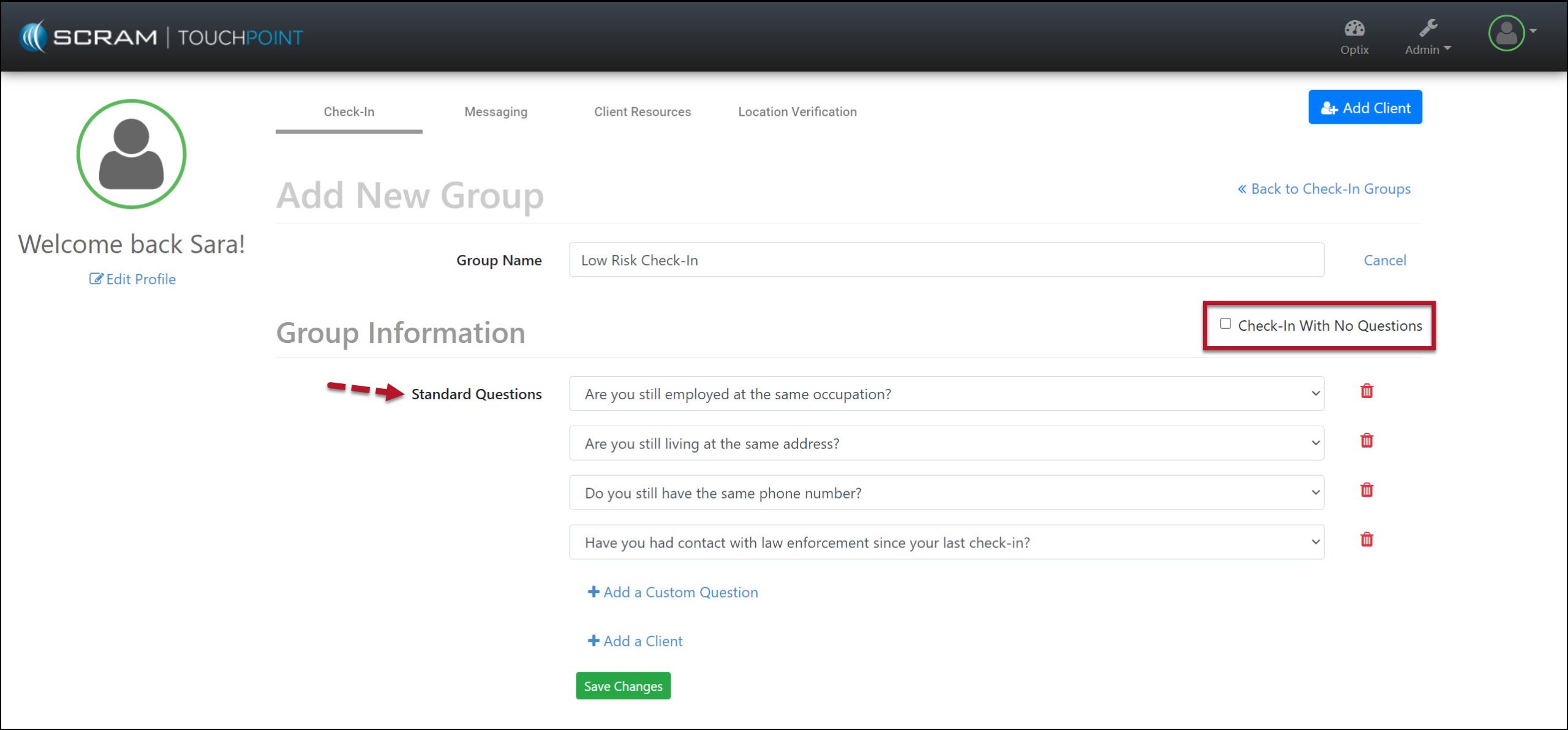
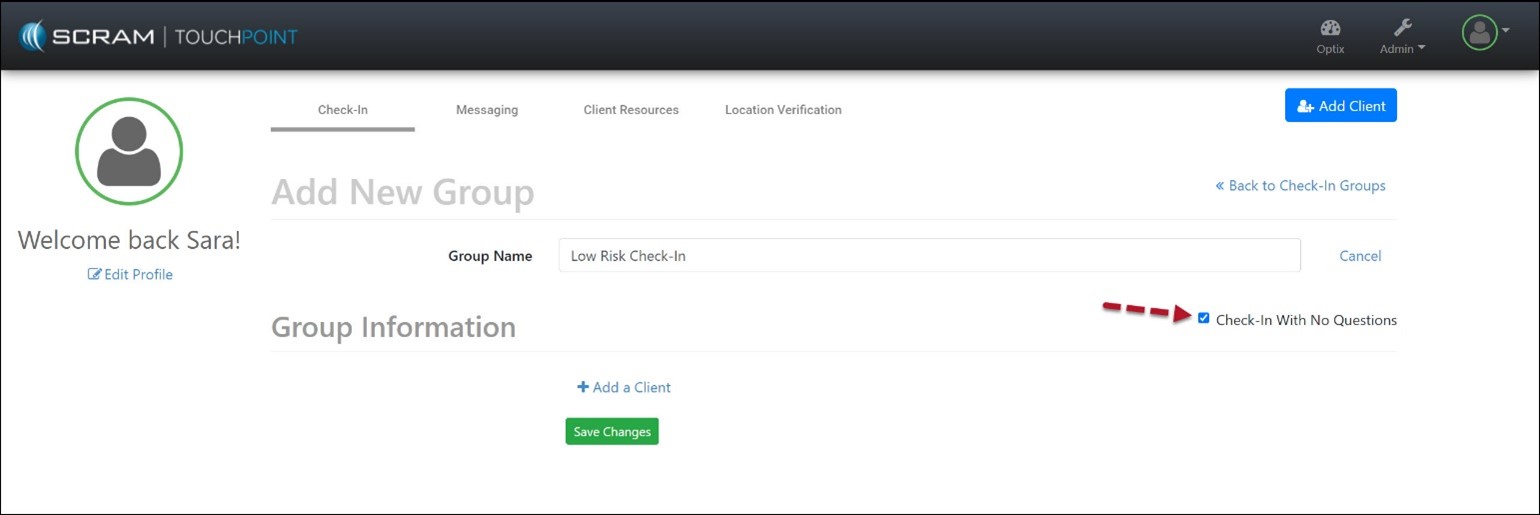
When creating a new Check-In Group, select the checkbox next to the statement “Check-In With No Questions” to remove all questions from the check-in.
Example: Before the checkbox is selected – click to enlargeExample: After the checkbox is selected – click to enlarge
Edit a Current Check-In Group
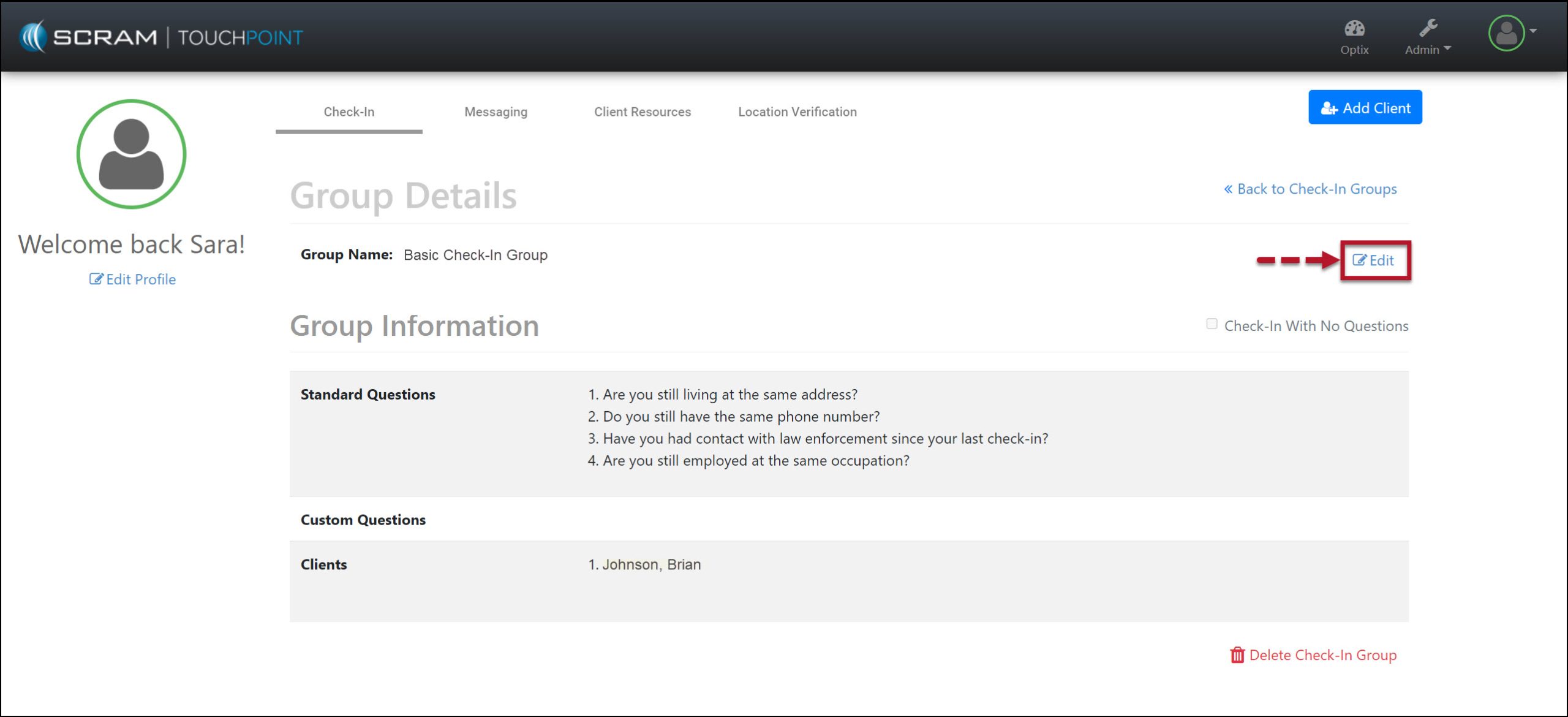
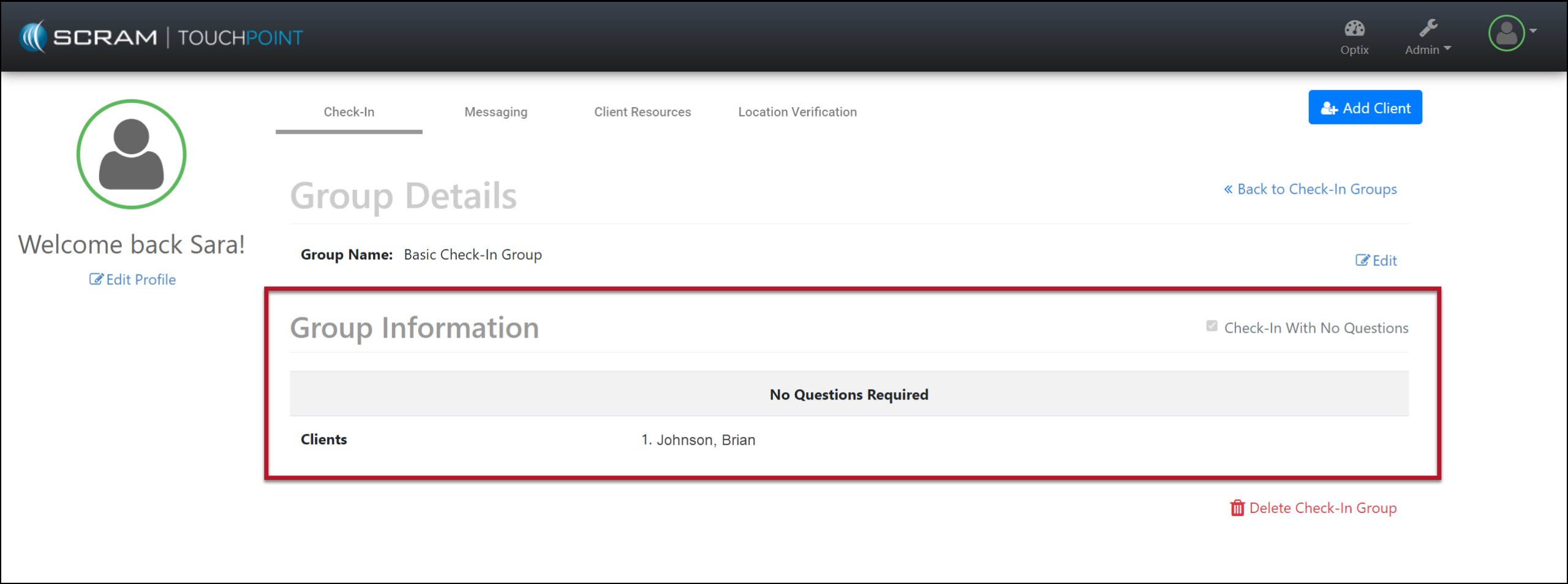
To remove the questions from a current Check-in Group, select the Edit link and the checkbox next to “Check-in Group With No Questions.”
Edit current Check-In Group – click to enlargeCheck-In Saved with Updated Settings – click to enlarge
During a Check-In, once the client has selected the Check-In button within the TouchPoint mobile application and completes the Biometric verification (fingerprint or face ID), they will be prompted to take a photo and submit the check-in.
Document Sharing from the Client’s TouchPoint Mobile Application
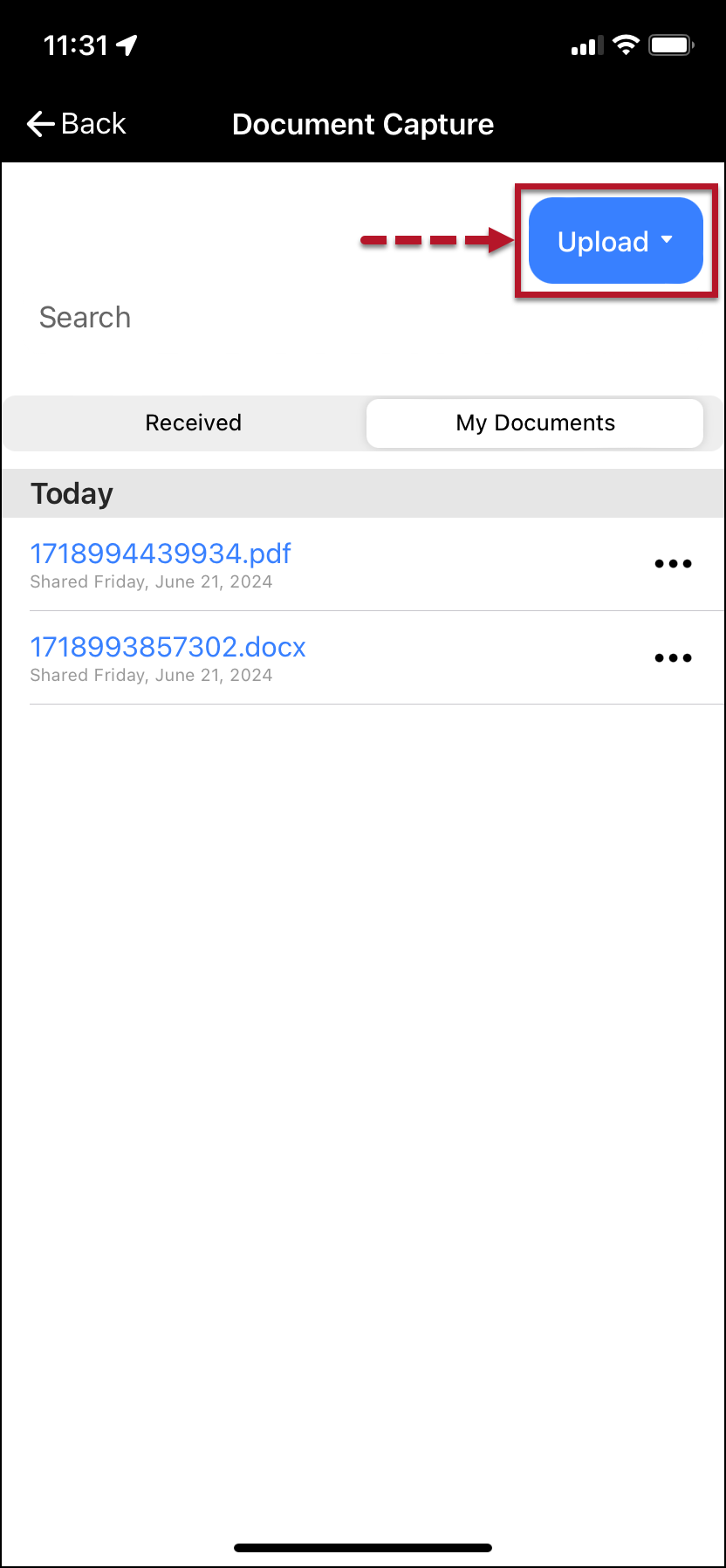
The client may share images from their TouchPoint mobile application from the Documents Capture screen. With this update, the client may also share Word documents and PDF files from their mobile application.
Once the client has saved a document to the smartphone, on the Document Capture screen:
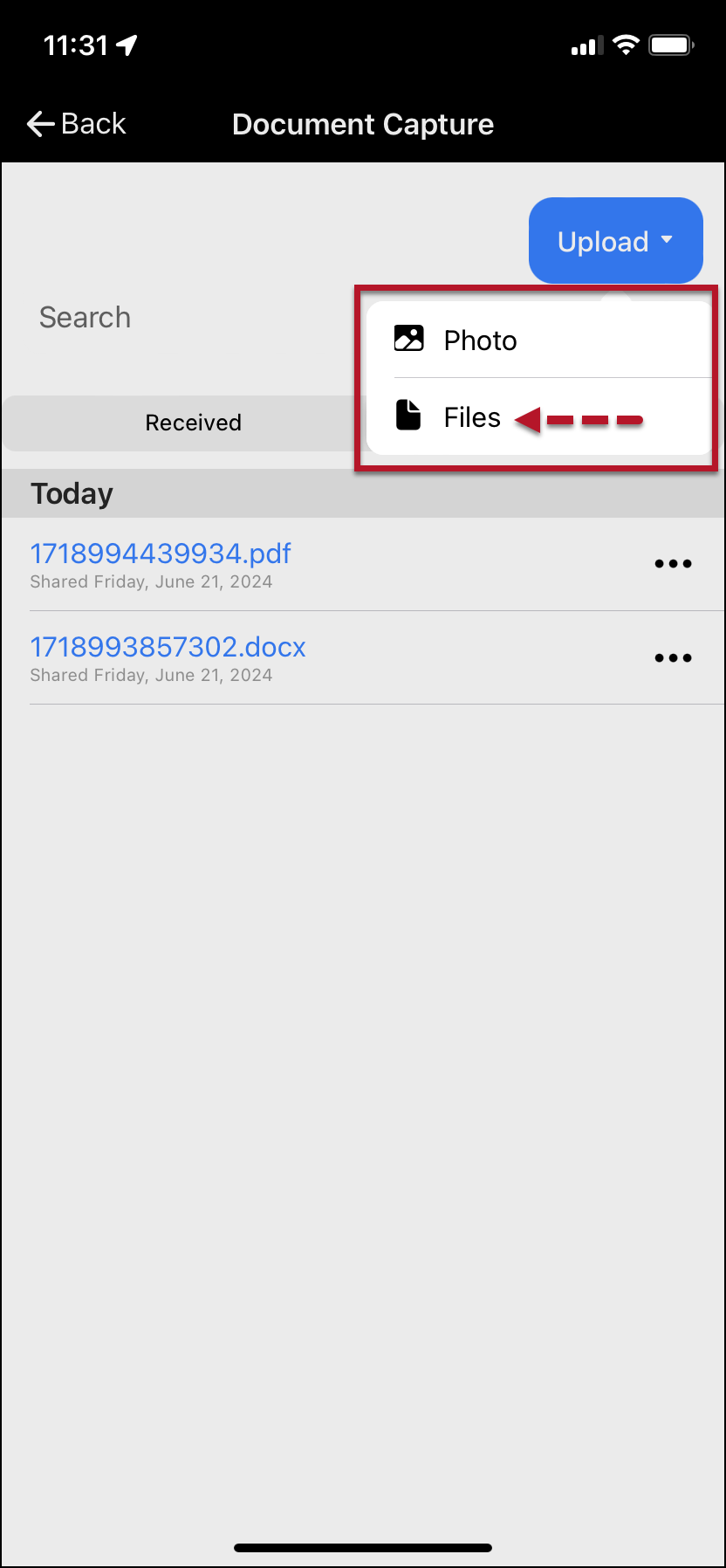
Tap the Upload button.
Tap the Files option on the dropdown menu.
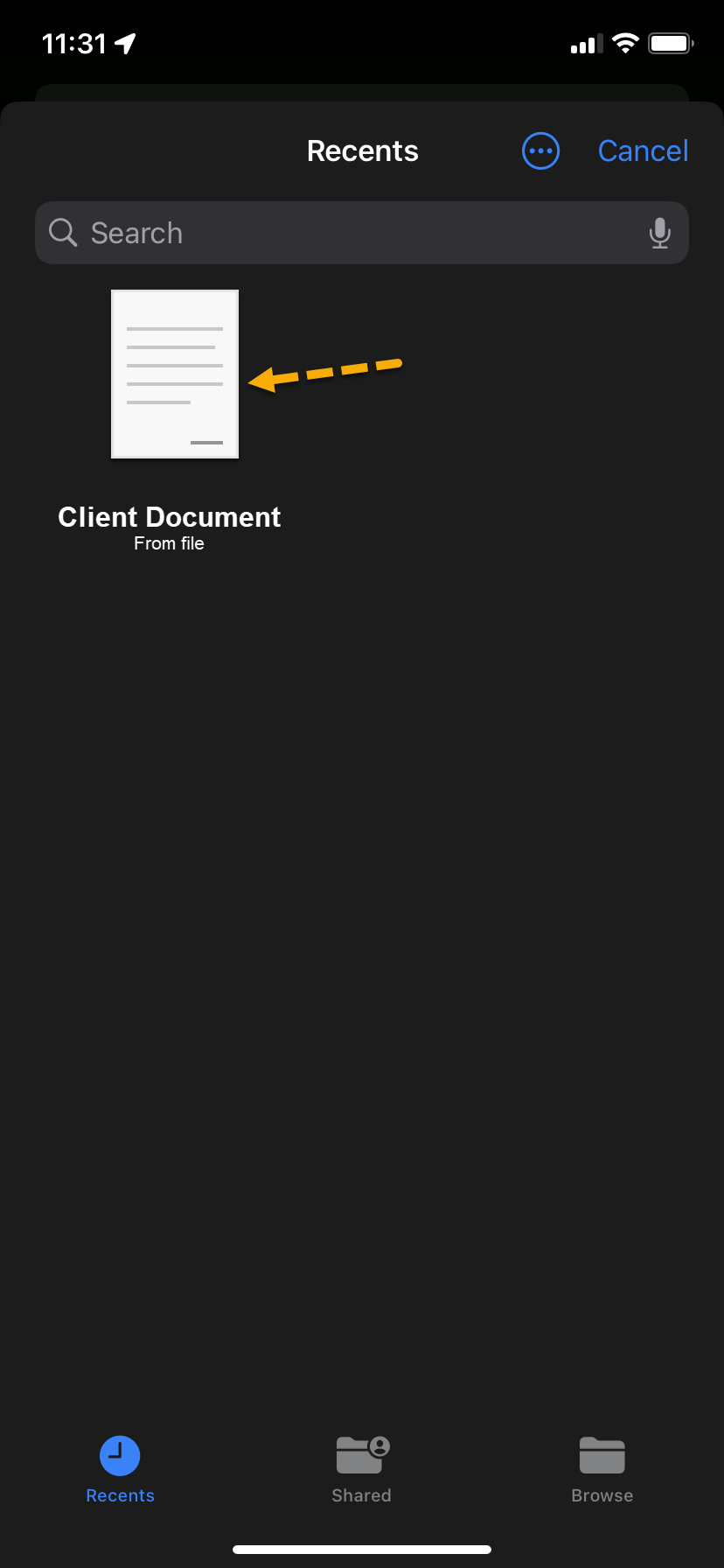
Search for or tap on the file to be shared.
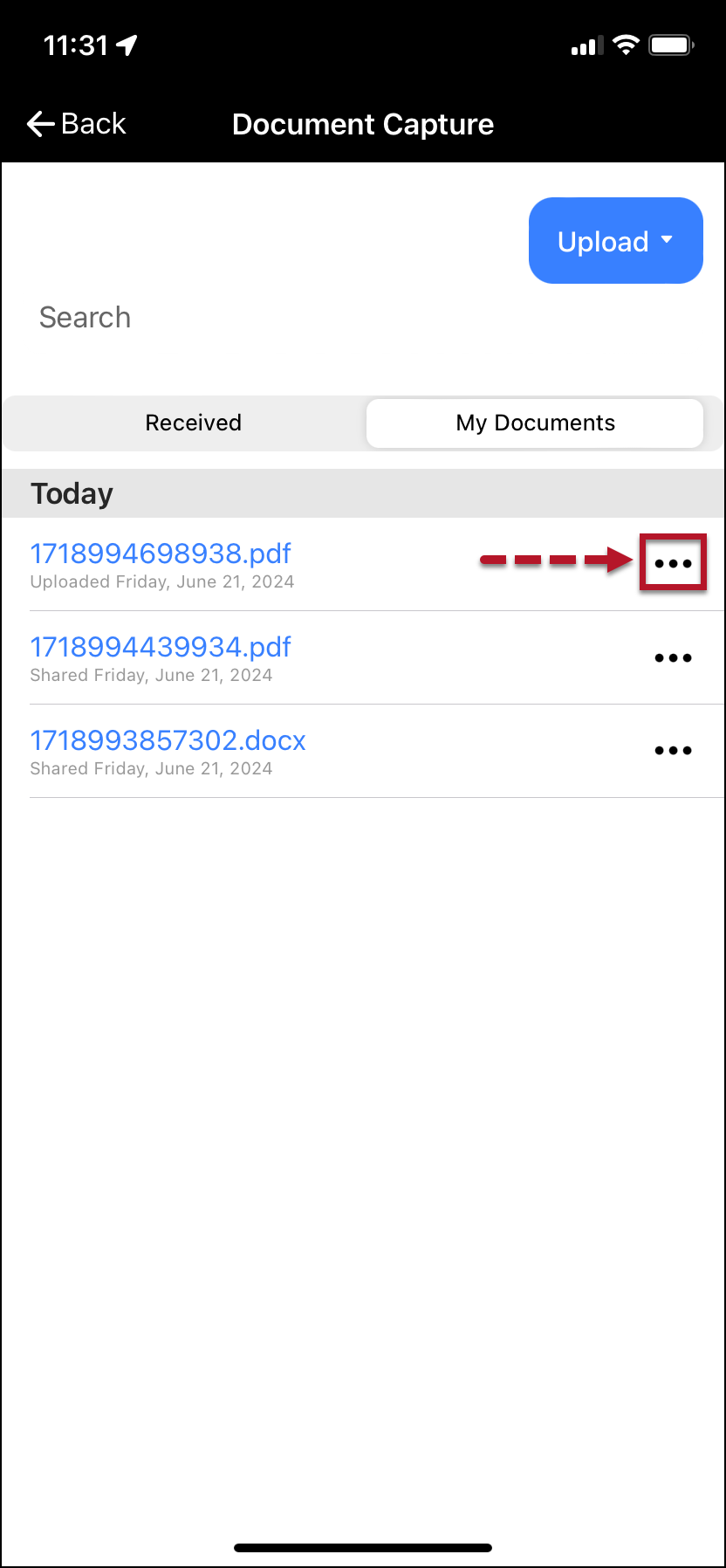
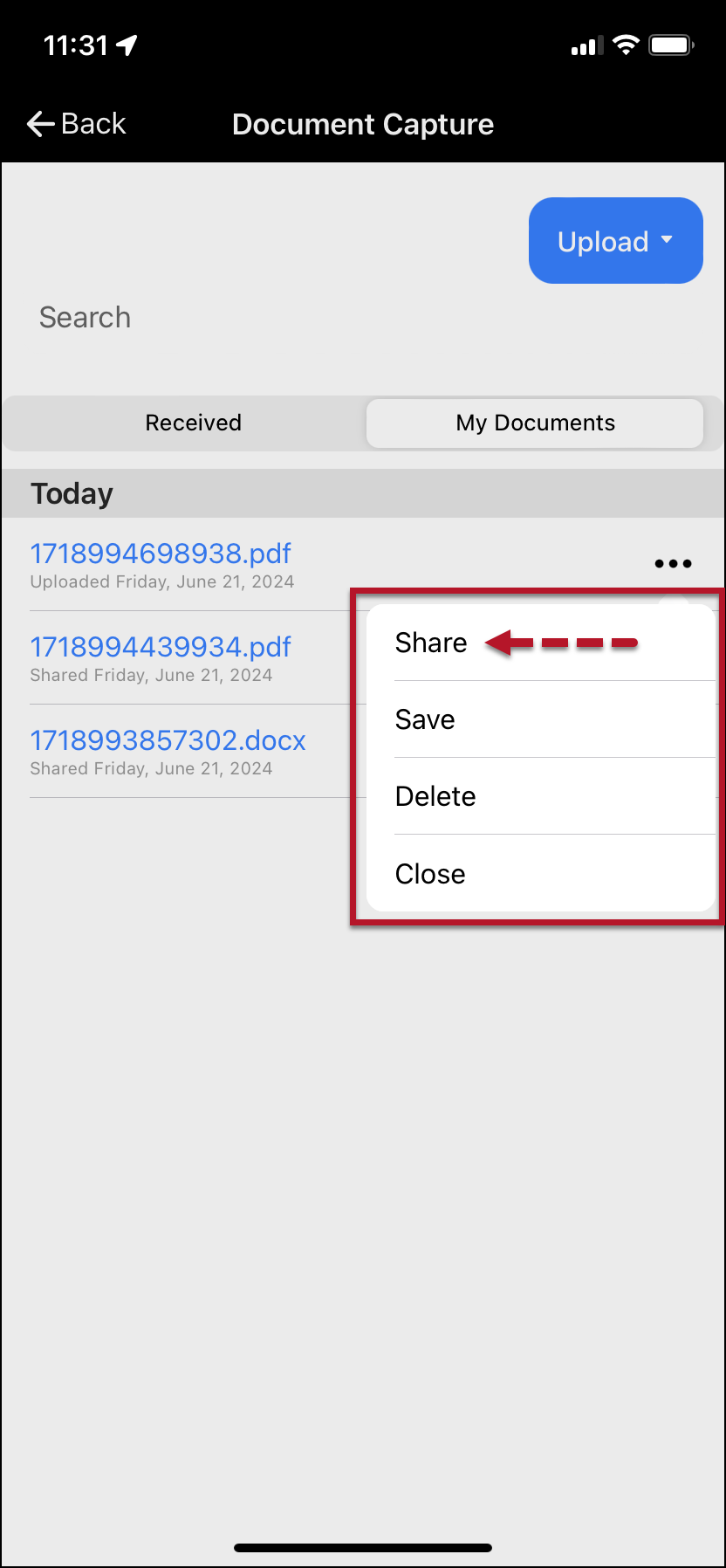
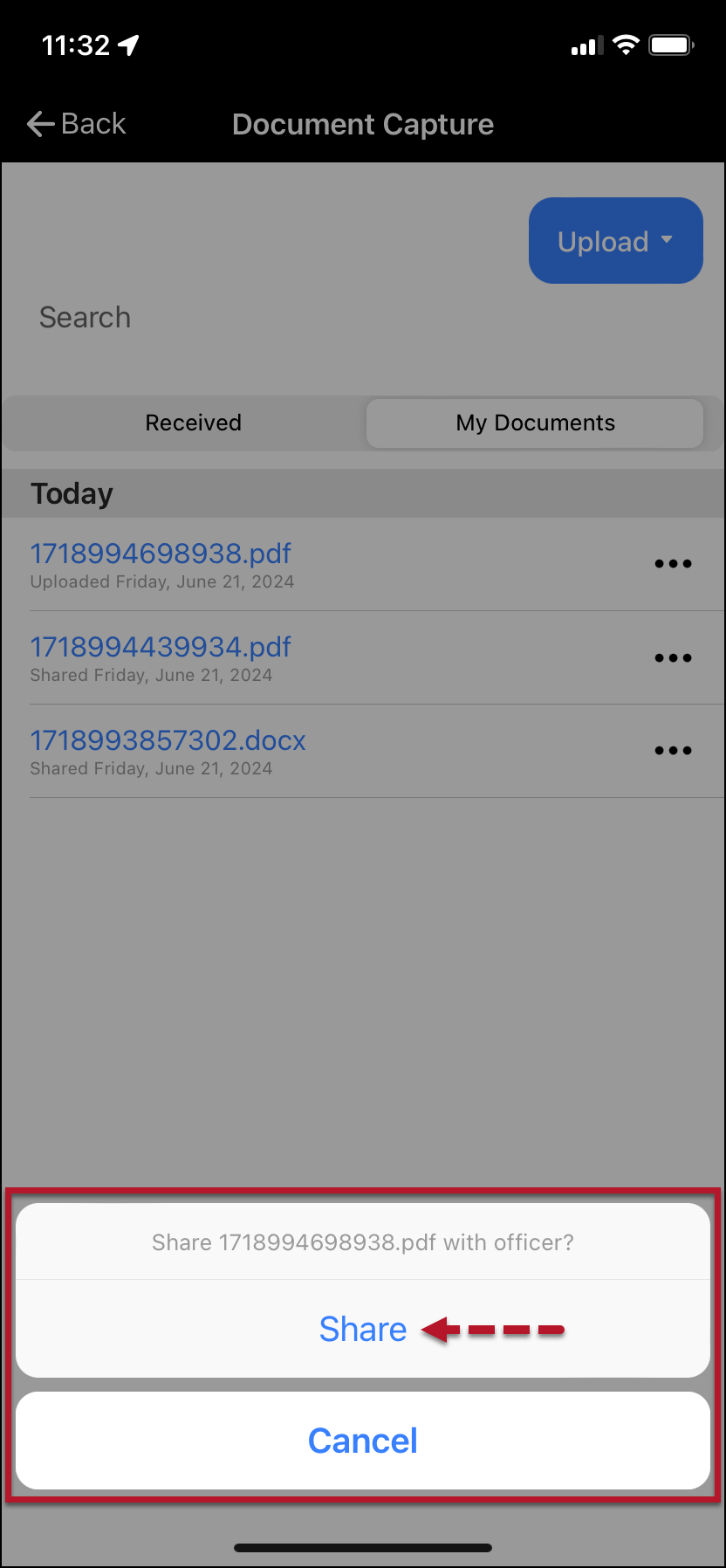
The uploaded file will be listed on the client’s My Documents screen. Select the ellipsis next to the file and tap the Share option on the dropdown menu to access it.
Tap the Share file acknowledgment button.
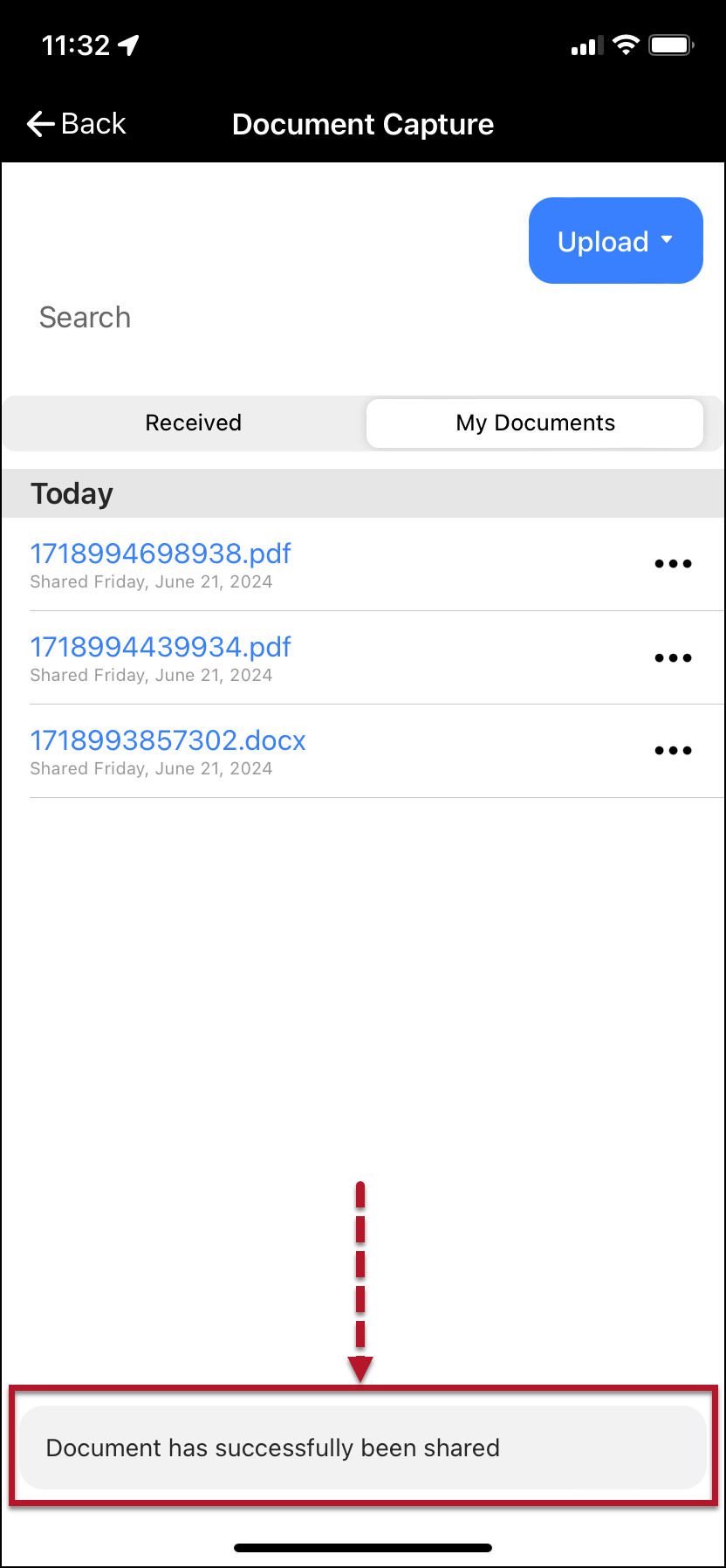
Once shared, a “success” banner will be displayed on the bottom of the screen.
click to enlarge
click to enlarge
click to enlarge
click to enlarge
click to enlarge
click to enlarge
click to enlarge
Supported file types include .pdf, .doc, and .docx.
There is a 5 MB file size maximum.
The client is responsible for managing their smartphone’s file storage location.
Viewing a Shared File
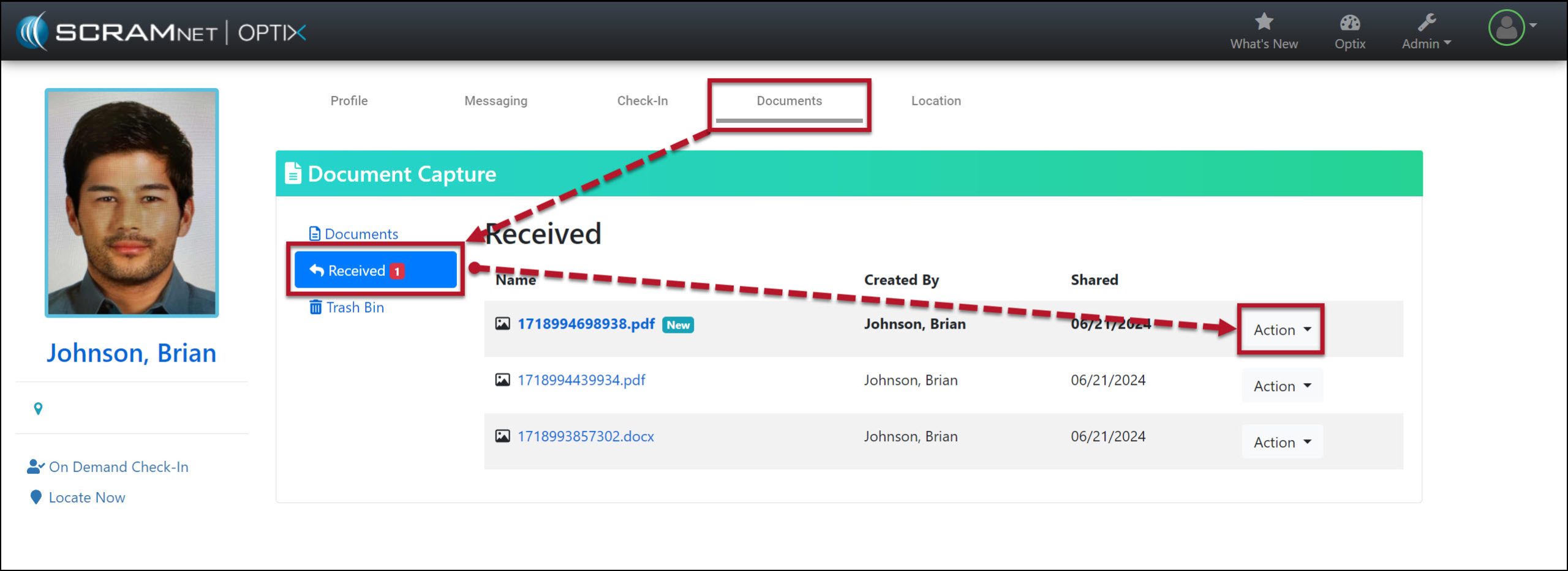
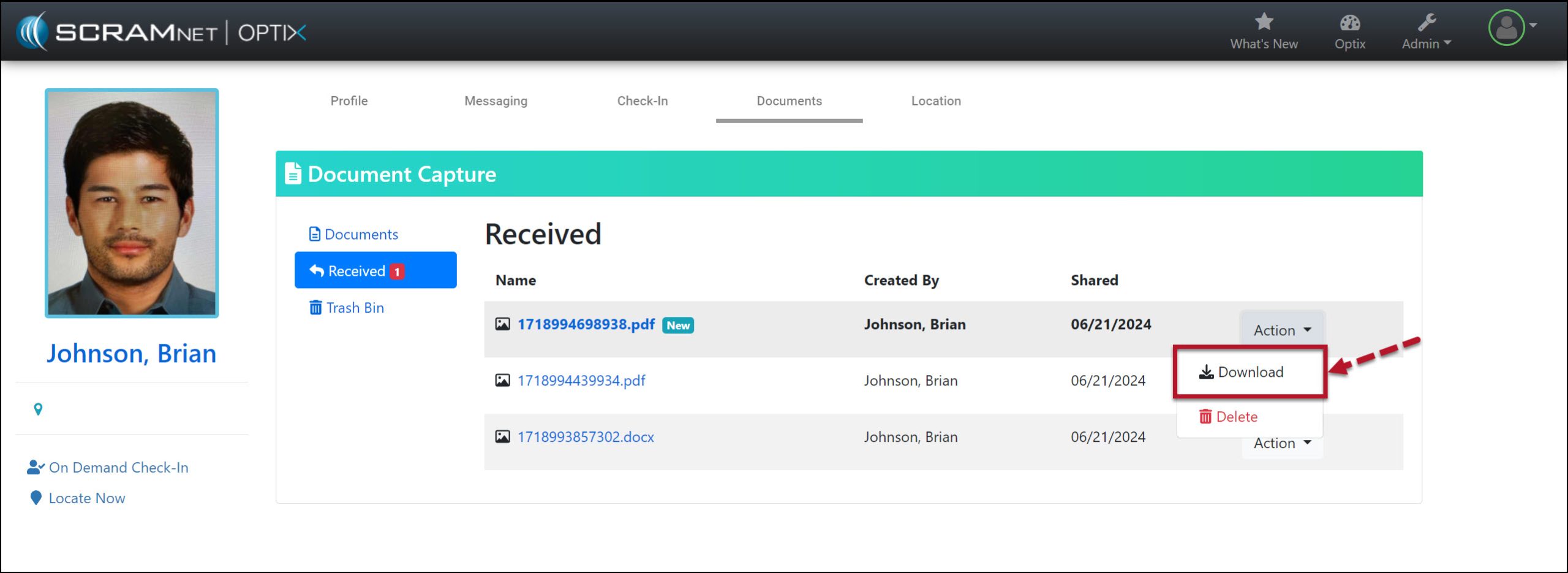
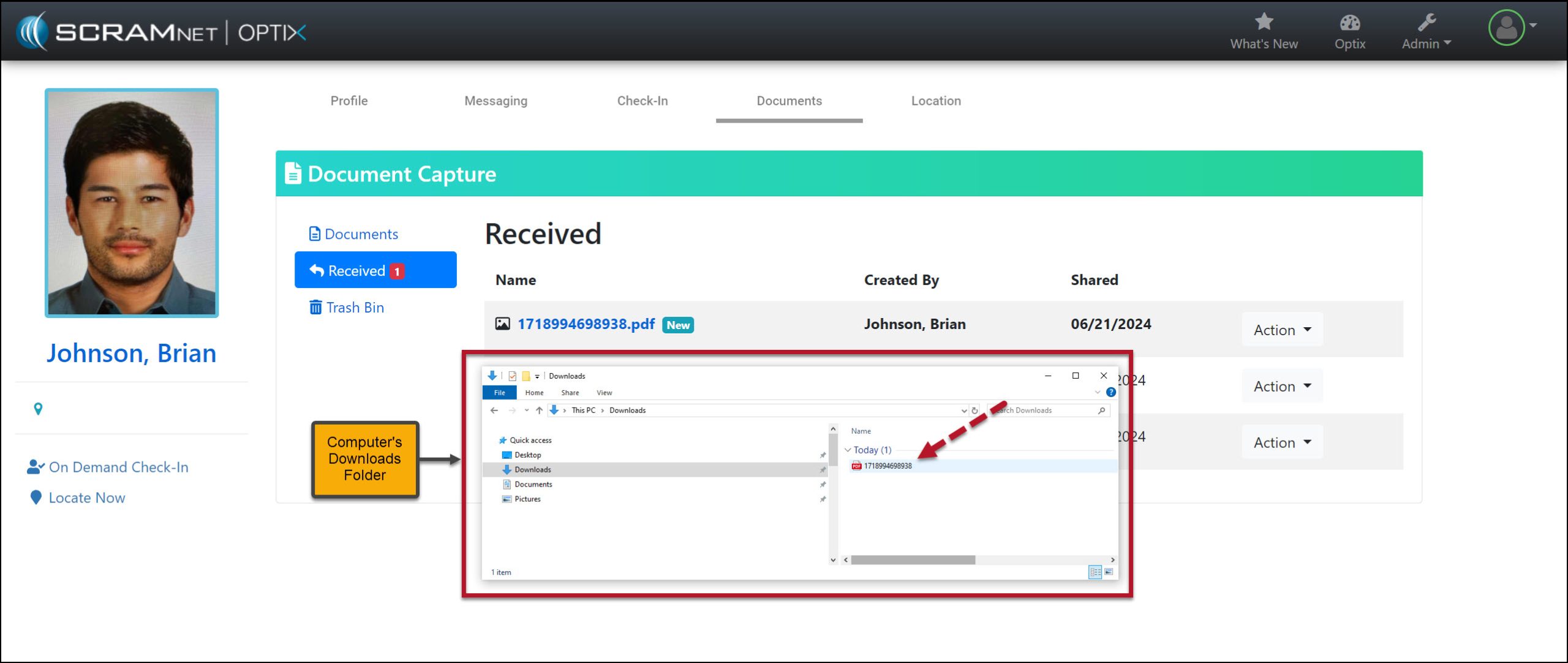
In SCRAM Optix, access the Received section of the DocumentsCapture page for the client, and then open the Action dropdown menu to download the shared file.
Received Documents Screen – click to enlargeAction Dropdown Menu Download Option – click to enlargeComputer’s Downloads Folder – click to enlarge
At 5:00 AM MDT on Thursday, June 27, 2024, SCRAM Systems released an enhancement to the SCRAMNET GPS Suspend Alerts feature.
Suspend Alerts
The Suspend Alerts feature in SCRAMNET GPS is used to suspend alerts from appearing on the Dashboard and to pause notifications from being sent for specific clients during a specified time period. This is useful when you know alerts will be generated and there is no need for supervising authorities to take any action. For example, a client in the hospital might generate ‘No Communication’ and ‘No Location’ events while admitted, due to the hospital building’s impaired environment, but the client’s location and condition is known; so there is no need to take action.
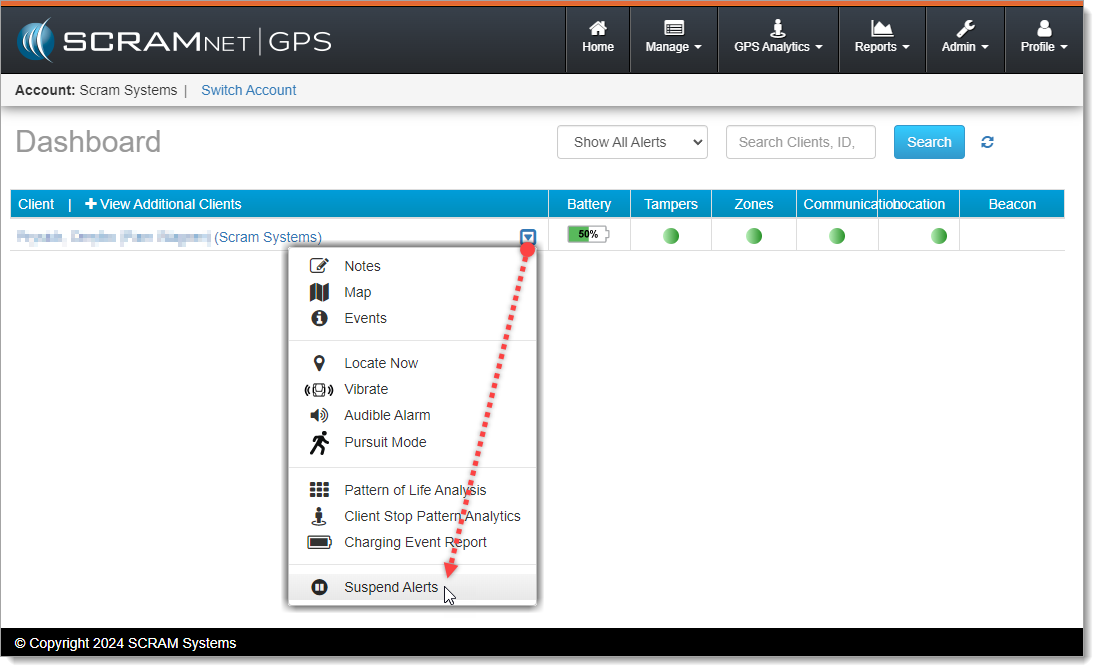
Alerts can be suspended by selecting Suspend Alerts from the context dropdown menu next to the client’s name on the SCRAMNET GPS Dashboard:
Select ‘Suspend Alerts’ from the Dropdown Menu (click to enlarge)
Prior to this release, SCRAMNET GPS offered two options for suspending alerts:
Suspend All Alerts – During the suspension period, alerts do not show on the dashboard, notifications are not sent, and tickets are not generated for the GPS Monitoring Center.
Suspend Alerts to Call Center Only – During the suspension period, tickets will not be generated for the GPS Monitoring Center; however, the alerts are shown on the dashboard, and notifications are still sent.
The ‘Suspend Alerts to Call Center Only’ option is only visible to accounts using the GPS Monitoring Center service.
Simplified Process for Enabling Suspend Alerts
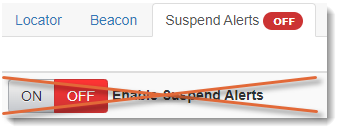
Previously, to suspend alerts users had to first toggle the Enable Suspend Alerts button to ON before selecting the suspension timeframe. With this release, the toggle button has been removed. Users may configure the suspension directly without first setting the button to ON.
The Toggle is Gone, but the Badge Remains
Although the toggle is gone, the ON / OFF badge in the Suspend Alerts tab is still used to indicate at a glance if a suspension is active, without having to click into the tab.
Suspend Alerts by Dashboard Column
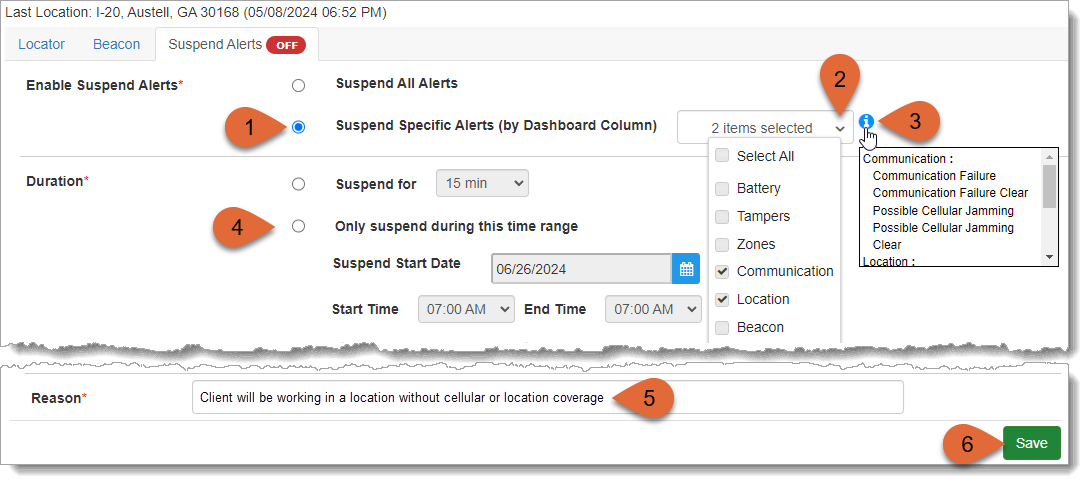
Thursday’s release introduced a third Suspend Alerts option in addition to the two described above: Suspend Specific Alerts (by Dashboard Column). This option supports suspending specific alerts that appear in the columns on the SCRAMNET GPS Dashboard. This is useful when you want to suspend some alerts, but don’t want to suspend all alerts. For example, you could suspend ‘No Communication’ and ‘No Location’ events, but leave ‘Tamper’ events active. To use this new feature:
Select the Suspend Specific Alerts (by Dashboard Column) radio button
Then select the desired Dashboard columns from the dropdown menu
Hover over the Information icon to see which specific alerts apply to the selected columns
Select the appropriate Duration for the alert suspension(s)
Add a Reason for the alert suspension
Save your new alert suspension schedule
New ‘Suspend Specific Alerts’ Feature (click to enlarge)
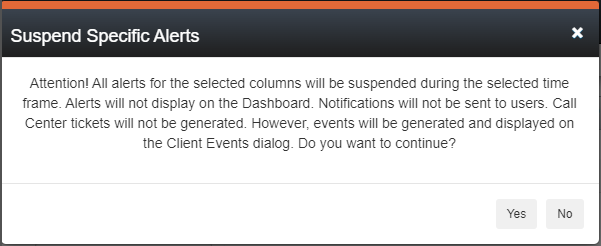
Upon selecting Save, the Suspend Specific Alerts dialog window will appear:
‘Suspend Specific Alerts’ Dialog Window
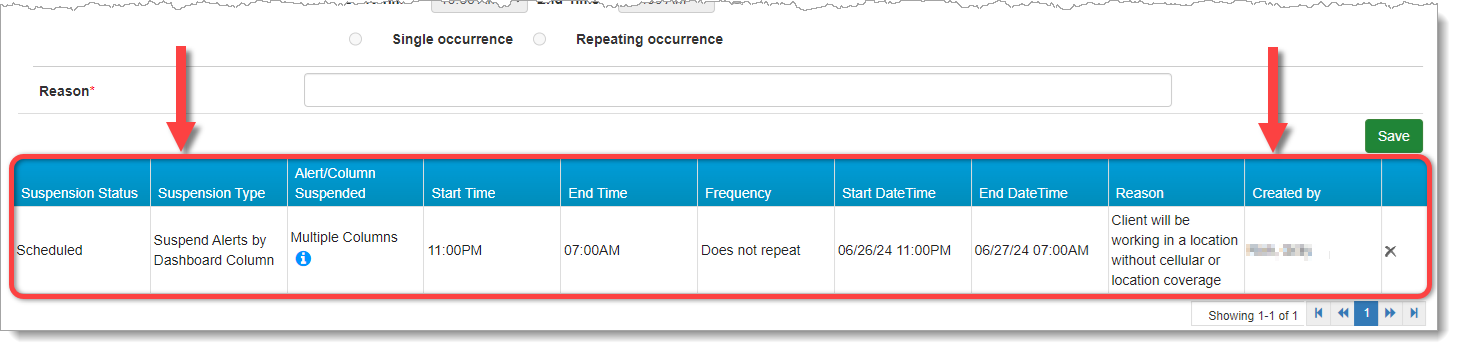
Select Yes on the dialog window to confirm your new alert suspension schedule. It will appear in a table beneath the Save button at the bottom of the page:
GPS Suspension Status: Scheduled (click to enlarge)
Schedule Multiple Suspensions
Additionally, Suspend Alerts by Dashboard Column supports multiple and recurring suspensions. To schedule multiple suspensions:
Select Only suspend during this time range
Set the Suspend Start Date, Start Time, End Time, and Suspend End Date
Then click Save
Schedules may be for overnight, or may last longer than 24 hours. Please note, however, that no part of a scheduled suspension can overlap with any other scheduled suspension. For example:
Start Date
Start Time
End Date
End Time
Result
June 26
11:00 PM
June 27
7:00 AM
This is an overnight schedule and will end the next morning
June 26
11:00 PM
June 30
7:00 AM
The suspension will start June 26 at 11:00 PM and continue until June 30 at 7:00 AM
Schedule Recurring Suspensions
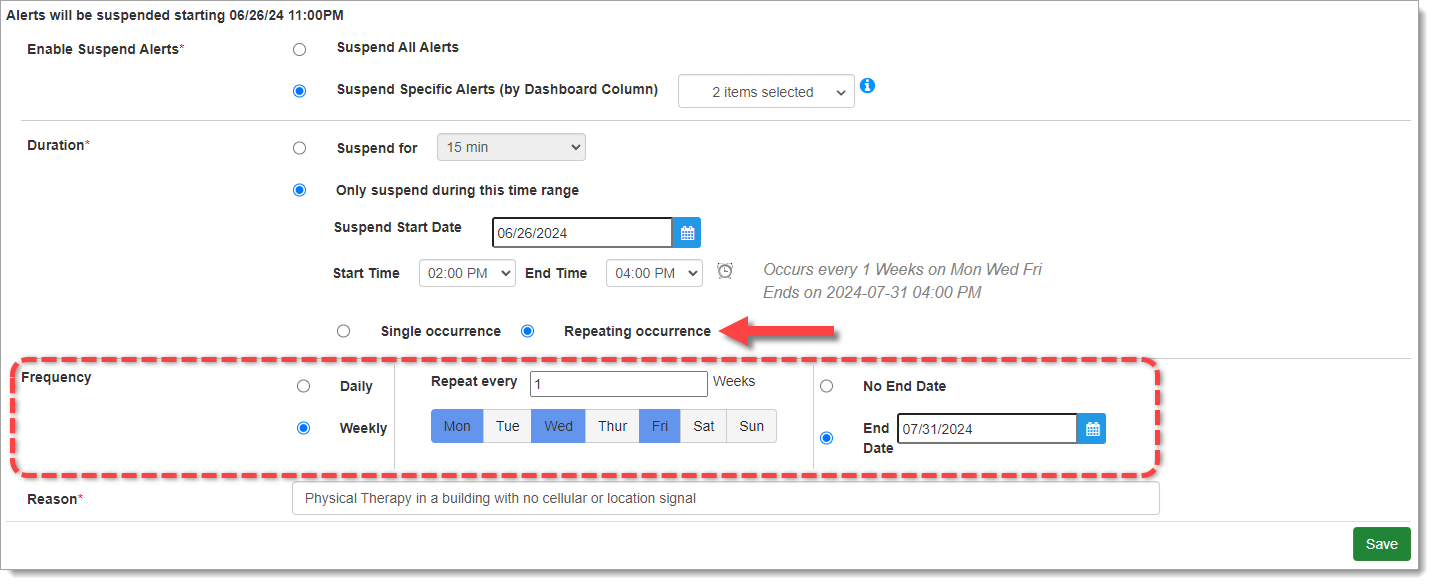
Scheduled suspensions can be recurring. For example, alerts can be suspended every day for the next five days, or every Monday, Wednesday, and Friday. When creating the suspension select the Repeating Occurrence radio button to reveal the Frequency options. Then select the desired Frequency:
Recurring Alert Suspension (click to enlarge)
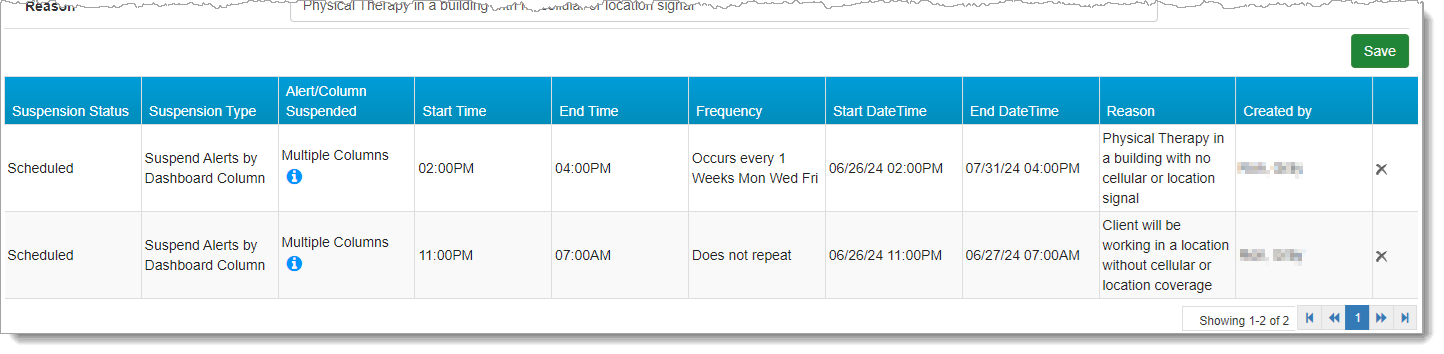
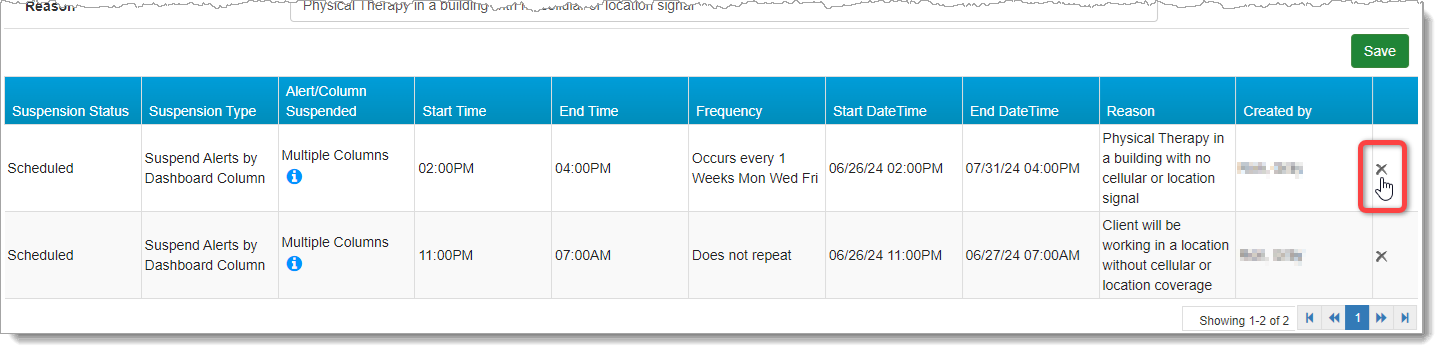
Once you Save the alert suspension schedule(s) and select Yes to confirm in the dialog window, the recurring suspension(s) will appear the table at the bottom of the page:
Recurring Suspensions Schedule (click to enlarge)
How Suspensions Appear on the Dashboard
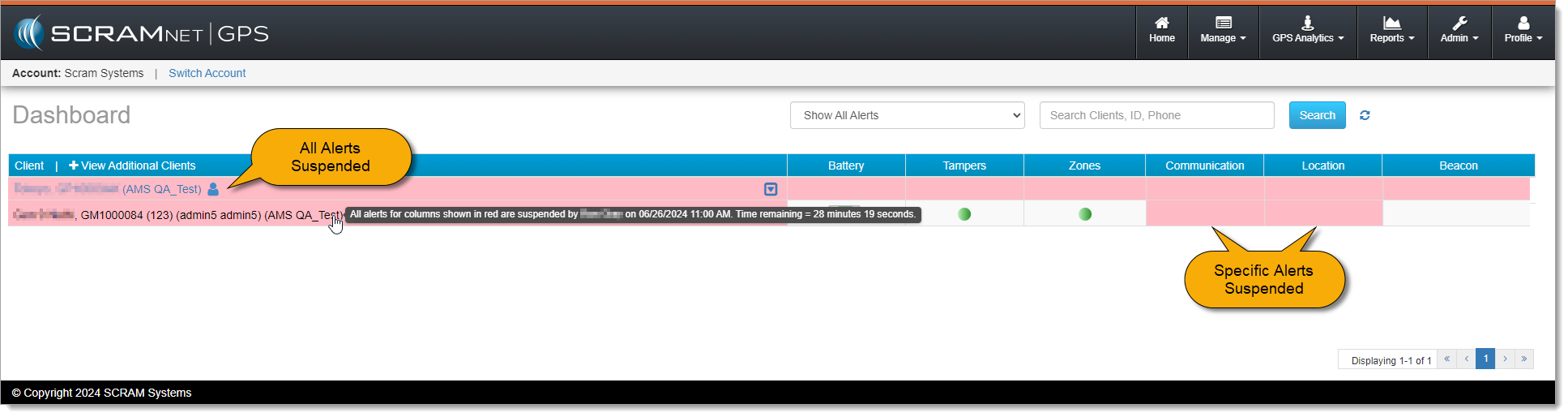
The Dashboard visually indicates if all alerts are suspended or if only alerts for specific columns are suspended. Suspended columns are highlighted in red. Alerts for other columns will continue to appear and function normally. Mouse over the client’s name to see details of the alert suspension:
SCRAMNET GPS Dashboard with Suspensions (click to enlarge)
Delete Active or Scheduled Suspensions
To delete an “Active” or “Scheduled” suspension, simply select the Delete (x) icon at the far right of the row you wish to delete:
Delete Suspension (click to enlarge)
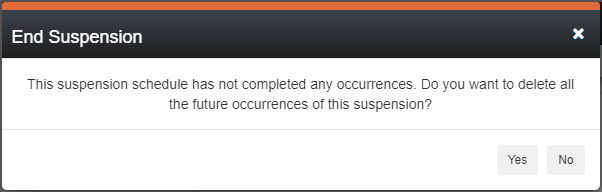
Deleting an active or scheduled suspension deletes the entire series, as indicated in the End Suspension dialog window.
‘End Suspension’ Dialog Window
Select Yes to confirm you wish to end the alert suspension series.
Auditing
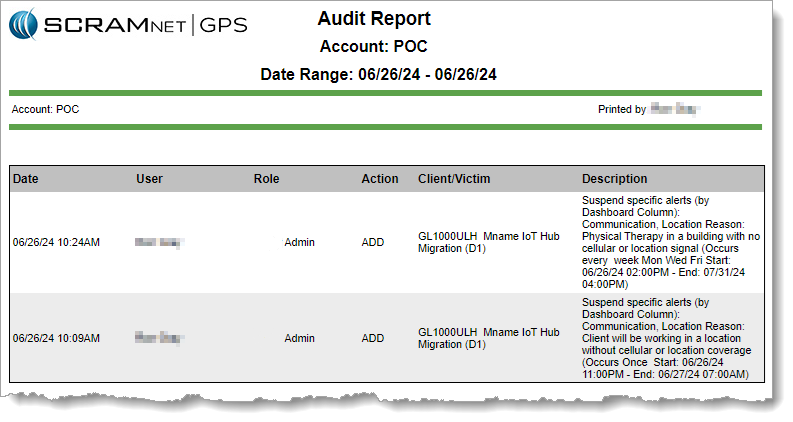
Audit entries are added to the Audit Report when schedules are created, deleted, become active, or end.
GPS Audit Report with Suspensions (click to enlarge)
On June 27, 2024, SCRAM Systems will release an enhancement that allows you to adjust and waive individual fees during the client Activity setup and on their Fee Amounts page.
If you don’t see the enhancement in SCRAM 24/7, please clear your cache and cookies and refresh your browser window.
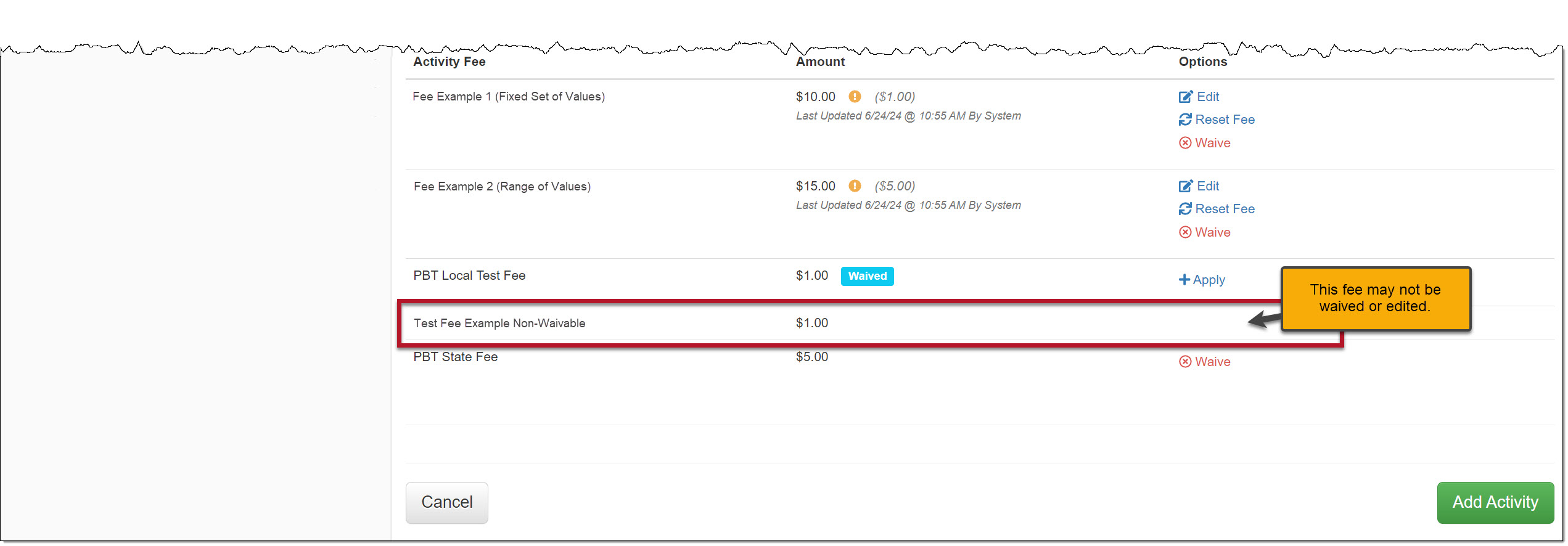
An administrator for your program manages the Activity’s fees and determines whether or not the fee may be adjusted or waived.
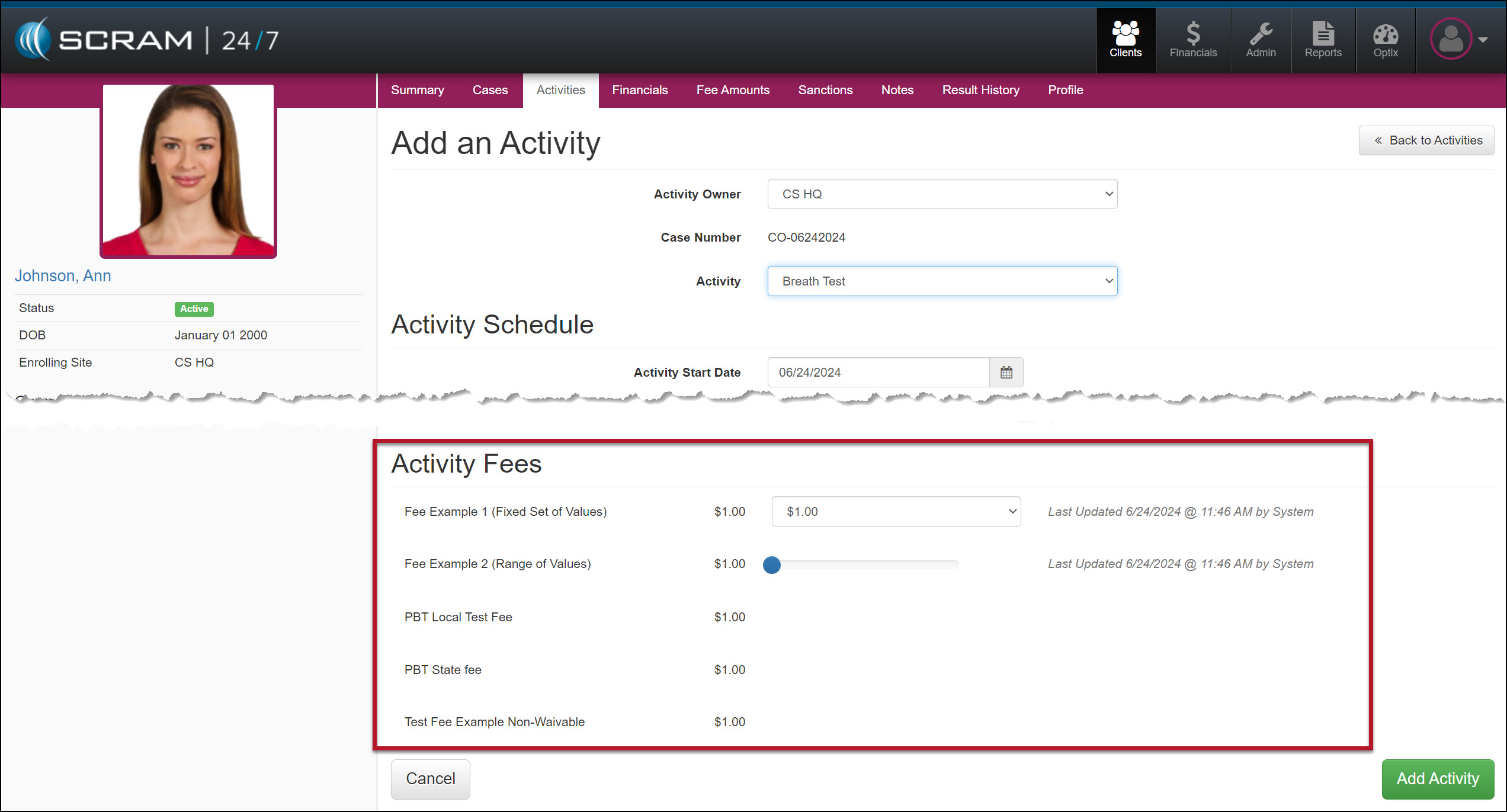
Current Add an Activity Page
Activity Fee Section – click to enlarge
Enhanced Add an Activity Page
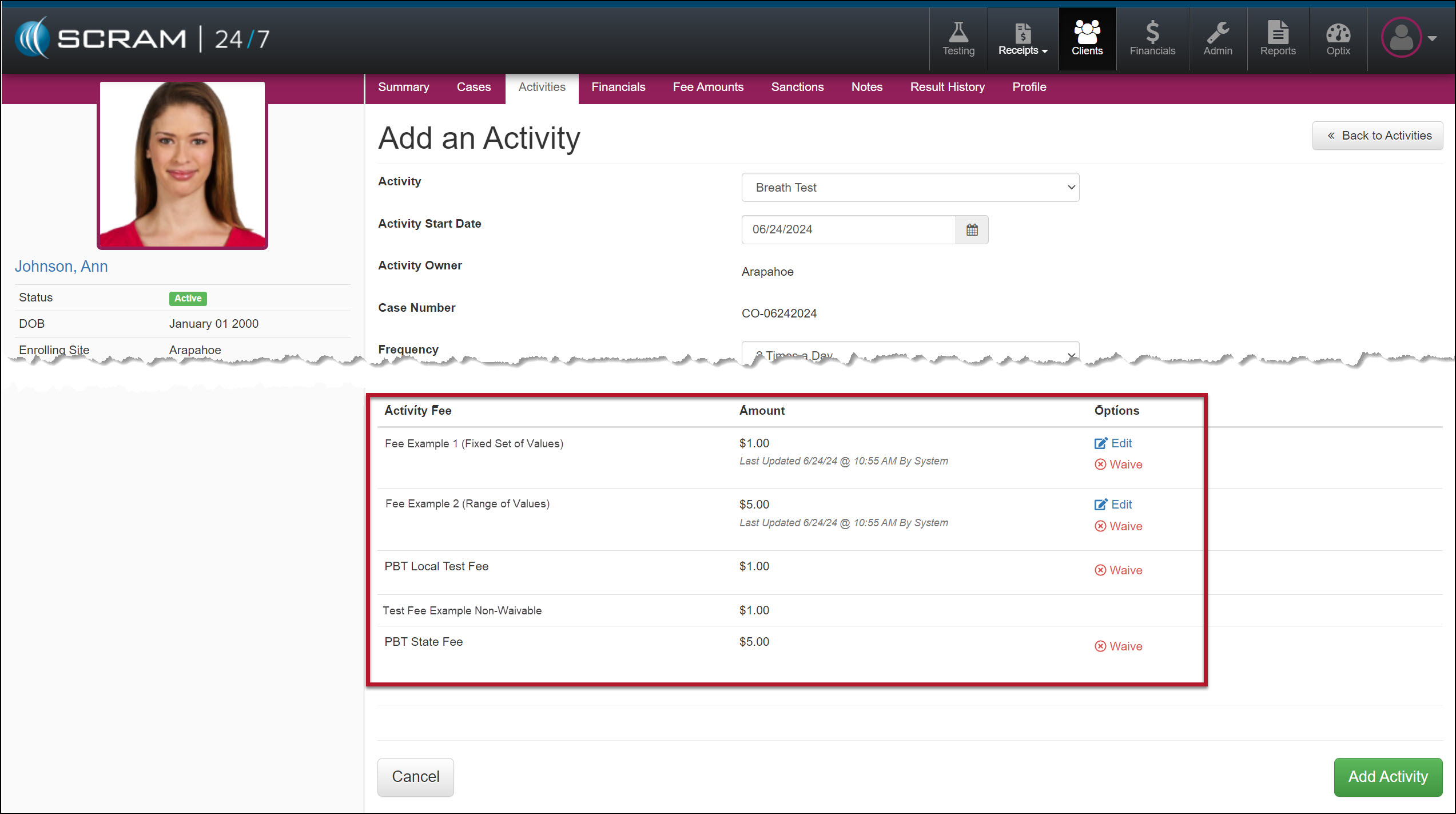
The Activity Fee section has a new “Options” column that allows you to Edit or Waive Activity fees for the client during enrollment.
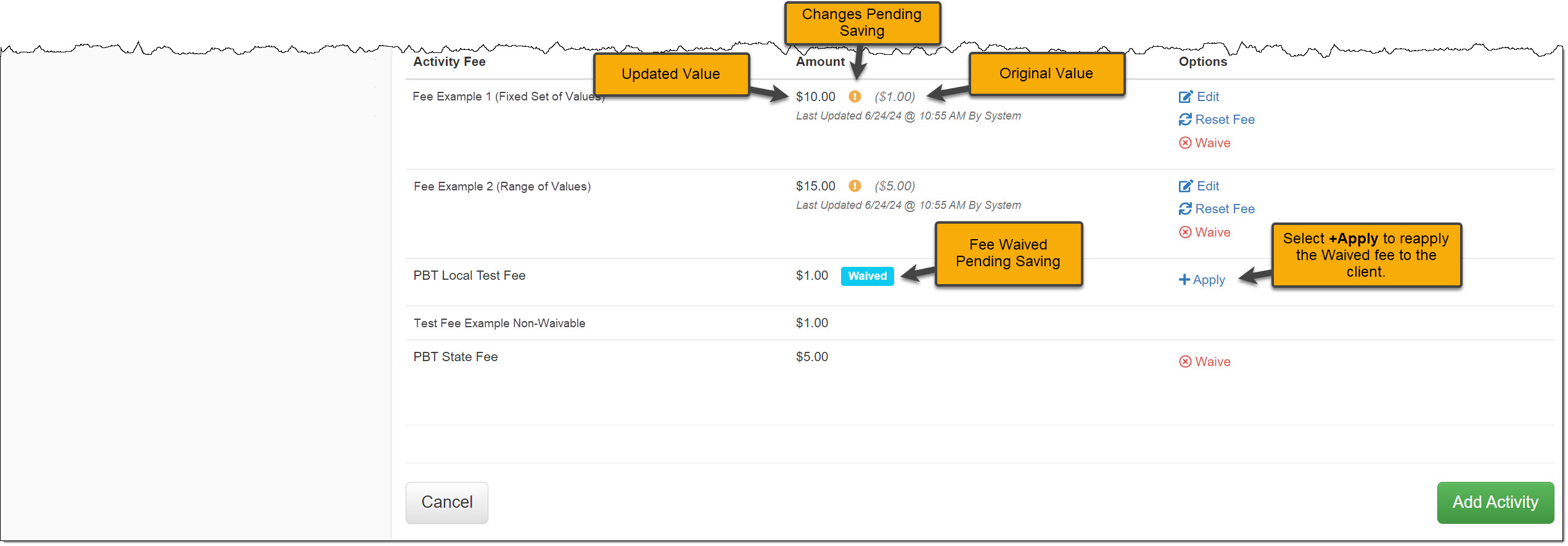
Edit and Waive Activity Fees – click to enlargeActivity Fees Updated Pending Adding the Activity – click to enlargeAn Example of an Activity Fee that Cannot be Edited or Waived During Enrollment – click to enlarge
After adjusting any Activity Fee, select the Add Activity button to save the changes.
Saved Activity Details page – click to enlarge
During the monitoring program, you may also adjust the Activity fees from the client’s Fee Amounts page.
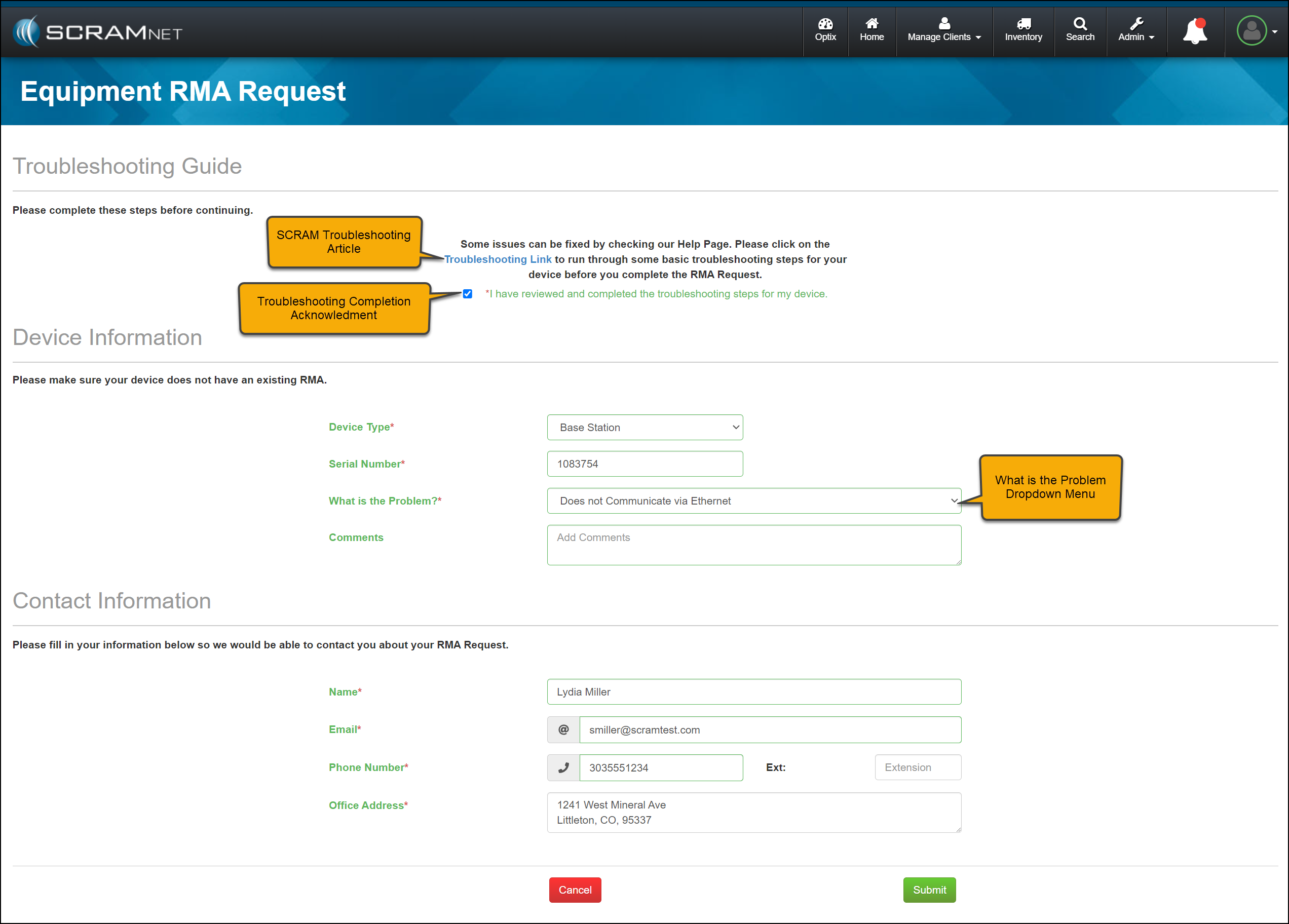
On June 12, 2024, SCRAM Systems will unveil an enhanced Equipment RMA Request page accessible from the SCRAM Systems Help & Support page. The new design contains a significant upgrade to streamline the workflow and improve your experience.
The newly designed page includes:
An updated single-page equipment RMA form.
A SCRAM Equipment Troubleshooting hyperlink providing quick access to basic troubleshooting. Following the troubleshooting steps may resolve the most common equipment issues, keeping functioning equipment available for client monitoring.
A troubleshooting acknowledgment checkbox confirming that troubleshooting steps have been taken before requesting an RMA for a device, thus ensuring no delay in processing the RMA request.
The Device Information section now includes a “What is the Problem?” dropdown menu to identify the specific issue quickly. The dropdown menu will also reflect the device type to customize the options available further.
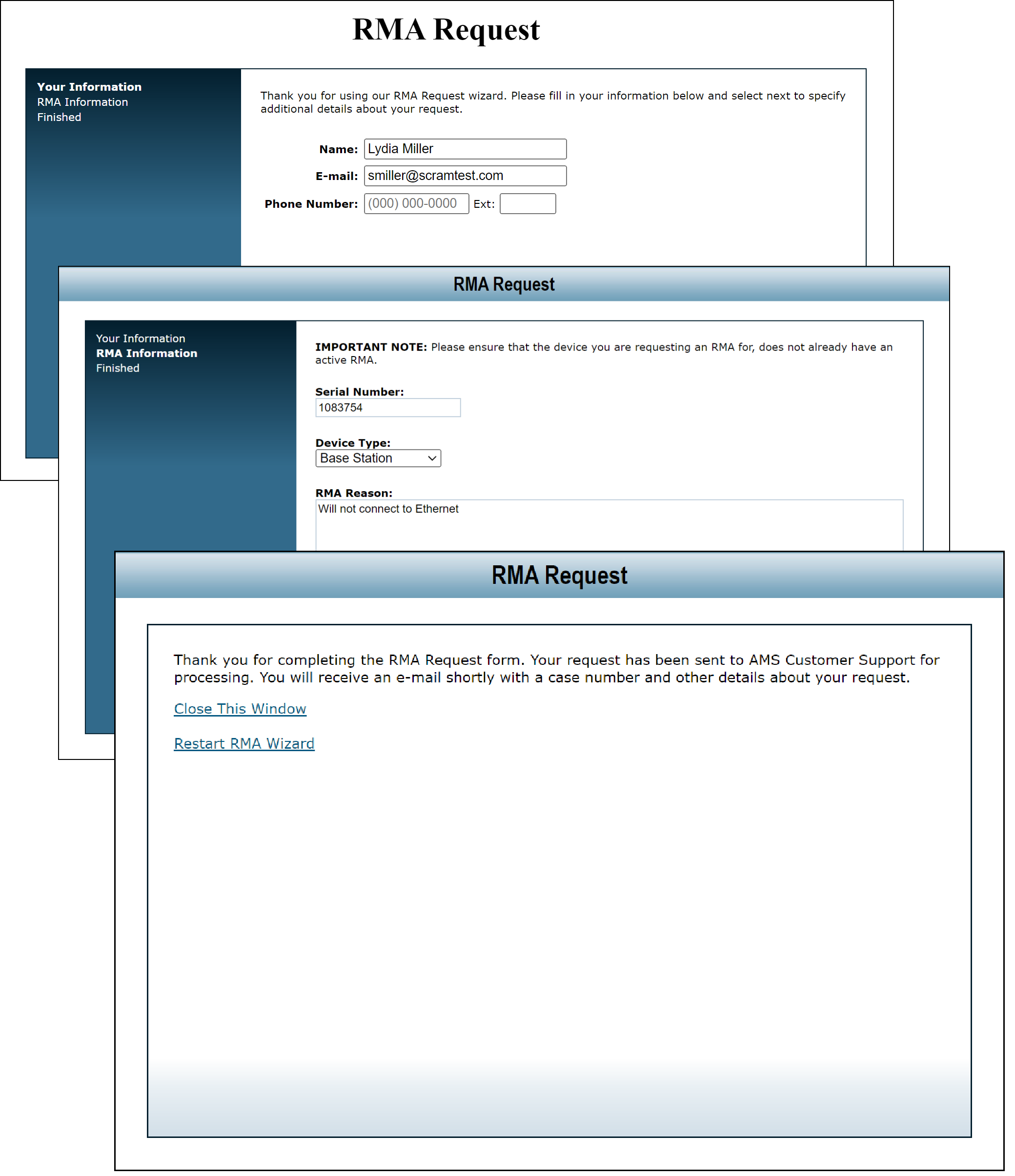
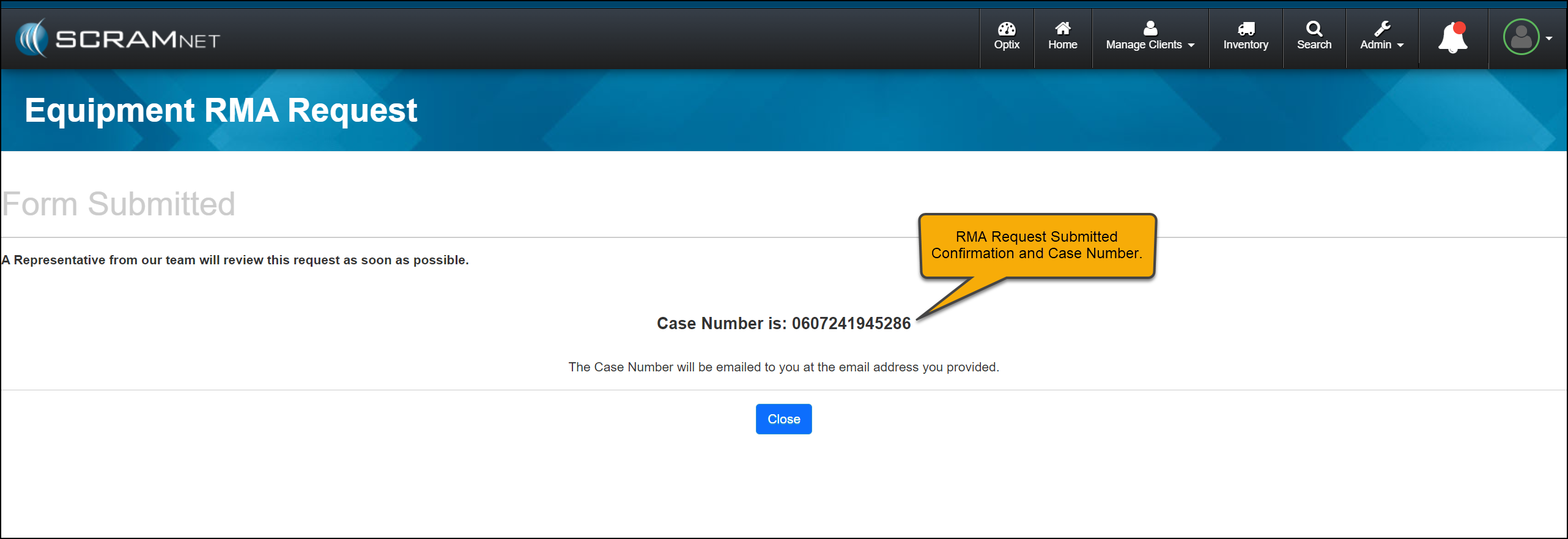
Once the RMA request has been submitted, the acknowledgment page will include the case number associated with the request for your reference.
Not seeing the enhancement in SCRAM Systems Help & Support page? Clear your cache and cookies and refresh your browser window.
Current Equipment RMA Request Page
Pre-release RMA Request page (click to enlarge)
Enhanced Equipment RMA Request Page
Equipment RMA Request page (click to enlarge)RMA Acknowledgement page with Case Number (click to enlarge)
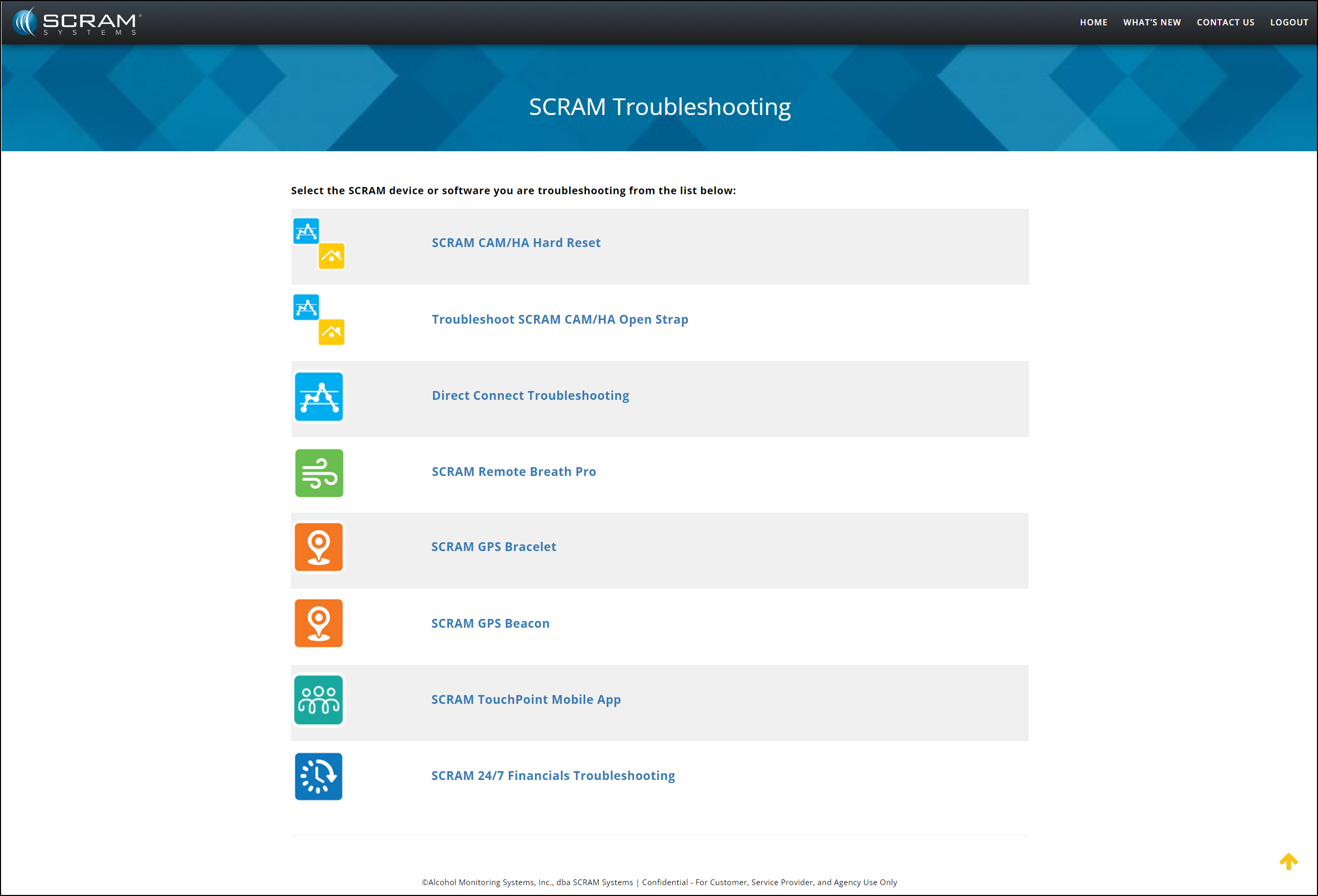
SCRAM Troubleshooting
On the SCRAM Troubleshooting article, select the product and issue to view step-by-step instructions.
SCRAM Troubleshooting Help Article (click to enlarge)
On June 12, 2024, SCRAM Systems will release two enhancements centered around the process of checking in a device as damaged.
You will now have the option to flag a device as damaged when stopping the monitoring for the client.
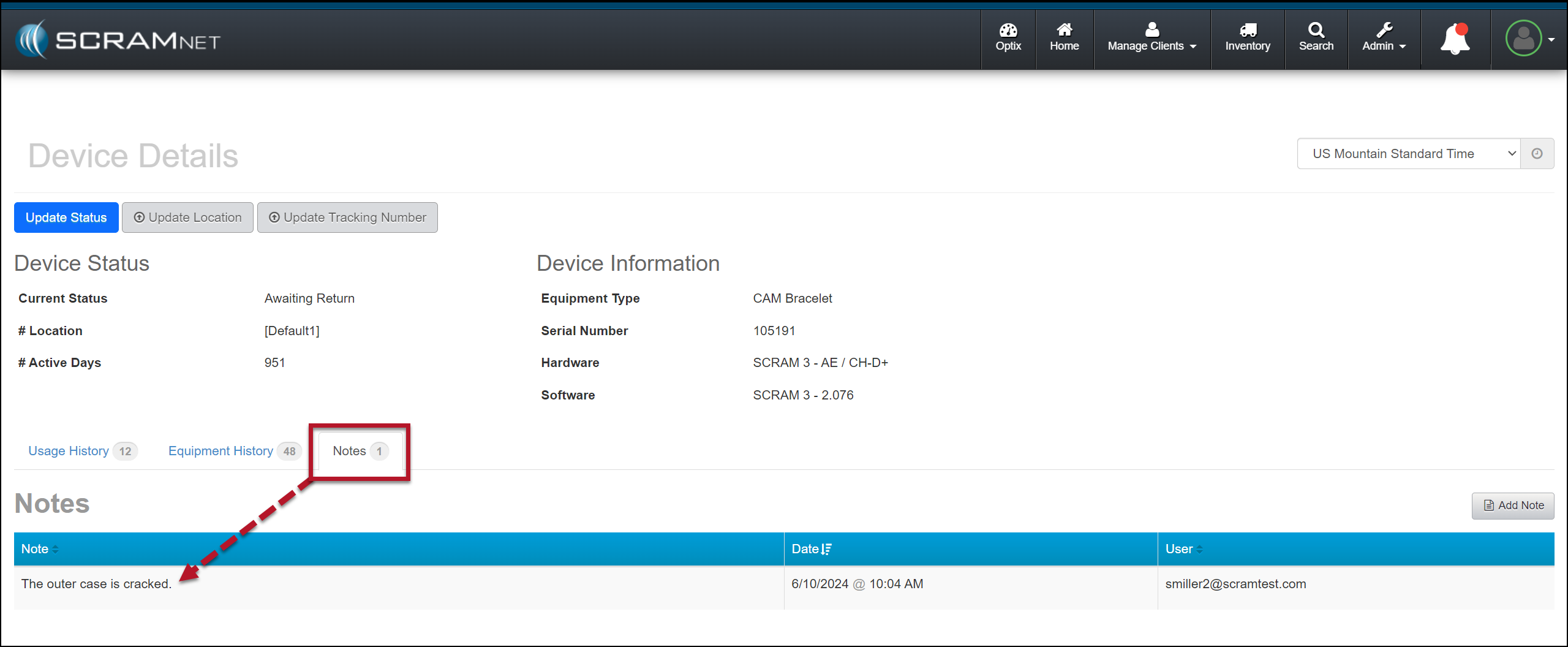
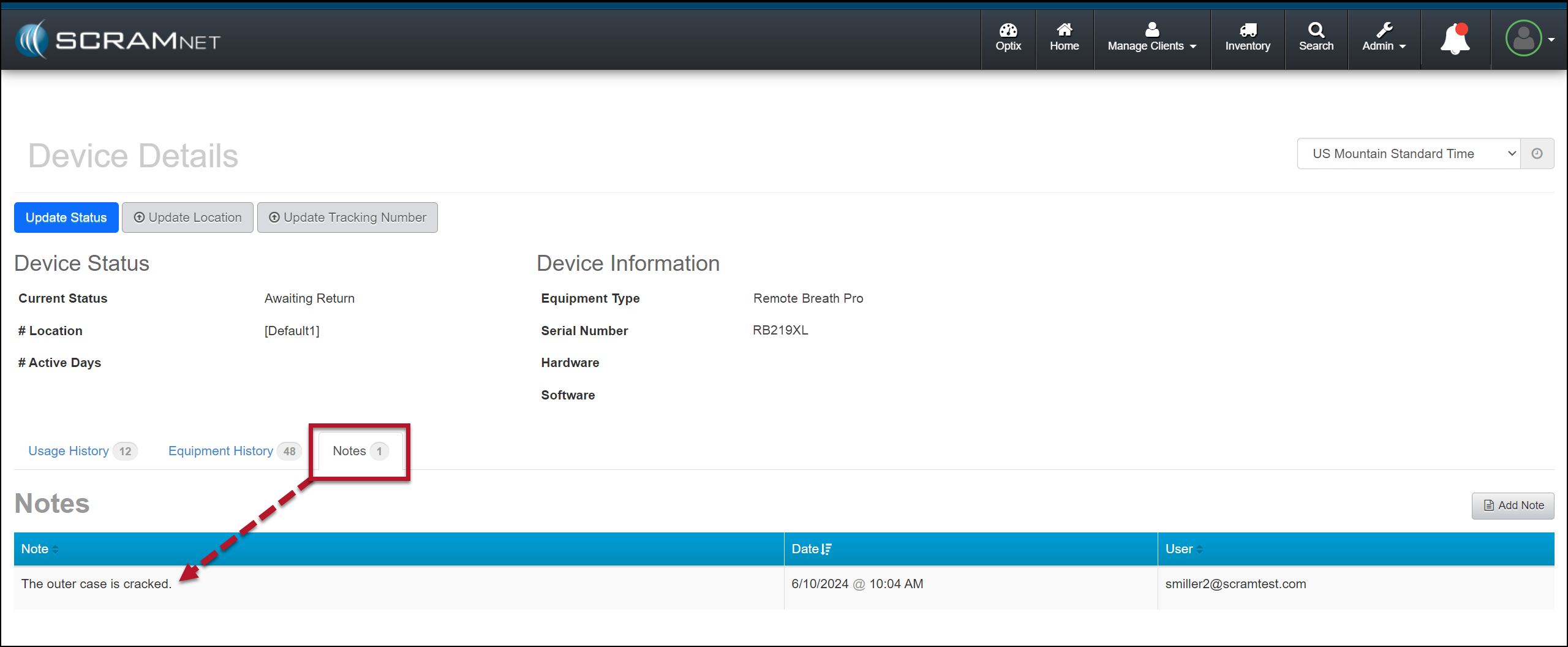
The notes entered for a device being checked in as damaged will now be visible on the Device Details page in SCRAMNET.
Not seeing the enhancement in SCRAMNET? Clear your cache and cookies and refresh your browser window.
Stop Monitoring and Check In Device as Damaged
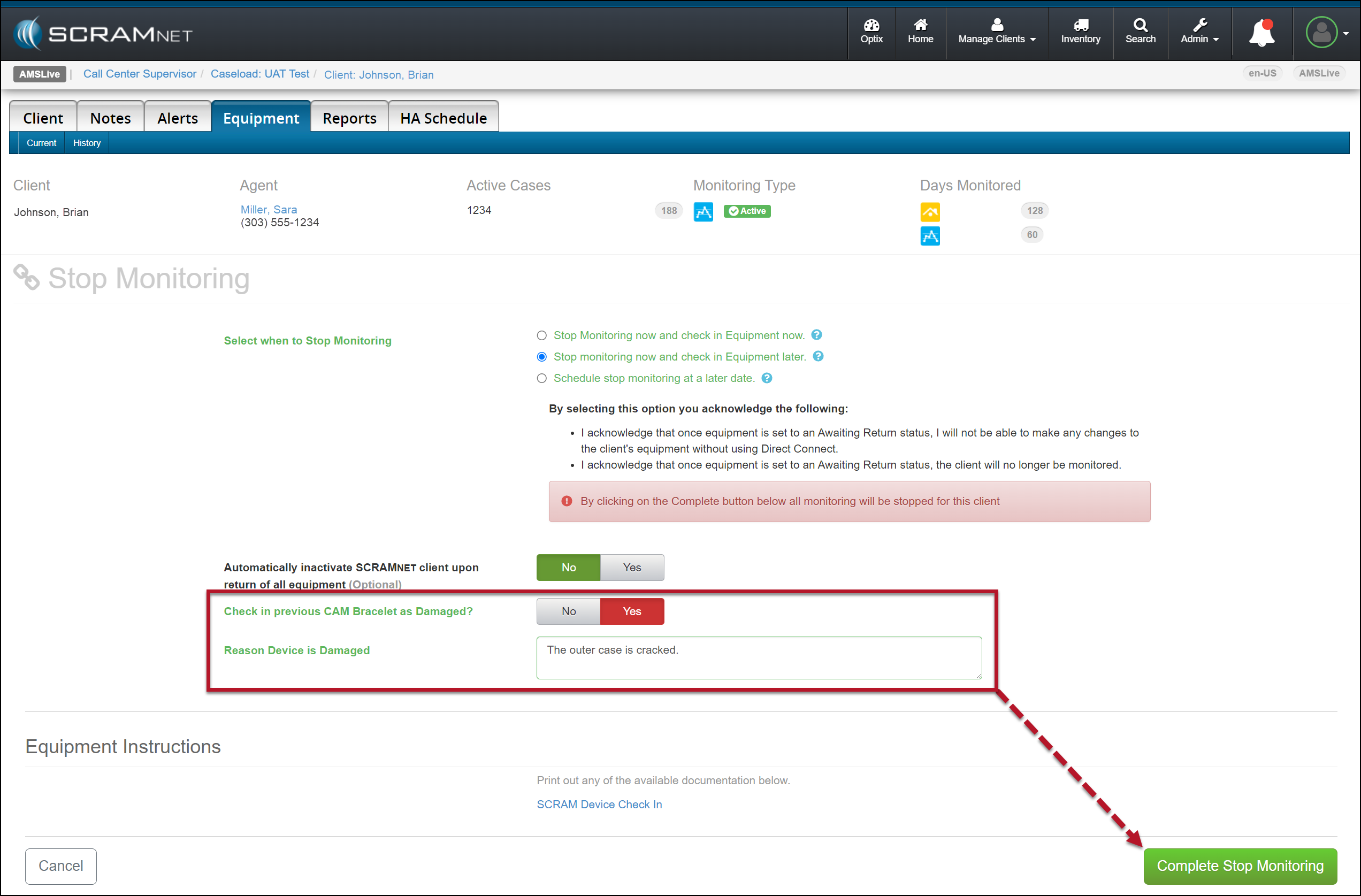
When stopping the monitoring, for your client in SCRAMNET, you may flag a device as damaged by setting the “Check in previous [Device type] as Damaged?” option to Yes. Once set, add a note explaining why you flagged the device as damaged, and then complete the stop-monitoring process as usual.
Example of a SCRAM CAM Client in SCRAMNET
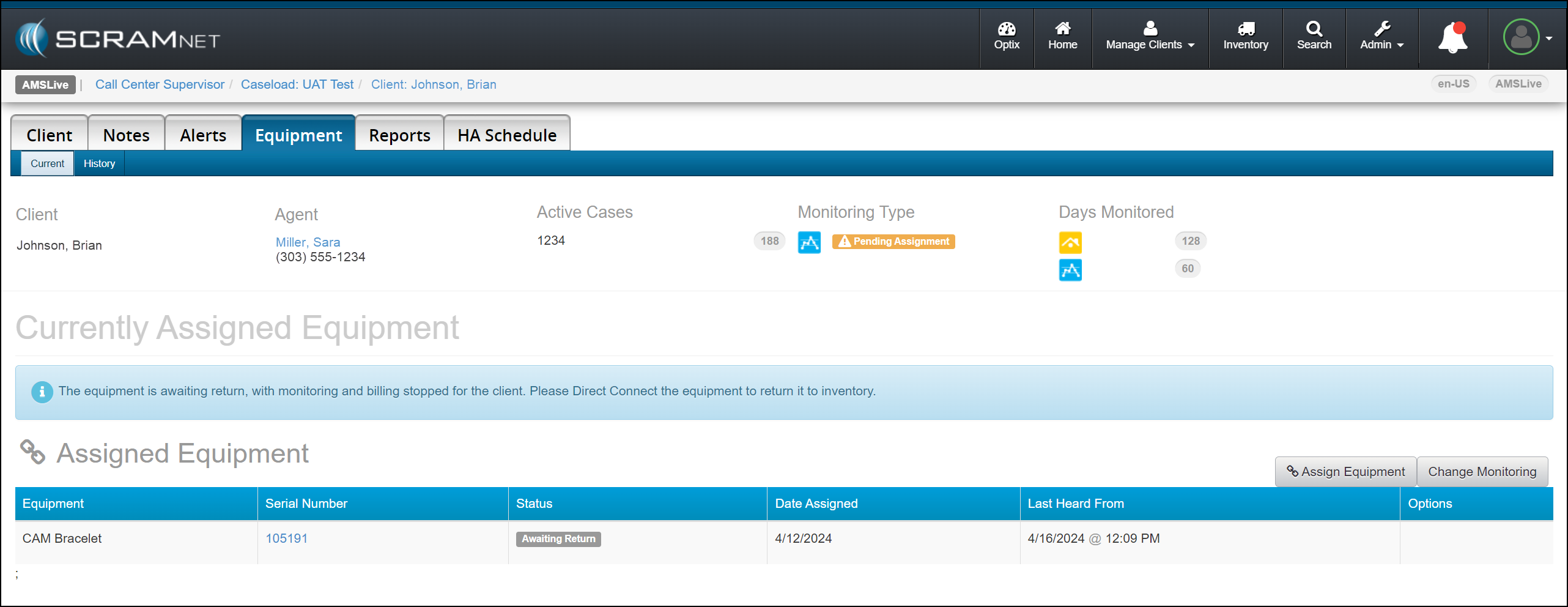
Stop Monitoring page, Device Flagged as Damaged (click to enlarge)Client’s Equipment page Device Awaiting Return Status Displayed (click to enlarge)
Once the device status is updated to either “Pending Removal” or “Awaiting Return” based on the Stop Monitoring page selection, complete the process to return the device to your inventory.
SCRAM Systems recommends selecting the “Stop monitoring now and check in Equipment later” option when flagging a damaged device. This ensures billing is stopped for the client when a device cannot be checked in following the normal process.
When scheduling the stop monitoring for a later date, you cannot flag a device as damaged.
Flagging a device as damaged on the Stop Monitoring page does not automatically update its status to “In Inventory.” You must complete the check-in process to ensure billing and monitoring for the client are stopped.
When a device is flagged as damaged on the Replace Equipment page, it will automatically be updated to an “In Inventory” status.
Device Details Damage Notes
Once a device has been flagged as damaged, you may view the notes associated with the damaged device on the Device Details page in SCRAMNET.
Device Details Page with Notes Tab Selected (click to enlarge)
This information is helpful to reference when troubleshooting a device or requesting an RMA.
The damage notes will remain visible on your Device Details page until the device is returned and serviced at SCRAM Systems. At that time, they will no longer be visible.
On June 12, 2024, SCRAM Systems will release multiple enhancements to SCRAM 24/7.
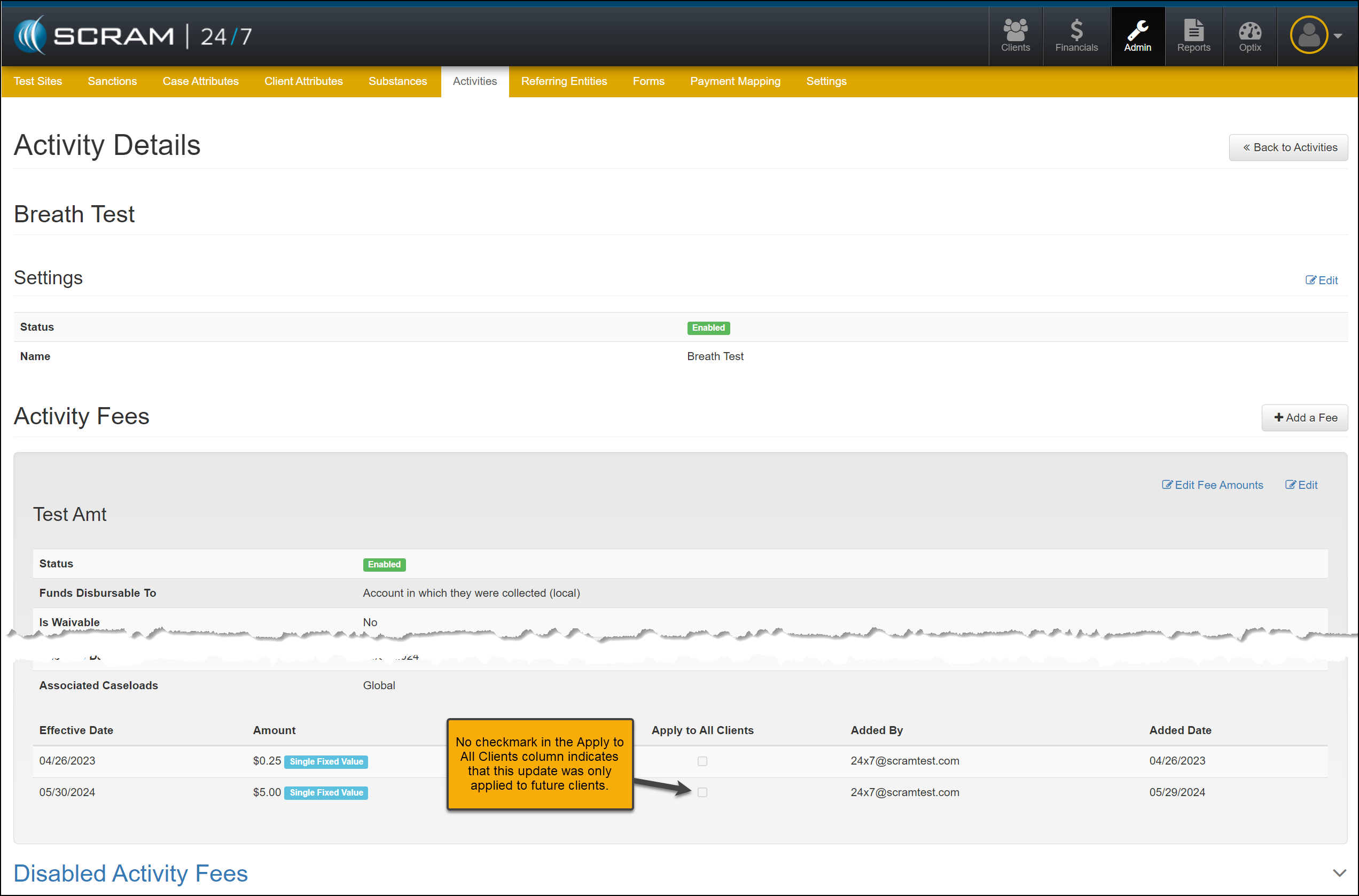
When viewing an activity fee, a new column displays whether the fee has been applied to all clients or will only be applied to future clients.
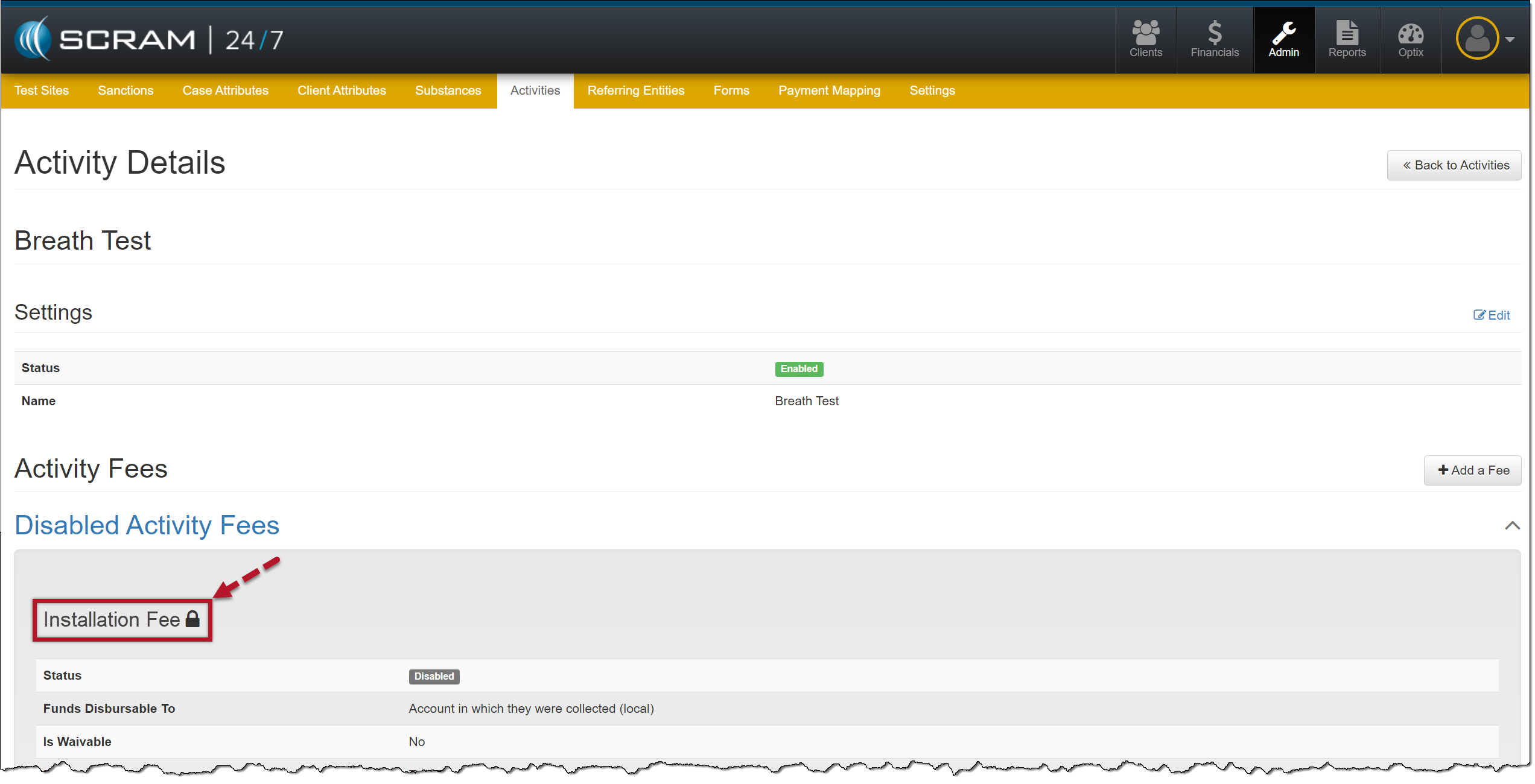
When deactivating an activity fee, a lock icon will be displayed next to the fee’s name when a fee is still being applied to currently active clients.
You will now have the option to flag a device as damaged when Suspending or Removing an EM Activity for the client.
The notes entered for a device being checked in as damaged will now be visible on the Device Details page in SCRAMNET.
Not seeing the enhancement in SCRAM 24/7? Clear your cache and cookies and refresh your browser window.
Apply to All Clients Column
When viewing or editing an Activity’s fee, an “Apply to All Clients” column indicates whether the adjusted fee has been applied to all current and future clients or will only apply to future clients.
Activity Details page- Apply to All Clients Checkbox Not Selected (click to enlarge)
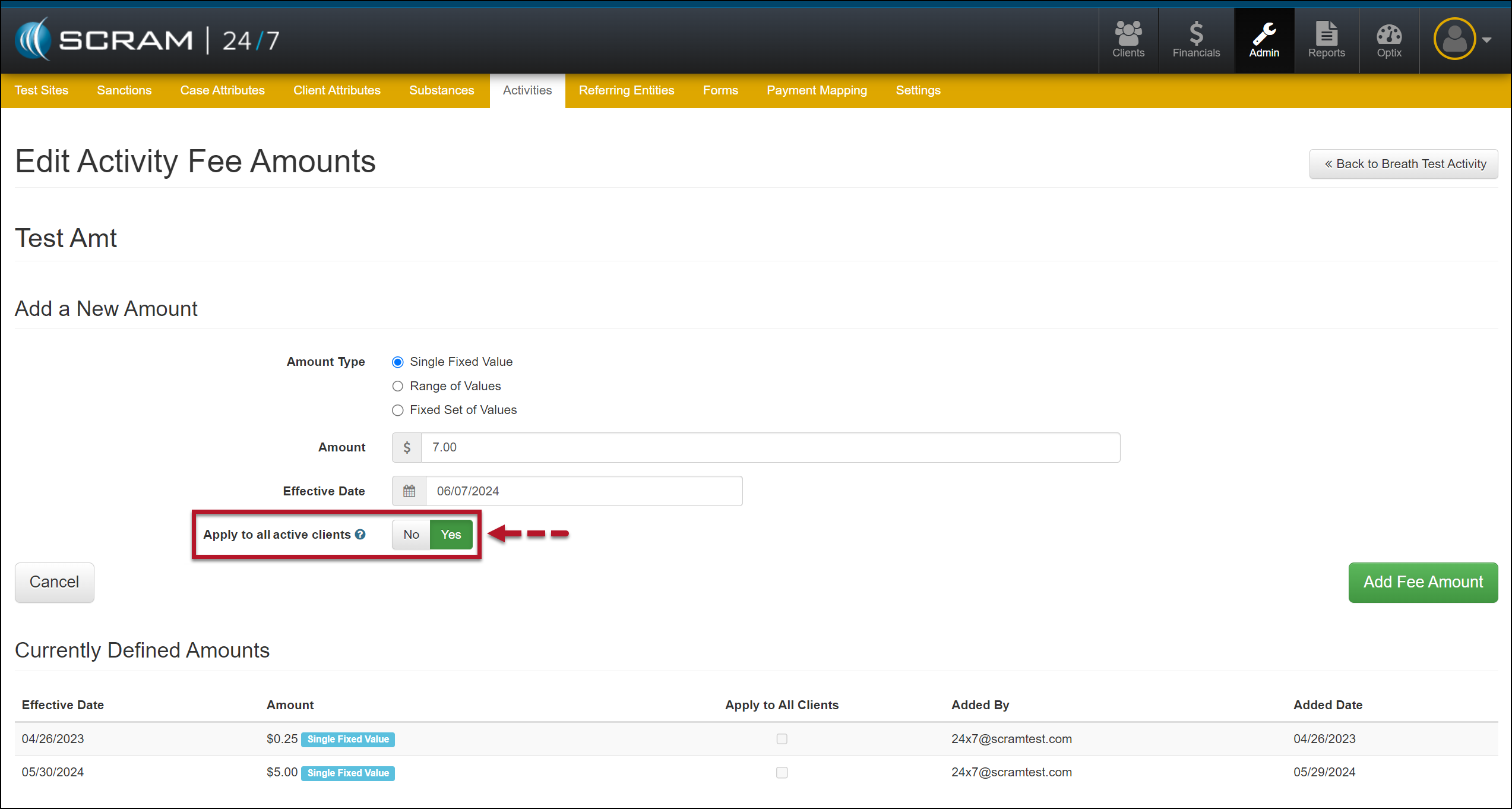
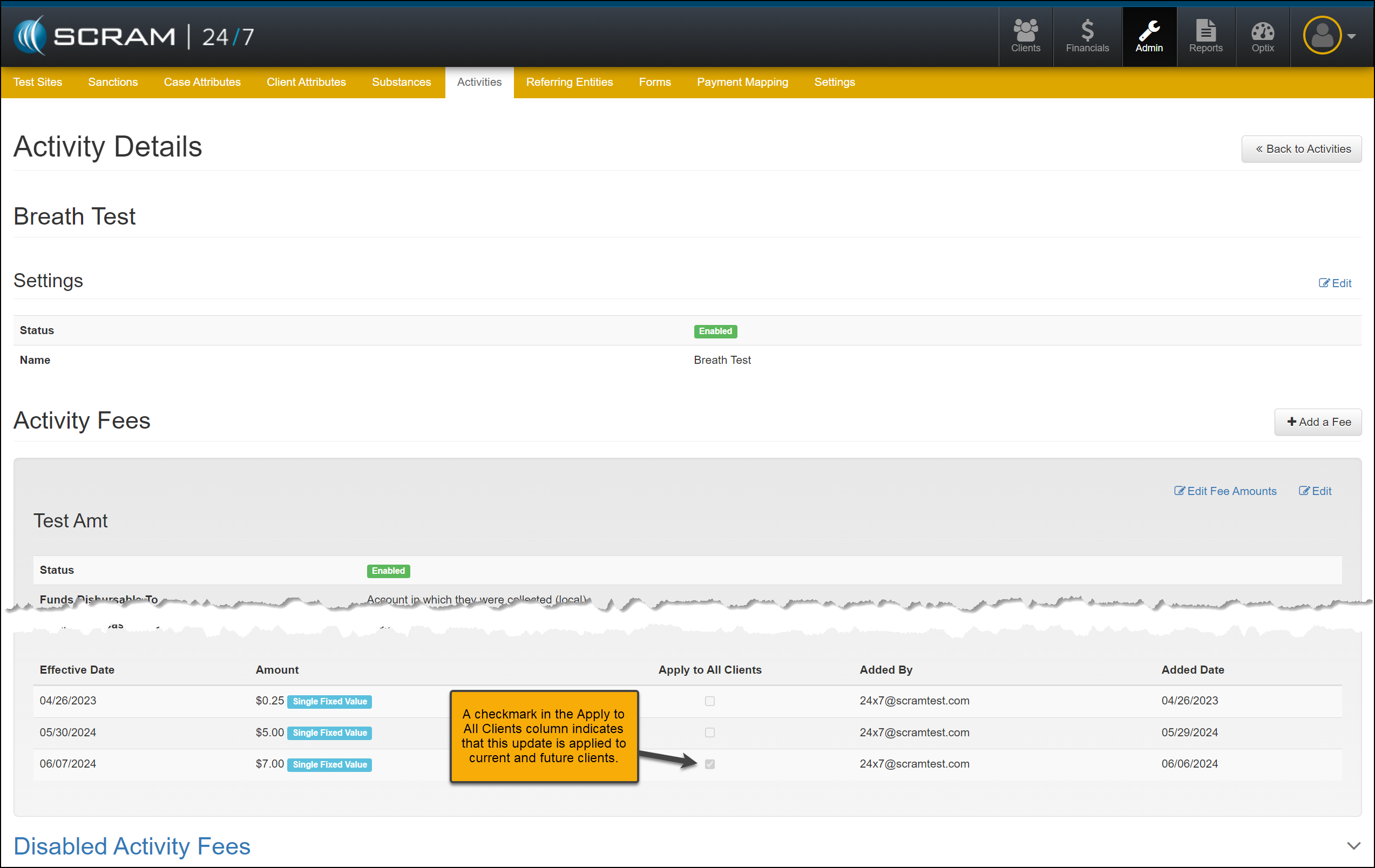
While editing a fee, when you select the “Yes” option to apply this updated fee to currently active and future clients, a checkmark will appear in the “Apply to all Clients” column.
Edit Activity Fee Amounts- “Apply to all active client” Set at Yes (click to enlarge)Activity Details page- Apply to All Clients Checkbox Selected (click to enlarge)
Disabled Fee Lock Icon
As fees for activities are disabled, you may continue billing or remove that fee from currently active clients.
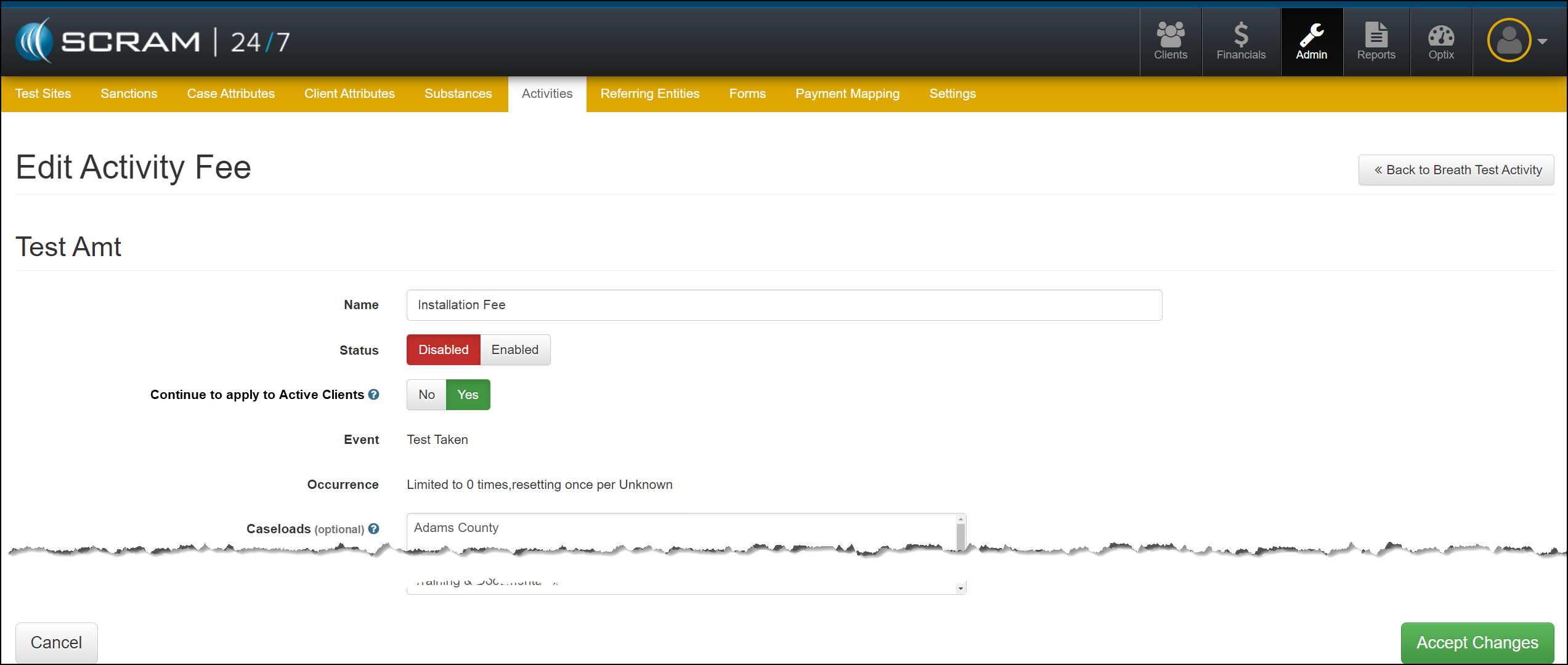
When you select the “Yes” option to continue billing current active clients, a lock icon will appear next to the disabled fee’s name.
Edit Activity Fee (click to enlarge)Disabled Activity Fee with Lock Icon (click to enlarge)
Suspend or Remove Activity and Check In Device as Damaged
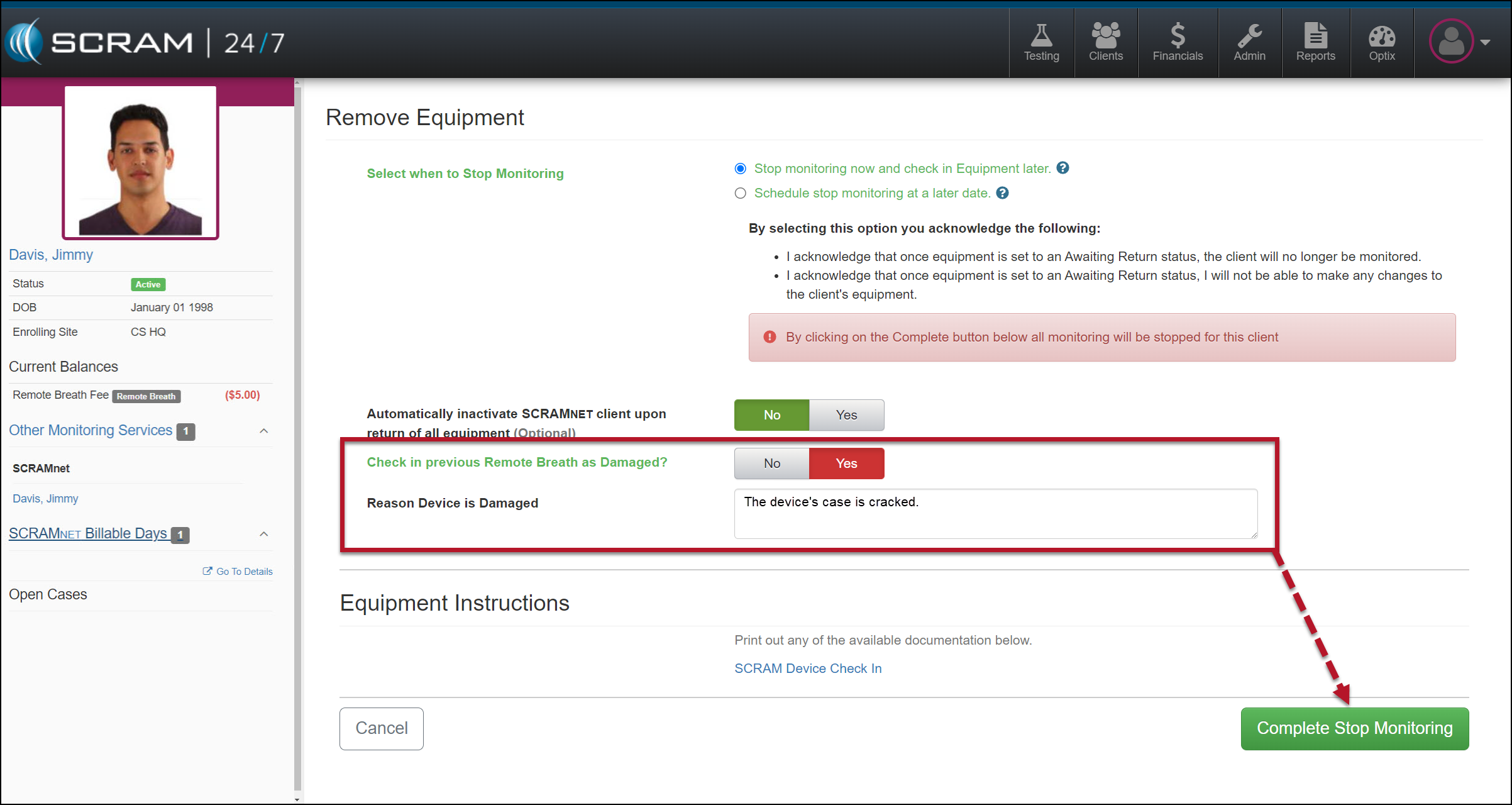
When removing or suspending an Activity for your client in SCRAM 24/7, you may flag a device as damaged by setting the “Check in previous [Device type] as Damaged?” option to Yes. Once set, add a note explaining why you flagged the device as damaged, and then complete the stop-monitoring process as usual.
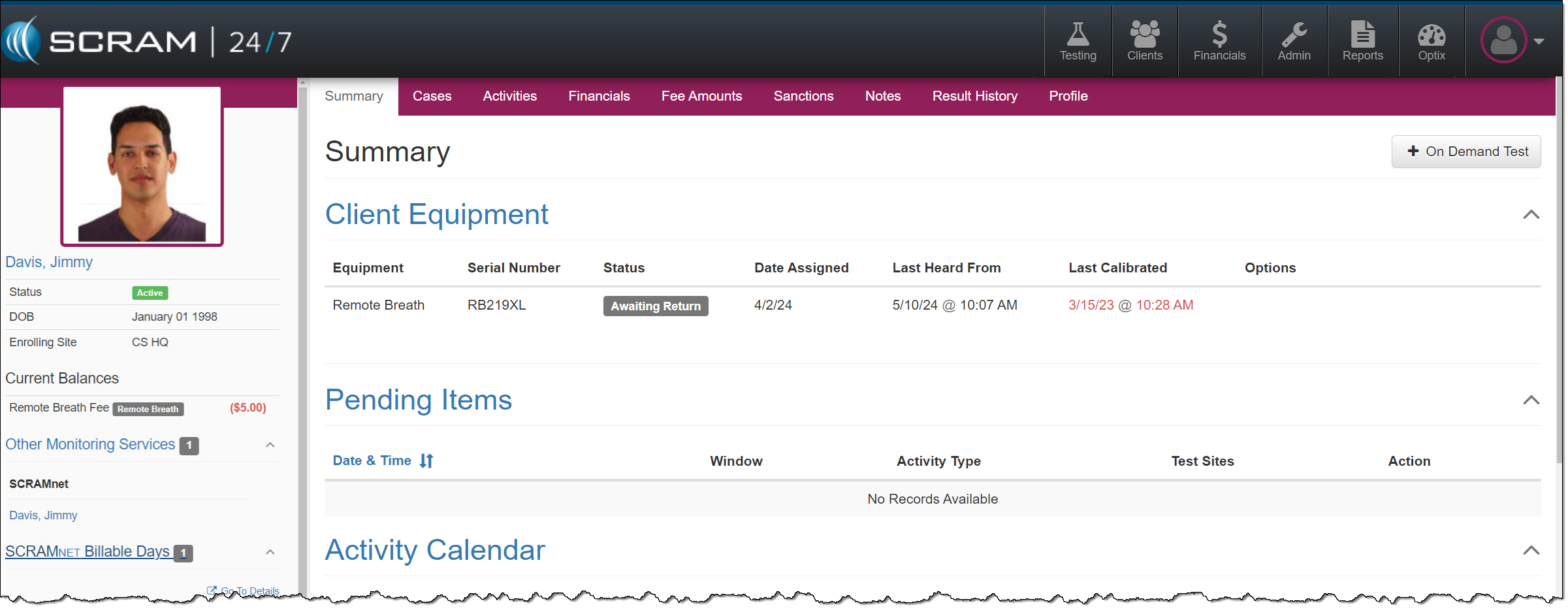
Remove Equipment page (click to enlarge)Client Summary page, Equipment Status of Awaiting Return (click to enlarge)
Once the device’s status is updated to “Awaiting Return,” complete the process of returning it to your inventory.
When scheduling the stop monitoring for a later date, you cannot flag a device as damaged.
Flagging a device as damaged on the Remove Equipment page does not automatically update its status to “In Inventory.” You must complete the check-in process.
When a device is flagged as damaged on the Replace Equipment page, it will automatically be updated to an “In Inventory” status.
Device Details Damage Notes
Once a device has been flagged as damaged, you may view the notes associated with the damaged device on the Device Details page in SCRAMNET.
SCRAMNET Device Details page (click to enlarge)
This information is helpful to reference when troubleshooting a device or requesting an RMA.
The damage notes will remain visible on your Device Details page until the device is returned and serviced at SCRAM Systems. At that time, they will no longer be visible.
On June 6, 2024, SCRAM Systems will release three SCRAM TouchPoint Location feature enhancements:
The SCRAM Optix Location tab will display “Compliant” or “Non-Compliant” depending on the location service settings the client has chosen for the SCRAM TouchPoint Mobile app.
For clients on a Nexus Supervision Plan with Location Verification enabled, Location Records will now indicate whether the location record was captured before, during, or after the scheduled appointment.
The TouchPoint Location Verification service may now be disabled at the client level for clients who do not need to report their location as part of their monitoring program.
The latest version of the TouchPoint app will be available to clients in the app stores. As a best practice, SCRAM Systems recommends that all TouchPoint app users enable their smartphones to automatically update their apps to make this process easier.
Not seeing the enhancement in SCRAM Optix? Clear your cache and cookies and refresh your browser window.
Compliant and Non-Compliant Smartphone Location Access
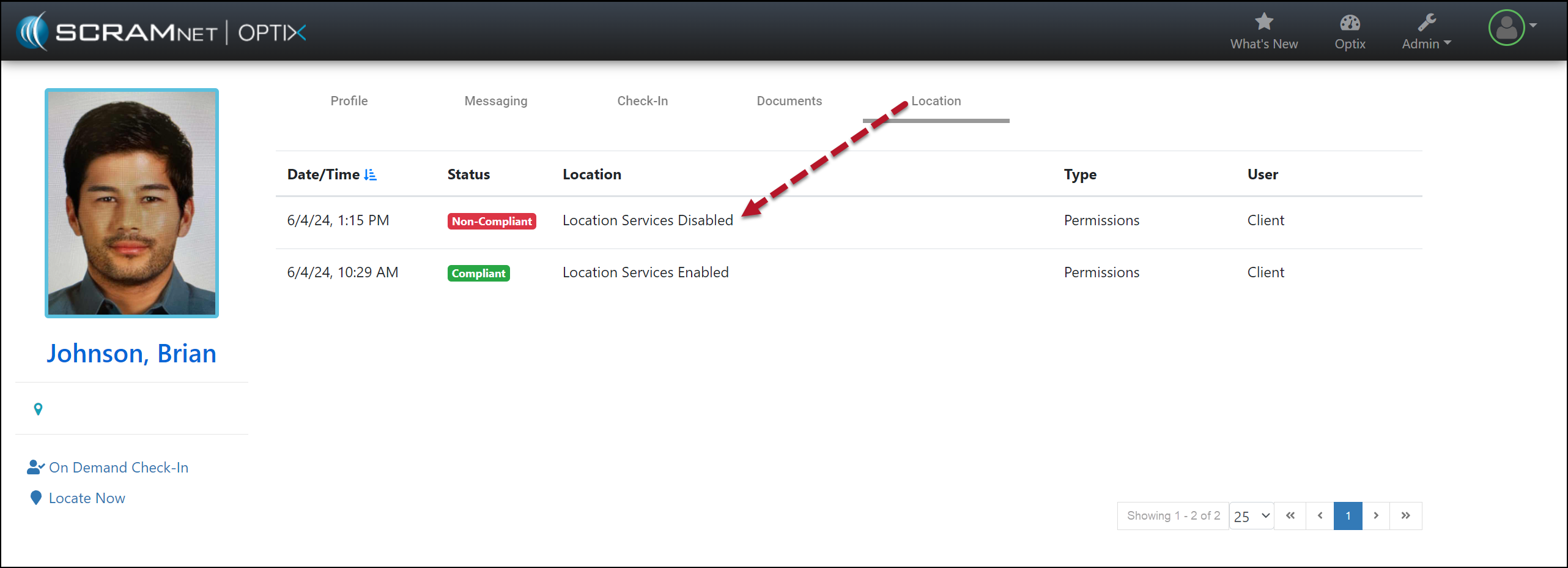
During a client’s TouchPoint monitoring program, you may now view in real-time whether or not the client has the SCRAM TouchPoint application’s location access permissions set to “Always Allow” the location data to be shared. The SCRAM TouchPoint Location tab will display “Compliant” when the client’s smartphone location permissions are set to Always Allow for the TouchPoint app, and will display “Non-Compliant” when the client has selected something other than Always Allow.
Additionally, when location services access is set to any option other than Always Allow, an event will be generated with a time and date stamp indicating when location services were disabled.
SCRAM Optix Client Location Page (click to enlarge)
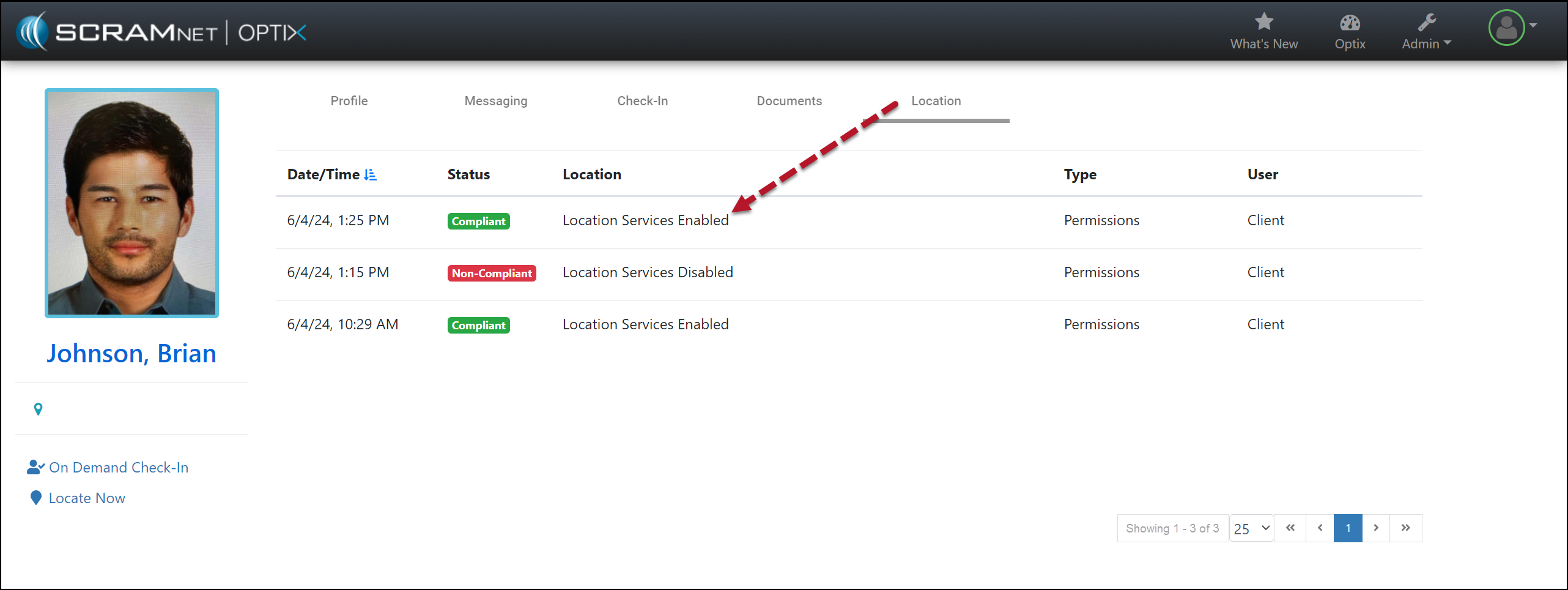
As soon as the client updates the location service settings on their smartphone to “Always Allow” location access, a new event will be generated with the updated “Compliant” status.
SCRAM Optix Location Page (click to enlarge)
Android smartphones only: An event of Non-Compliant is reported within one minute of the change to the smartphone’s location service settings, however, the update from Non-Compliant to Compliant (location services enabled) may take up to 12 hours to be reported to the monitoring software.
Location Verification Notation “Prior to” and “After” an Appointment
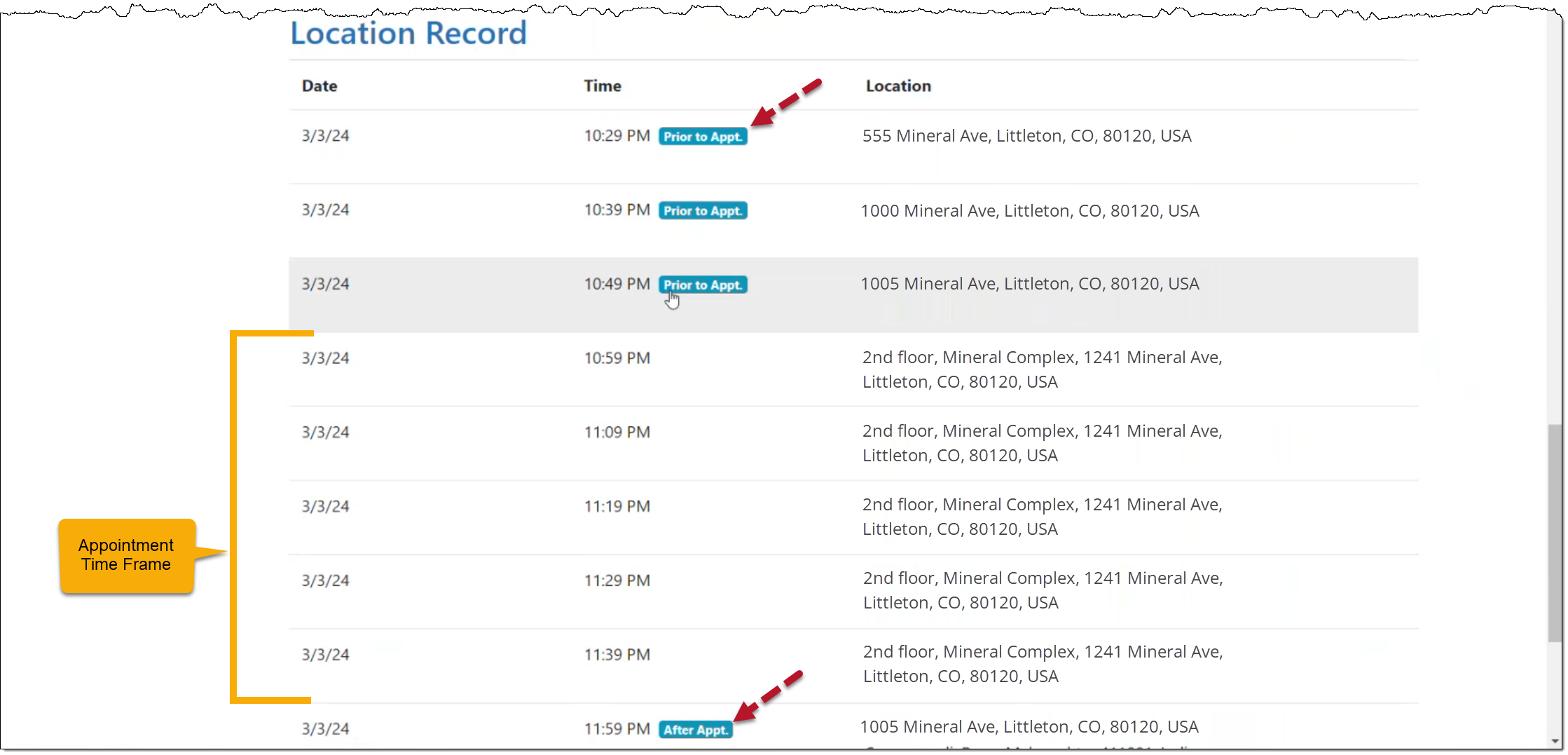
For clients on a Nexus Supervision Plan with Location Verification enabled, when accessing the Location page, the “Time” column for an individual Location Record will now clearly indicate whether the location record was captured prior to, during, or after the scheduled appointment timeframe, thus aiding in interpreting the location data presented.
When viewing the Location Record for a client’s appointment, the “Time” column displays “Prior to Appt.” for location points gathered before the appointment start time, and “After Appt.” for location points gathered after the appointment.
When there is no notation, the location points were captured within the appointment timeframe.
Client Location Record with Details of Appointment (click to enlarge)
Disable Location Verification Services
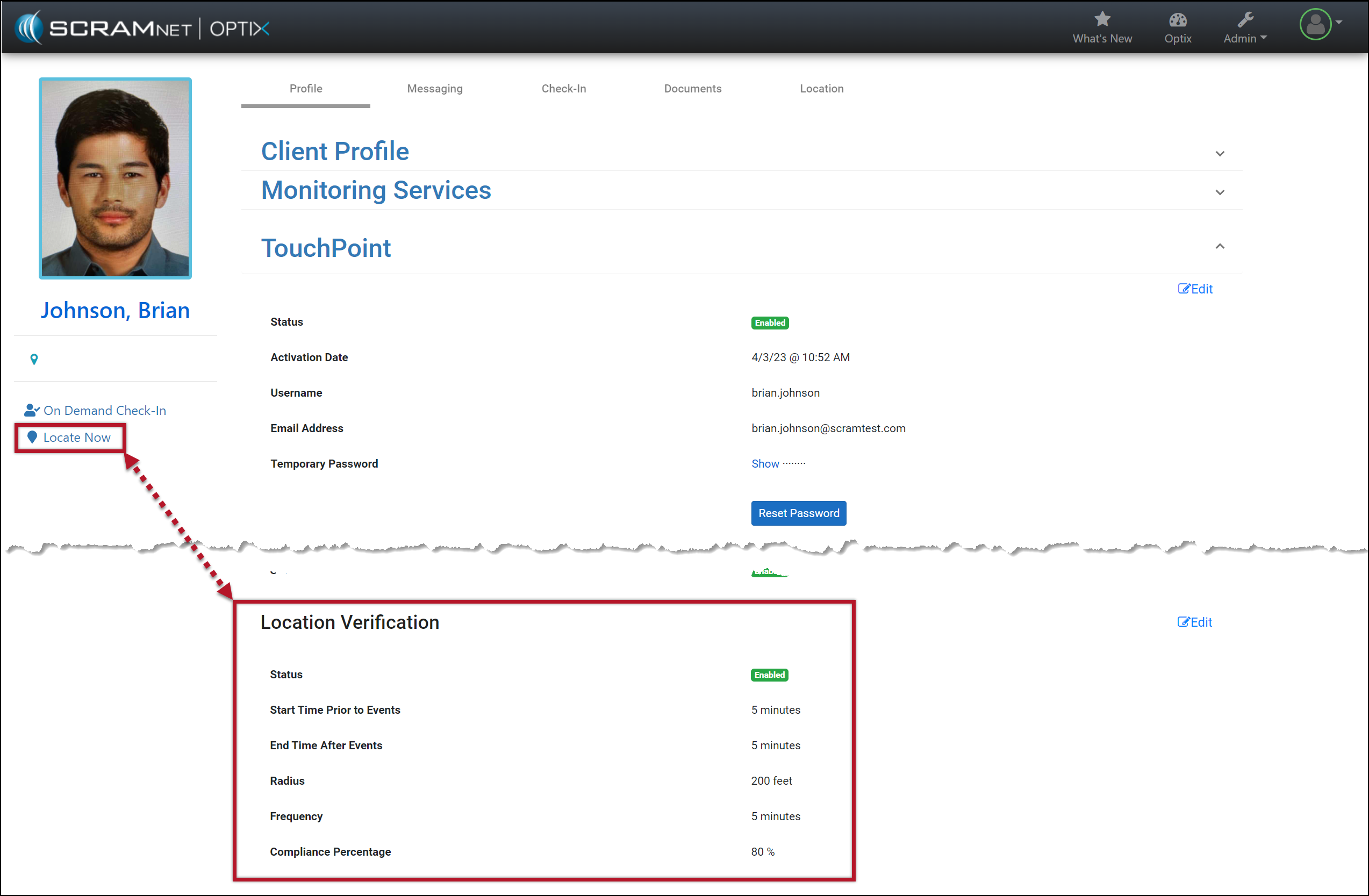
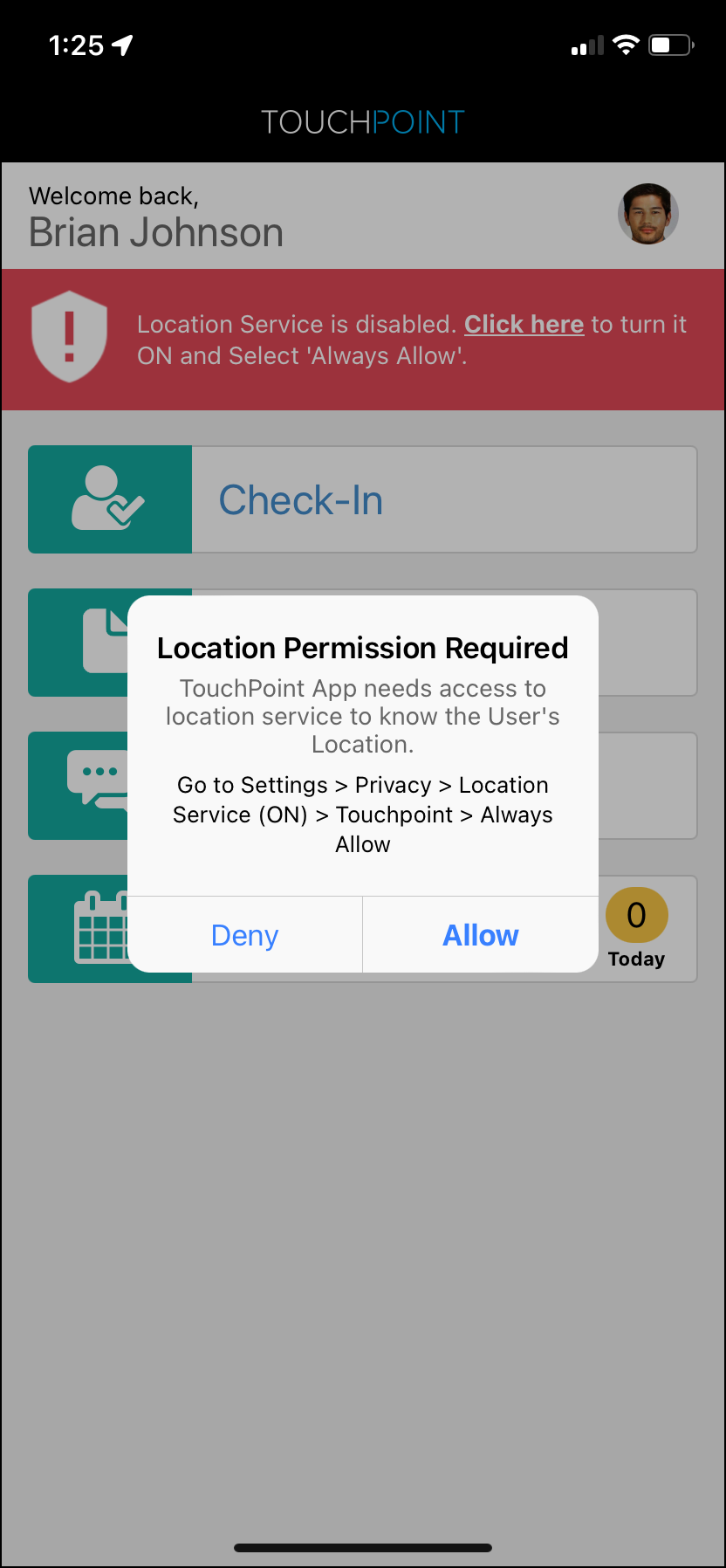
Currently, any time the client restricts access to their smartphone’s location data, the SCRAM TouchPoint application prompts the client to allow access to this data by sending push notifications, a pop-up, and a red banner within the application itself. These notifications will continue until the client updates the application’s location permissions.
Client Location Verification Enabled (click to enlarge)
SCRAM TouchPoint Mobile App Location Permission Alert (click to enlarge)
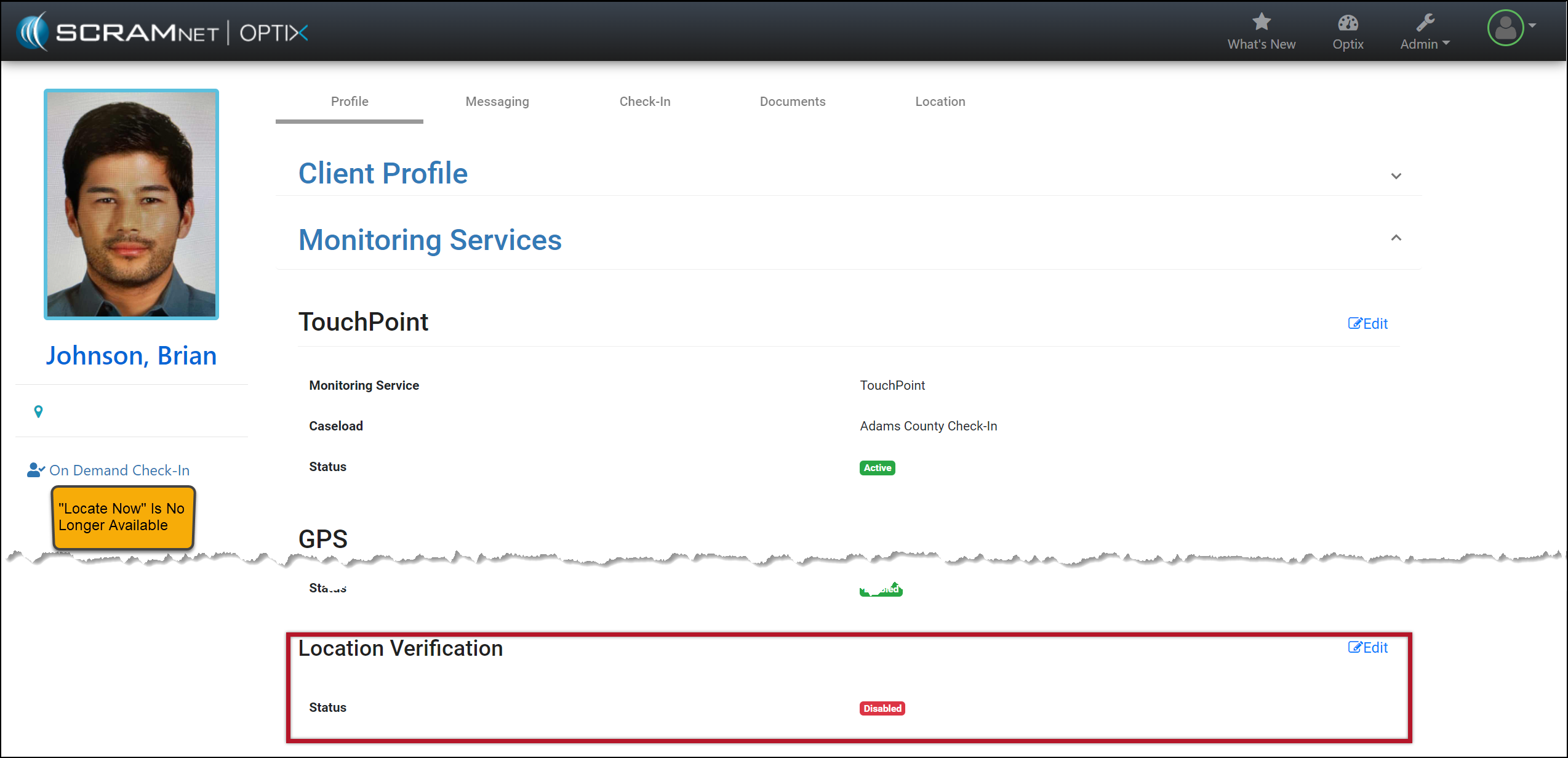
With this update, you may disable the Location Verification feature on the client’s Profile page when it is not required for client monitoring. Once disabled, regardless of the smartphone location access settings, the client will no longer be prompted to share their smartphone’s location data. Additionally, the on-demand Locate Now feature will no longer be available.
Client Location Verification Disabled (click to enlarge)
At 5:00 AM MDT on Thursday, May 23, 2024, SCRAM Systems released two enhancements to SCRAMNET GPS:
Two new features that clarify client location points on the map while in Pursuit Mode.
MC Customers Only – A new checkbox added to the Client Profile for future use.
Pursuit Mode Enhancements
While in Pursuit Mode, the SCRAM GPS device acquires and transmits location points every 15 seconds. The high frequency of location point acquisition and transmission during Pursuit Mode can sometimes lead to confusing map results; specifically:
Location points failing to appear on map when expected, or
Multiple location points appearing on the map at the same time.
New features have been added to Pursuit Mode to help clarify each of these two occurrences.
Location Point Message
Due to the rapid acquisition and transmission of location points during Pursuit Mode, there is an increased possibility that the Locator (SCRAM GPS device) will sometimes send a location point to the monitoring system more quickly than it can be verified. When the SCRAMNET GPS monitoring system receives an unverified location point, it labels it as “inconclusive” and cannot display it on the map.
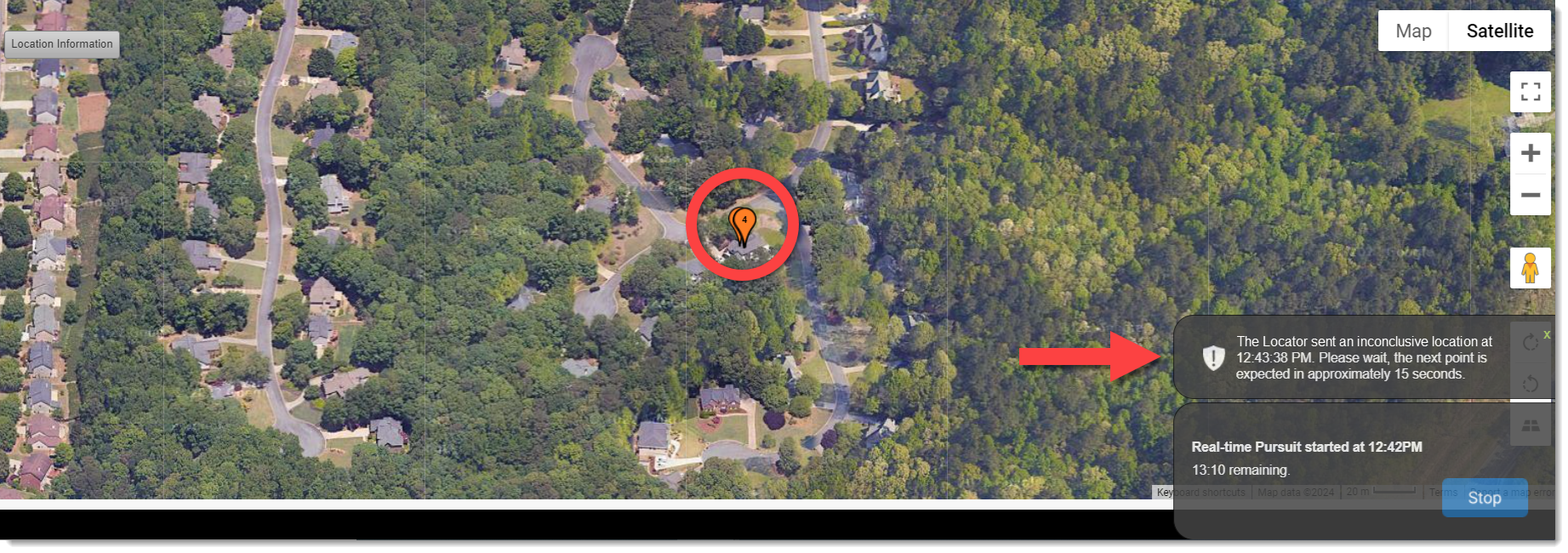
With this release, SCRAMNET GPS will display a 10-second message which explains, “The Locator sent an inconclusive location,” the exact time the inconclusive location was sent, and to expect the next location point in approximately 15 seconds (see arrow below).
SCRAMNET GPS Pursuit Mode Enhancements (click to enlarge)
Location Point Auto-Sequencing
During Pursuit Mode, there is also an increased possibility that the SCRAMNET GPS monitoring system will receive multiple location points at the same time. This can be confusing when viewed on the map because the sequence of the points is unknown.
With this release, when the monitoring system receives multiple location points at once, each point will automatically be sequenced and separated by one second when displayed on the map in SCRAMNET GPS (see circle above).
New Client Profile Checkbox – Future Use
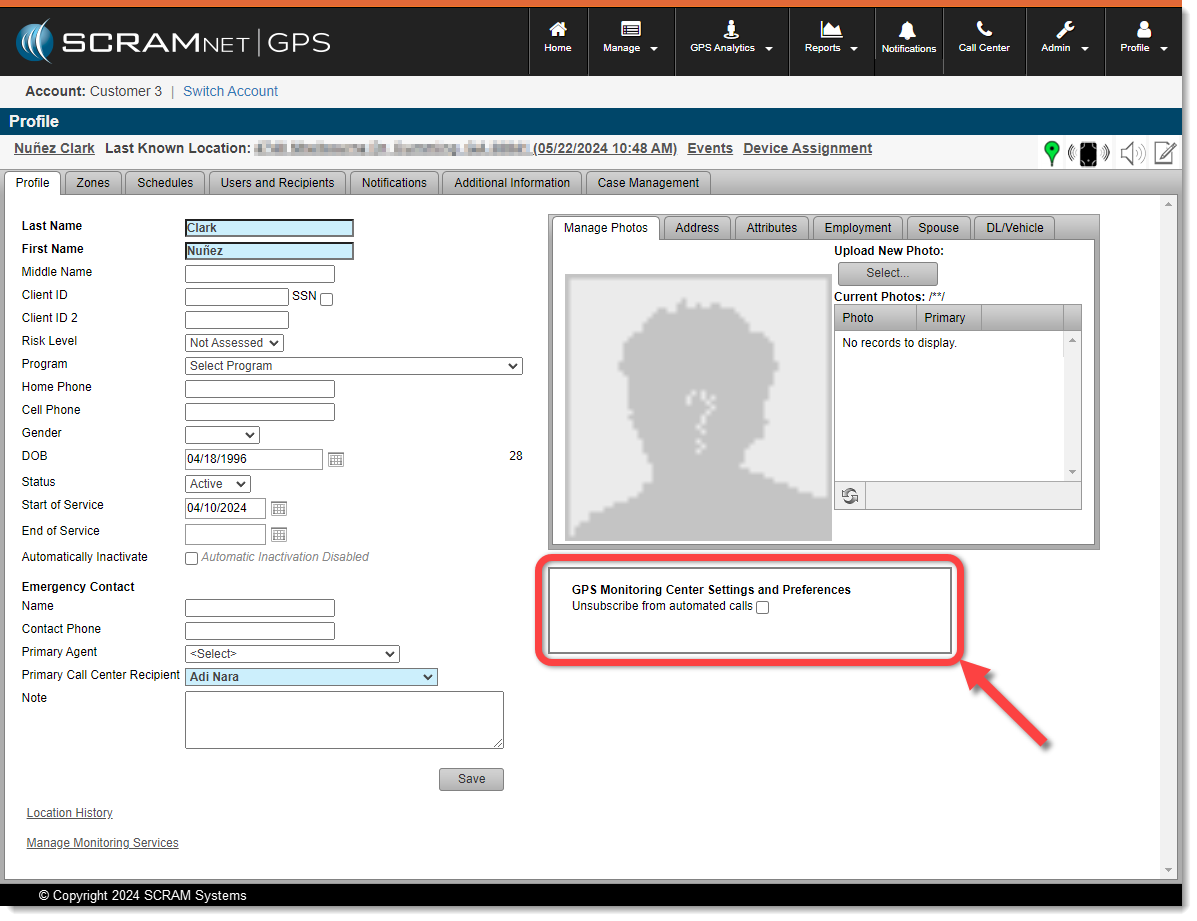
When accessing the Profile tab for clients, SCRAM GPS Monitoring Center customers may notice a new “GPS Monitoring Center Settings and Preferences” section beneath the client photo.
New “GPS Monitoring Center Settings and Preferences” Section (click to enlarge)
This new section and checkbox support a future SCRAM GPS Monitoring Center feature that is currently entering beta testing, and the checkbox does not impact anything at this time.
At 11:00 PM MDT on April 30, 2024, SCRAM Systems® will release a firmware update to the SCRAM Remote Breath Pro (RB Pro) device, which will result in multiple enhancements to your Remote Breath client Caseloads.
Firmware Download Tips:
SCRAM Systems recommends you power on and update the firmware on your inventory devices before you assign them to clients.
It will take up to 15 minutes for the device to download and install the firmware update.
You and your clients may see the RB Pro device power cycle itself several times during the download and installation process. This is normal behavior.
If it is taking longer than 30 minutes to download and install the firmware update, then follow these tips for troubleshooting Extended Firmware Download Times
Currently, when the device prompts the client to provide a breath sample, it will “wake up,” provide visual instructions on screen, an audible tone, and a solid red light to alert the client that it is time to give a breath sample. The screen will continue to display the instructions and an audible alert sound until the client completes the breath test or the Grace Period expires. If the client does not provide a breath sample in a timely manner, this causes the device to consume a lot of its battery power.
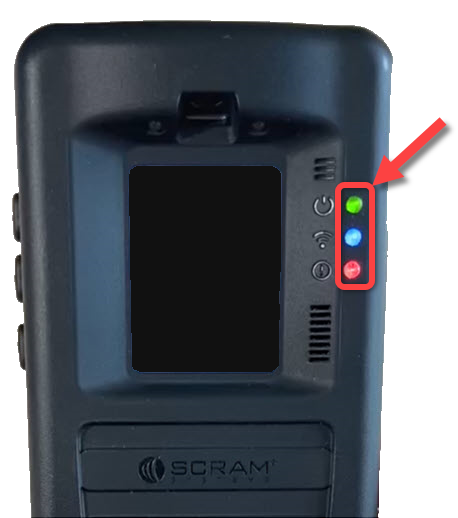
With this update – to conserve power and extend battery life between charges – if the client is not actively blowing into the breath tube 30 seconds after the initial breath test alert, then the screen will “sleep.” All three of the green, blue, and red indicator lights will remain on. Specifically, the red light remains on to remind the client a breath test is pending.
Red Light Remains On While in Sleep Mode When a Test is Pending
At set intervals throughout the Grace Period, the device’s screen will “wake up” and produce an audible tone to remind the client to complete the breath test as well.
When the client sees a solid red light on the device, with or without on-screen instructions, this indicates a pending breath test. If the screen is asleep, instruct the client to press one of the buttons on the side of the device to “wake” it, and then follow the on-screen prompts.
When the device’s battery level is Low or Critically Low, the red indicator light flashes continuously and does not stay solid to signify a pending breath test. Instruct the client to press one of the buttons on the side of the device if the screen is asleep, follow the on-screen prompts to complete a breath test, and then connect the device to a charging cable.
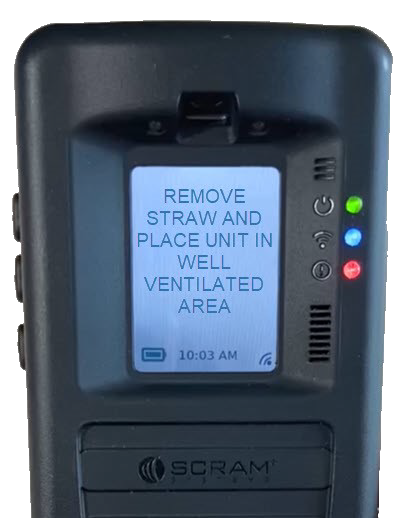
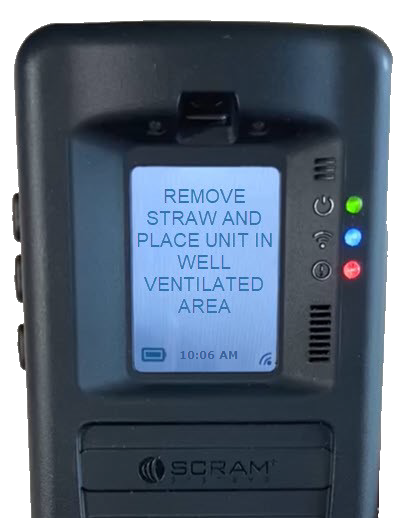
Once a breath test has been requested for the client, and before the RB Pro prompts the client to “Align Eyes,” the device will complete a VOC (Volatile Organic Compound) flow path check. When the device detects a VOC in the breath flow path, “Remove Straw and Place Unit In Well Ventilated Area” will be displayed on the screen:
RB Pro Device Displays ‘Remove Straw and Place Unit In Well Ventilated Area’
Instruct the client to follow the on-screen instructions by having the client:
Remove the breath tube from the device.
Relocate the RB Pro device to an area of fresh air and free of chemicals (like air fresheners) and cleaning agents (including freshly cleaned countertops).
Ensure the RB Pro device is not in its carrying case. Place the device on its side on a tabletop or other clean surface away from contaminants, with the vent and breath tube port unobstructed.
After a period of time, the RB Pro’s screen will update to “Blow Again” and the device will complete a second VOC flow path check.
If VOCs are still detected, the screen will update to “Please Wait,” then “Remove Straw and Place Unit In Well Ventilated Area” for an additional period of time…
RB Pro Device Displays ‘Remove Straw and Place Unit In Well Ventilated Area’ Again
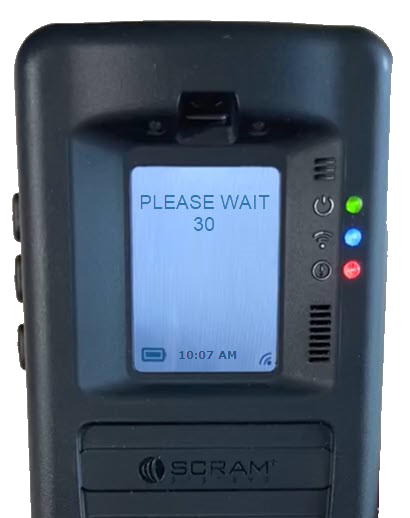
…followed by “Please Wait” with a timed countdown:
RB Pro Device Displays ‘Please Wait’ and Counts Down
At the end of the countdown, the device will complete another VOC flow path check.
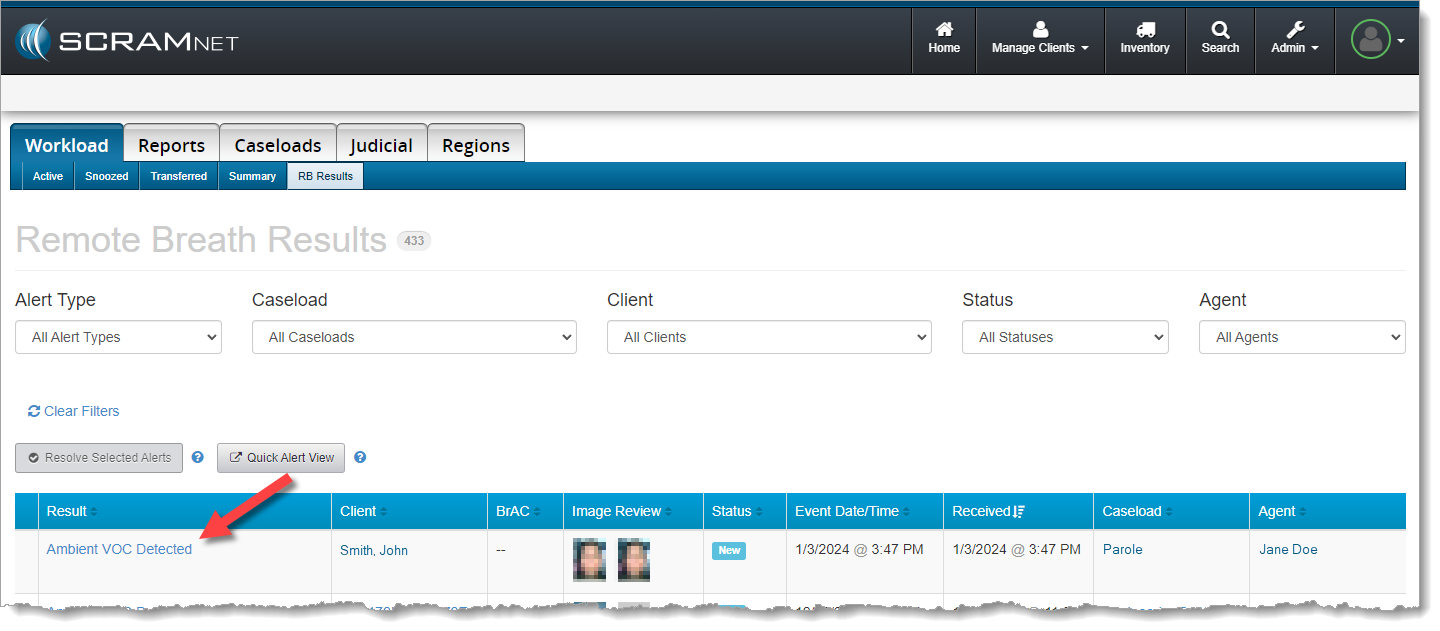
After three to four attempts (depending on the level of VOCs detected), if VOCs are still being detected, the screen will update to “Monitoring.” In SCRAMNET, an “Ambient VOC Detected“ result will be displayed on the client’s RB Results page.
‘Ambient VOC Detected’ on RB Alerts Page in SCRAMNET (click to enlarge)
When the client is set up for Test to Zero, an On-Demand test will be sent – automatically – 20 minutes after the “Ambient VOC Detected” test result is received in SCRAMNET.
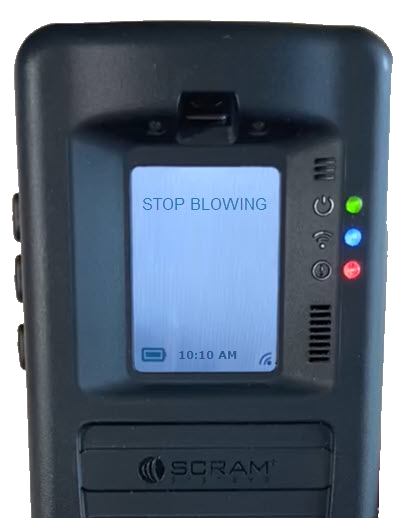
New “Stop Blowing” Message
When a breath test is requested, if the client is actively blowing into the device without being prompted, a new “Stop Blowing” message will be displayed on the device’s screen. The client should follow the on-screen instructions when providing a breath sample.
RB Pro Device Displays ‘Stop Blowing’
Additional Usability Improvements
RB Pro Indicator Lights
Currently, when an RB Pro is in “sleep” mode, the green, blue, and red lights to the right of the RB Pro display screen will turn off. With this firmware update, the lights will remain on, even during sleep.
Indicator Lights Remains On Even While in Sleep Mode
In addition to the lights remaining on, the blue and red lights will display as solid or flashing, based on the device’s current status. Indicator light statuses are:
Green Light: Active, assigned device
Solid Blue Light: Connected to a Data or Wi-Fi Network
Flashing Blue Light: Establishing a Data or Wi-Fi Network Connection
No Blue Light: No Data or Wi-Fi Network Connection
Solid Red Light: Breath Test Required
Slow Flashing Red Light: Low Battery
Quick Flashing Red Light: Critically Low Battery
Periodically, the screen will wake up when the device is in sleep mode. This occurs during communication with SCRAMNET, or when an indicator light’s status changes. The client should be instructed to follow on-screen prompts when appropriate.
Wi-Fi Sleep Mode
With this update, the device will now go to sleep during inactive periods while connected to a Wi-Fi network. This will extend the battery life between charges while connected to Wi-Fi.
Internal testing has revealed that – thanks to this firmware update – battery life more than doubled as compared to the current battery life of an RB Pro device connected to a Wi-Fi network. Regardless of this improvement, the client should still be instructed to connect the device to a charging cable whenever possible to ensure proper device operation.